The yellow, radiating crusts of Candelariella medians can spread up to 3 cm across on lime-rich surfaces. It is a crustose lichen in the family Candelariaceae, and William Nylander first described it in 1862.
The species grows most often where people have disturbed lime-rich surfaces, particularly in churchyards and on old buildings. It favors calcareous masonry such as limestone memorials, church walls and gravestones.
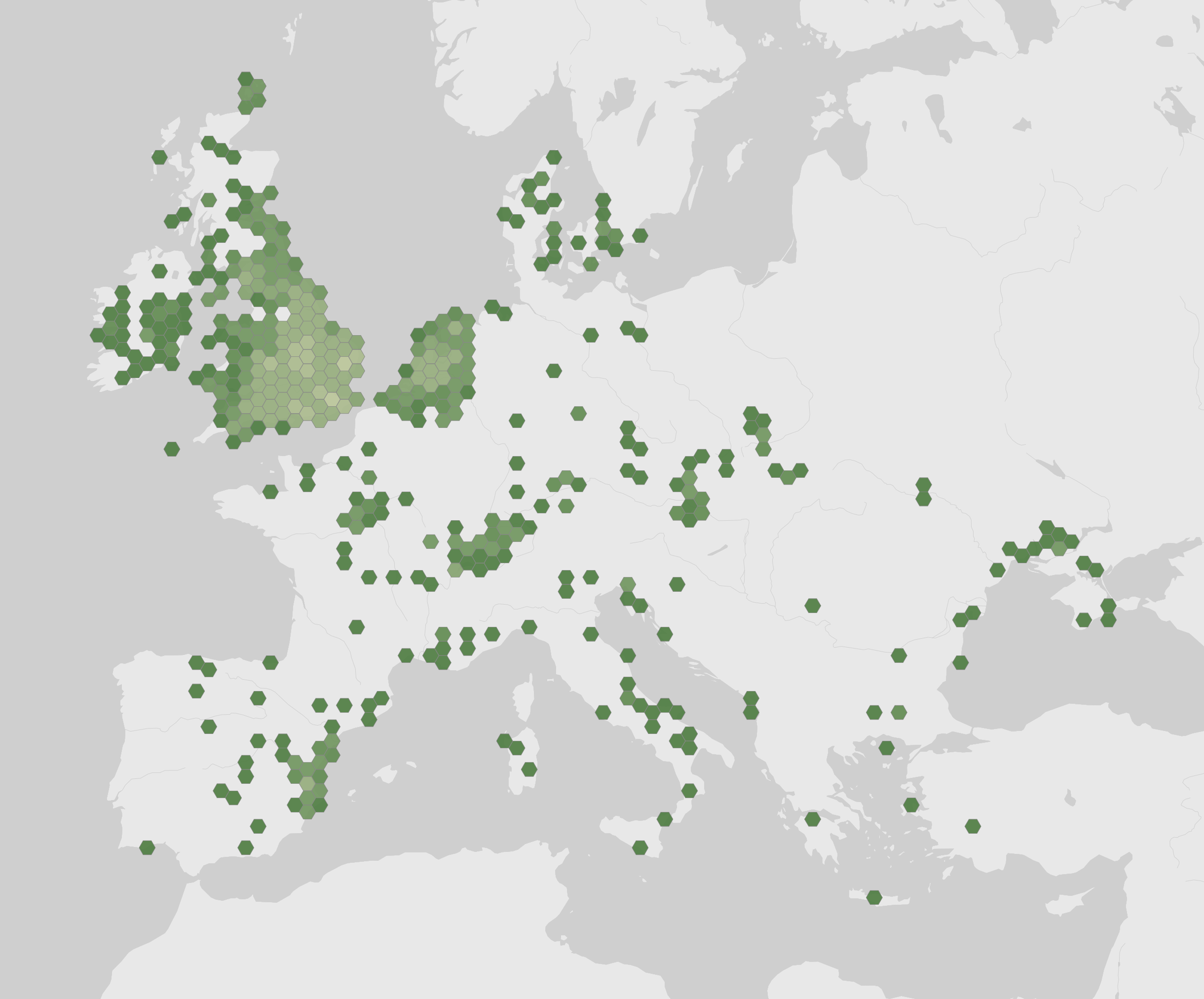
The lichen is abundant in southern and eastern England and occurs throughout Europe. Its fondness for worked stone makes it a common sight on older monuments.
Fruiting Body and Identification
The most reliable identifying feature is the yellow thallus, a placodioid crust that spreads from the centre and has a fringe of small lobes at its edge. The lobes are usually round, radiate outward and mostly touch one another, so the whole colony looks like a sunburst on the stone.
The surface is often slightly rough or dusted with a fine, pale bloom called pruina. Towards the centre the texture changes from granular-areolate, broken into tiny block-like patches, to very finely coralloid-isidiate, where minute coral-like outgrowths act as vegetative propagules. The centre often turns greyish compared with the margin.
Individual lobes are 0.3–1 mm wide and may lie flat or become gently convex. They are typically contiguous but can be separate or overlapping.
The fruiting bodies, called apothecia, are occasional and small, 0.3–1.2 mm in diameter. They are dull yellow and flat to slightly convex, with a smooth to finely scalloped margin. Each sac, or ascus, holds eight ascospores that measure 11–17 × 4–6 micrometres. The spores are usually without an internal cross-wall, though a single septum may sometimes appear, and their outline ranges from ellipsoidal or cylindrical to tear-drop or slipper-shaped.
A citrine-green form, f. steepholmensis, looks much like the typical morphology but lacks calycin. It has not been seen fertile and was described from Steep Holm in Somerset.
Distribution and Habitat
In Britain, the species is abundant in southern and eastern England and less common in other parts of the country. In urban areas it is characteristic of old limestone memorials and other calcareous masonry. Around London it was locally abundant on eighteenth- and nineteenth-century headstones and chest tombs, and more rarely on concrete.
Around London it grew with nitrophilous associates in the Caloplacetum heppianae community, which is maintained by bird droppings on horizontal ledges and grave-tops. In his 1967 report of the British lichen flora, Jack Laundon described thriving patches on the limestone walls at The Fountain in Kensington Gardens. He treated the species as a selective and sometimes dominant member of that community.
In Italy it is typically found in mild-temperate regions on human-made calcareous surfaces such as churches, monuments, park statues and gravestones. It is most frequent above the Mediterranean belt and is especially common in small villages along the eastern Apennine Mountains.
In natural settings it grows on the tops of isolated calcareous boulders, on nutrient-enriched rock and on calcareous bird perches. It tolerates a range of light conditions, from shade to full sun, but it is uncommon in natural habitats.
Photos
Photographs from via iNaturalist, licensed under CC0 1.0., by k via iNaturalist, licensed under CC BY 4.0., by FloraJenensis via iNaturalist, licensed under CC BY 4.0., by Aaron Chidwick via iNaturalist, licensed under CC BY 4.0., by Katharine Khamhaengwong via iNaturalist, licensed under CC BY 4.0., by Jason Grant via iNaturalist, licensed under CC BY 4.0., by Demian Hiß via iNaturalist, licensed under CC BY 4.0., and by Татьяна Максимова via iNaturalist, licensed under CC BY 4.0., credited on each photo.
Ecology and classification
Habitat
Classification
- Phylum
- Ascomycota
- Class
- Candelariomycetes
- Order
- Candelariales
- Family
- Candelariaceae
- Genus
- Candelariella
- Species
- Candelariella medians
Sources
- GBIF Species names and classification
- iNaturalist Photos
- Wikidata Common names and conservation status
- Wikipedia Summary extract