A Venus flytrap can slam its hinged leaf lobes shut in as little as one-tenth of a second after an insect brushes against its trigger hairs — one of the fastest movements in the plant kingdom.
Dionaea muscipula is a carnivorous plant native to the temperate and subtropical wetlands of North Carolina and South Carolina, on the East Coast of the United States. It is the only species in its genus and belongs to the sundew family, Droseraceae, alongside the waterwheel plant and the cosmopolitan sundews of genus Drosera. The species is classified as Vulnerable.
Few plants combine mechanical precision with such a narrow, fragile range. What makes the Venus flytrap worth a closer look is not just its trap, but how tightly its survival is bound to one small stretch of coastal wetland.
Identification and Appearance
The clearest field mark is the trap itself: a pair of hinged lobes lined with red anthocyanin pigment on the inside and fringed with stiff, interlocking cilia along the edges. Three tiny trigger hairs sit on the upper surface of each lobe, and the lobes snap shut only after two are touched in succession, typically within twenty seconds, closing in about a tenth of a second.
The whole plant is small. It grows as a rosette of four to seven leaves from a short, bulb-like underground stem, with individual leaves reaching only about 3 to 10 centimeters depending on the season; longer, more robust traps tend to form after flowering. A plant with more than seven leaves is usually not a single individual but a colony formed by rosettes that have divided underground.
Each leaf blade has two parts: a flat, heart-shaped petiole capable of photosynthesis, and the terminal trap lobes hinged along the midrib. The lobe edges secrete mucilage, and the interlocking cilia mesh together to block the escape of larger prey while allowing small insects to slip through the gaps.
The species shows four recognized growth forms — 'typica', with broad decumbent petioles; 'erecta' and 'linearis', held at 45-degree angles with narrower petioles; and 'filiformis', with extremely narrow, linear petioles. Petiole width and leaning angle also shift with season, day length, and light intensity, so a single plant can look quite different in spring versus summer. Above the leaves, a flower stalk about 15 centimeters (6 inches) tall carries flowers pollinated by sweat bees, longhorn beetles, and checkered beetles.
Distribution and Habitat
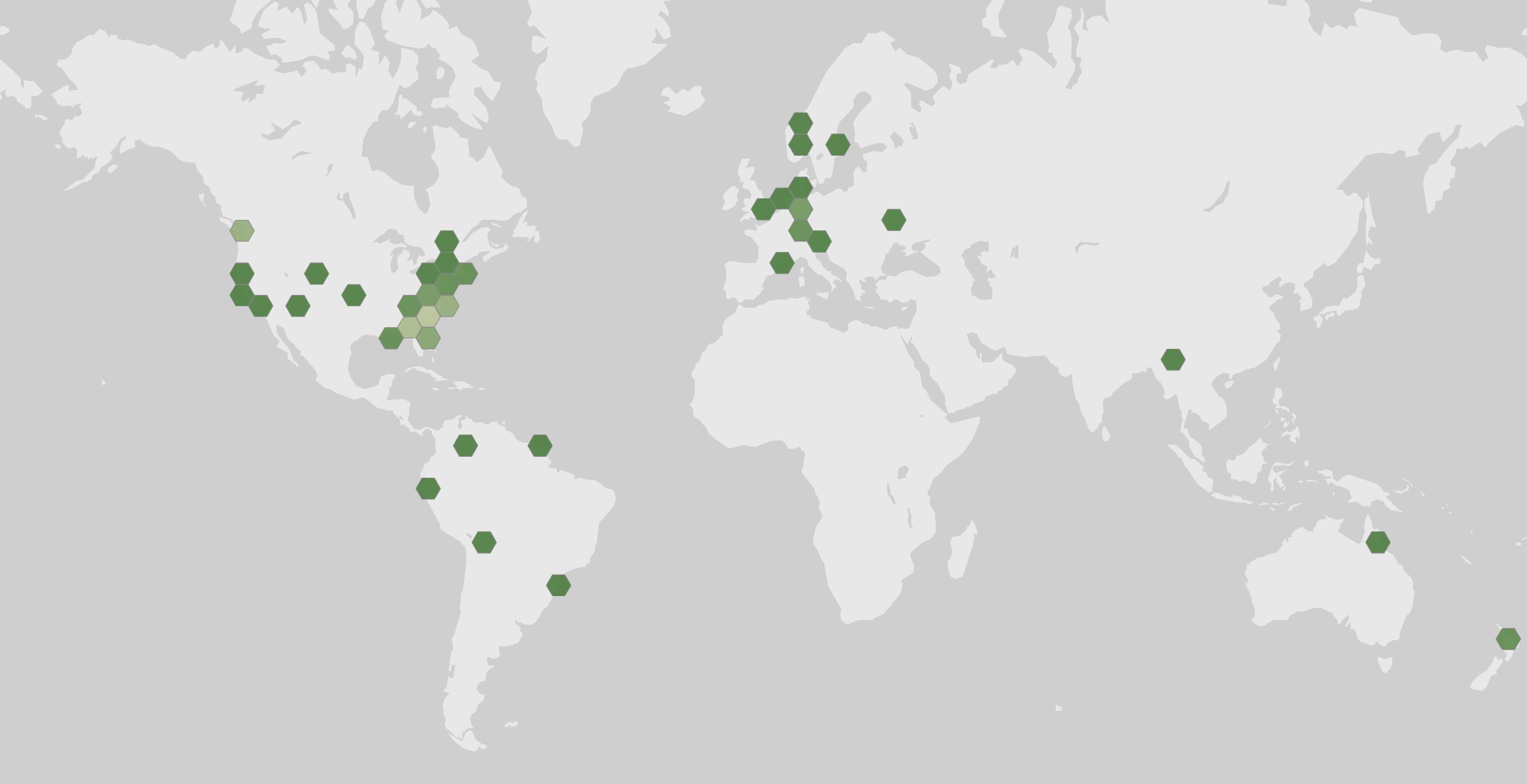
Dionaea muscipula occurs naturally only along the coastal plain of North and South Carolina, with every known current site within about 90 kilometers (56 miles) of Wilmington, North Carolina. A 1958 survey of herbaria and historical records documented 259 sites across 21 counties, though naturalized populations have since appeared in northern Florida and an introduced population exists in western Washington.
The plant favors pine savannas, bogs, wet savannahs, and canebrakes on sandy, peaty soils that stay fairly consistently moist but are poor in nitrogen and phosphorus — the nutrient scarcity that drives its reliance on trapping insects. It needs full sun, generally growing only where canopy cover is under 10%, and depends on wildfire recurring every 3 to 5 years to clear out competing shrubs and trees.
As of 2019, the species was considered extirpated from the inland North Carolina counties of Moore, Robeson, and Lenoir, and from Charleston and Georgetown counties in coastal South Carolina. Remaining populations persist in North Carolina's Beaufort, Craven, Pamlico, Carteret, Jones, Onslow, Duplin, Pender, New Hanover, Brunswick, Columbus, Bladen, Sampson, Cumberland, and Hoke counties, plus Horry County in South Carolina.
Monthly observation records show a sharp rise from a low of 48 sightings in January to a peak of 609 in May, tapering off through the fall to just 52 in December. These figures reflect presence observations rather than population size, but the spring peak is consistent with the period when flytraps are most visible and actively observed in the field.
Ecology and Relationships
The Venus flytrap's carnivory is a direct answer to its habitat: soils in its bog and savanna range are so poor in nitrogen and phosphorus that trapped insects supply nutrients the ground cannot. Once a trap seals around prey that continues to struggle, glands release hydrolase enzymes, including a chitinase that breaks down the insect's exoskeleton; digestion takes about ten days before the trap reopens, leaving behind only a chitin husk.
The closing mechanism itself runs on an electrical signal, an action potential involving calcium ions that spreads across the lobes and midrib after the trigger hairs are stimulated. The plant effectively counts: a first touch is held in a kind of short memory for a few seconds, a second touch within that window trips the trap, and after closing, five total stimulations are needed before the trap commits to producing digestive enzymes — a safeguard against wasting energy on debris or non-prey contact.
The flytrap does not grow in isolation from fire. It shares its wetland and savanna habitat with sphagnum moss, grasses, and fire-dependent Arundinaria bamboo, and its seeds germinate best in the ash and open sandy soil left behind after a burn, with seedlings thriving in the resulting full-sun conditions.
Uses and Human Relationships
The plant's scientific name carries its own piece of cultural history: Dionaea is drawn from Dione, mother of Aphrodite in Greek mythology, while muscipula means "mousetrap," a nod to the housefly or house mouse the plant's snapping action recalls.
Venus flytraps are the most widely recognized and cultivated carnivorous plant, commonly sold as houseplants. They can be grown from seed, though that takes four to five years to reach maturity, or propagated faster by clonal division or, most commonly for commercial nurseries, through plant tissue culture. Selected cultivars such as 'Akai Ryu' and 'South West Giant' have earned the Royal Horticultural Society's Award of Garden Merit, and a well-cultivated plant can live 20 to 30 years.
Extract from the plant is also sold commercially as an herbal remedy, sometimes as the main ingredient in a product called "Carnivora," marketed in alternative medicine for conditions including HIV, Crohn's disease, and skin cancer. The American Cancer Society notes that available scientific evidence does not support these health claims.
Conservation and Threats
The IUCN lists Dionaea muscipula as Vulnerable, and the numbers behind that status are stark: a 2019 survey by the North Carolina Natural Heritage Program counted roughly 302,000 individuals remaining in the wild, down more than 93% from an estimated 4.5 million in 1979. By 2016 only 71 known wild sites remained, and just 20 of those were rated as having excellent or good long-term viability.
Habitat loss ranks as the most severe threat, driven by residential and commercial development, road building, and drainage that dries out the moist soils the species needs; Brunswick County, North Carolina, home to the largest number of populations, saw a 27% rise in human population between 2010 and 2018. Fire suppression is a close second, allowing shrubs and trees to encroach and shade out the plant in habitats that require burning every 3 to 5 years. Poaching and other biological resource use, along with fertilizer pollution and other natural systems modifications, round out the main pressures identified in a 2011 threat review.
The species is protected under CITES Appendix II, regulating international trade in the plant and its parts, and North Carolina lists it as a Species of Special Concern–Vulnerable. NatureServe classified it as Imperiled (G2) in 2018, and it has been under U.S. Fish & Wildlife Service Endangered Species Act review since 2018, though no timeline for a decision has been set.
Conservation status
- LC
- NT
- VU
- EN
- CR
Vulnerable
Fun Facts
- The genus name Dionaea honors Dione, mother of Aphrodite in Greek mythology, while muscipula means "mousetrap," referencing the plant's snapping action.
- Despite its fearsome reputation in fiction, the real plant is small, with leaves rarely exceeding about 10 centimeters.
- Digestion of trapped prey takes roughly ten days, after which the trap reopens and only a chitin husk remains.
- The cultivars 'Akai Ryu' and 'South West Giant' have both received the Royal Horticultural Society's Award of Garden Merit.
- Extract from the plant is sold as an herbal remedy called "Carnivora" for ailments such as HIV and skin cancer, despite a lack of scientific support for these claims.
Ecology
Habitat
- Wetland
- Savanna
- Disturbed Ground
Behavior
- Predator
Growth habit
- Herb
Diet
- Insectivore