The round-leaved sundew survives in some of the most nutrient-starved soils on Earth by eating insects. It supplements what its acidic, boggy home cannot provide by trapping and digesting prey on its sticky, glandular leaves.
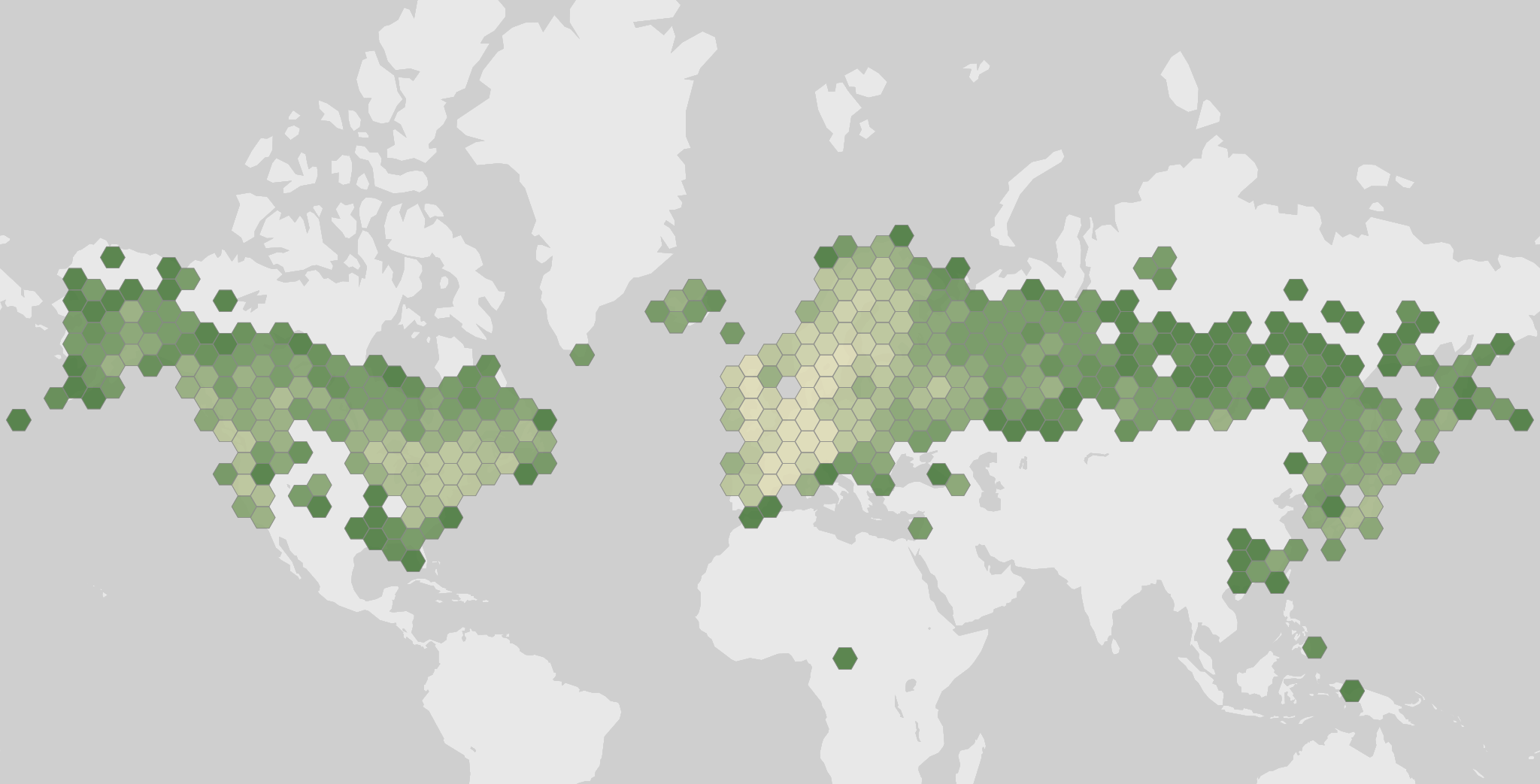
A carnivorous flowering plant in the family Droseraceae, it has a circumboreal distribution, found across nearly all of Europe, Siberia, much of North America, Korea, and Japan, with outlying populations as far south as the Philippines and New Guinea. The IUCN lists it as Least Concern globally. Its wide range and unusual way of feeding make it one of the most recognizable carnivorous plants in temperate wetlands.
Identification and Appearance
The most useful field mark is the rosette of round leaves covered in red, glandular hairs tipped with glistening drops of sticky mucilage. Each leaf sits on a narrow, hairy petiole 1.3 to 5.0 centimeters long, supporting a round lamina only 4 to 10 millimeters across.
A typical plant forms a rosette 3 to 5 centimeters in diameter. From its center rises a single slender, hairless flowering stalk 5 to 25 centimeters tall, bearing small white or pink, five-petalled flowers arranged along one side. The flowers produce slender, tapered, light brown seeds about 1.0 to 1.5 millimeters long.
In winter, the plant forms a hibernaculum, a tight bud of curled leaves at ground level, allowing it to survive cold conditions when the rest of the rosette dies back.
Distribution and Habitat
Drosera rotundifolia has one of the widest distributions of any sundew, occurring across the temperate and subarctic Northern Hemisphere, with outlying populations in the Philippines, New Guinea, and introduced in southern Argentina. In North America it spans most of Canada outside the Prairies and tundra, the Pacific Northwest, the Appalachians south to Georgia and Louisiana, and disjunct fen sites in Colorado and North Dakota. In Europe it ranges from the British Isles and Scandinavia through central Europe, and in Asia across Siberia, Japan, Korea, and parts of China.
It favors bogs above all else, but also grows in swamps, rotting logs, mossy rock crevices, and damp sand along streams, lakes, and ponds, usually rooted in or near sphagnum moss on floating mats or hummocks. It needs continually moist to wet, acidic, nutrient-poor soils low in nitrogen, phosphorus, and calcium, and is generally absent from limestone ground where high calcium levels may be toxic to it. It tolerates flooding for weeks but only brief dry spells, and occurs from sea level up to 1,500 meters in open, sunny or partly sunny sites.
Monthly observation records show a strong seasonal peak in the summer months, consistent with the period when the plant is most visible and actively growing above the hibernaculum stage, though these counts reflect observation effort rather than population size.
Growth and Form
Drosera rotundifolia is a small perennial herb, persisting year after year through its winter hibernaculum rather than dying after a single season. Each growing season it regrows its basal rosette of sticky leaves from the tightly curled bud formed the previous winter, before sending up its slender flowering stalk.
Ecology and Relationships
The plant feeds on insects attracted to the glistening, sugary mucilage on its glandular tentacles, then uses enzymes to dissolve them and extract nitrogen as ammonia, compensating for the poor nitrogen and phosphorus availability of its acidic bog habitat. Plants growing in naturally higher-nitrogen conditions rely less on captured prey, and experiments have shown the species can shift toward using inorganic soil nutrients when insect prey is scarce, revealing real flexibility in its nutritional strategy.
Although its red coloring has long been assumed to lure prey, trials with artificial traps found that color does not affect how many insects are caught. Recorded predation on the plant includes the specialist moth Buckleria paludum, whose larvae feed on sundews, alongside various finches, buntings, and other birds occasionally recorded consuming it, plus at least one recorded yeast parasite, Rhodotorula mucilaginosa.
It grows embedded in wider bog plant communities, typically alongside sphagnum mosses, leatherleaf, Labrador tea, bog rosemary, cranberry, and pitcher plants, all species adapted to the same acidic, nutrient-poor, waterlogged conditions.
Uses and Human Relationships
Drosera rotundifolia is cultivated by carnivorous plant enthusiasts, though wild-type plants need a substantial winter dormancy period in which they form hibernacula to be grown successfully; the cultivar 'Charles Darwin' can be grown without this dormancy requirement.
Extracts of the plant have been studied for anti-inflammatory and antispasmodic properties, attributed to flavonoids such as hyperoside, quercetin, and isoquercetin, which are thought to act on smooth muscle receptors, along with antiangiogenic effects attributed to ellagic acid in the extracts.
Conservation and Threats
Drosera rotundifolia is classified as Least Concern by the IUCN, reflecting its broad global range across the Northern Hemisphere. Despite this overall security, regional populations face pressure: it is considered endangered in the U.S. states of Illinois and Iowa, exploitably vulnerable in New York, threatened in Tennessee, and ranked imperiled (S2) in Colorado.
These regional declines point to the vulnerability of its bog and fen habitats at the edges of its range, particularly in areas where wetlands are limited or fragmented.
Fun Facts
- In Greek mythology, a naiad named Drosera was said to be one of the three ancestors of the Tyrians, alongside Abarbarea and Callirrhoe, a name later borrowed for this genus.
- The Toraja people of South Sulawesi in Indonesia believed that ants killed by local Drosera species housed the souls of dead ancestors.
Photos
Photographs from by Alexis Tinker-Tsavalas via iNaturalist, licensed under CC BY 4.0., via iNaturalist, licensed under CC0 1.0., by Patrick Comins via iNaturalist, licensed under CC BY 4.0., by Ryan Sorrells via iNaturalist, licensed under CC BY 4.0., by Matt Berger via iNaturalist, licensed under CC BY 4.0., by Dan Riley via iNaturalist, licensed under CC BY 4.0., by Steven Lamonde via iNaturalist, licensed under CC BY 4.0., and by gwynmwilliams via iNaturalist, licensed under CC BY 4.0., credited on each photo.
Ecology and classification
Classification
- Phylum
- Tracheophyta
- Class
- Magnoliopsida
- Order
- Caryophyllales
- Family
- Droseraceae
- Genus
- Drosera
- Species
- Drosera rotundifolia
Sources
- GBIF Species names and classification
- iNaturalist Photos
- Wikidata Common names and conservation status
- Wikipedia Summary extract
- Encyclopedia of Life Habitat, diet and behavior traits
- Plants of the World Online Native range, life form and climate (WCVP)
- GloBI What it eats, what eats it, parasites and pollinators
- trophiCH
- Wardeh et al. 2015 (EID2)