The star shape that gives this fungus its name is not a fixed structure but a mechanical event: a buildup of calcium oxalate crystals on the inner peridial layer physically forces the outer skin to split into rays just before the fruiting body opens.
Geastrum saccatum, known as the sessile earthstar, rounded earthstar, or in Brazil as "star of the land," is a saprobic mushroom in the family Geastraceae. It grows on soil among leaf litter across a cosmopolitan range that includes both temperate and tropical regions.
What sets this species apart from its many earthstar relatives is a small but reliable detail: a distinct circular ridge or depression encircling its central spore pore, a feature used to separate it from similar-looking Geastrum species in the field.
Fruiting Body and Identification
The clearest identifying trait of Geastrum saccatum is the circular ridge or depression that surrounds its central pore, forming a dull-brown apical disc unlike anything seen on related species. This detail alone helps separate mature specimens from close relatives.
Young fruiting bodies are egg-shaped, 0.6 to 2.5 cm in diameter and 0.8 to 1.5 cm tall, resembling small puffballs and anchored to the ground by thread-like mycelial rhizomorphs. As the fungus matures, the outer skin, or exoperidium, separates from the inner spore sac and splits into five to eight rays. These rays curve backward toward the base rather than lifting the fruiting body off the ground, so the mature mushroom lies flat and reaches 2 to 5 cm across once fully expanded.
The inner spore-bearing sac, or endoperidium, is 0.5 to 2 cm wide. Inside, tissue that starts out white matures into a powdery mass of brown spores mixed with thick-walled capillitium fibers. The spores themselves are rounded and warty, measuring 3.5 to 4.5 micrometers. The flesh is bitter, and the outer layer is golden tan to yellowish-brown.
Geastrum saccatum can be confused with several relatives. G. fimbriatum lacks an apical disc and has slightly smaller pores. G. indicum has loose tissue forming a collar around the base of the endoperidium, which G. saccatum lacks. G. fornicatum and G. triplex are also similar, while Astraeus earthstars tend to have less orderly, more irregular rays than the neat star of G. saccatum.
Distribution and Habitat
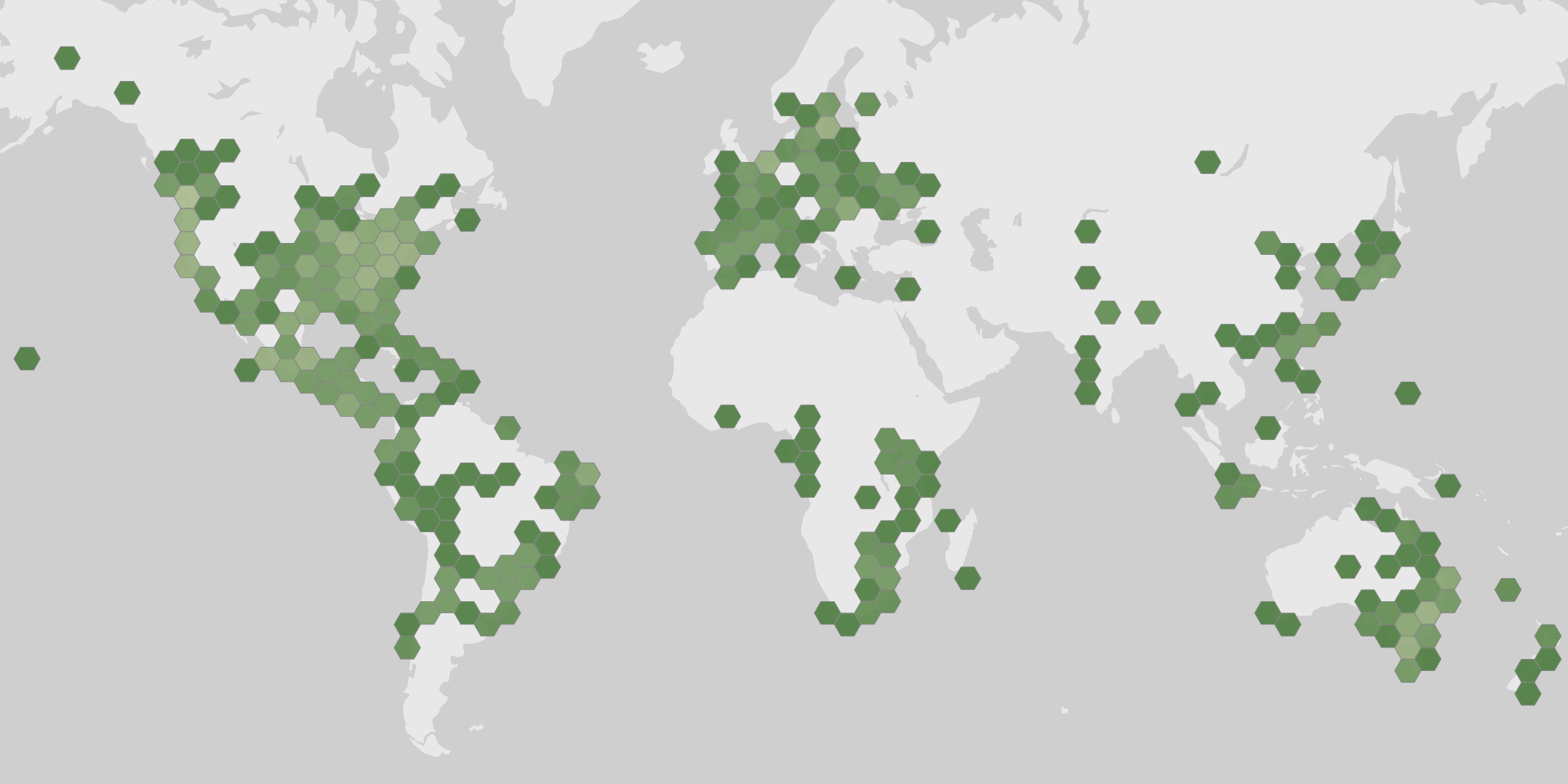
Geastrum saccatum has a cosmopolitan distribution and is especially well adapted to tropical regions, where it is common, including in Hawaiian dry forests. It has been recorded across North America (Canada, the United States, and Mexico), Central America (Panama), South America (Argentina, Uruguay, and Brazil), Cuba, Africa (Tanzania, other parts of West Africa, and South Africa), Asia (China and India), and in Tobago and Toowoomba, Australia.
The species is saprobic, growing scattered or clustered directly on soil within leaf litter and humus. Fruiting is concentrated in late summer and fall; in North America specifically, it appears from September to December on the west coast and from July to October elsewhere.
Monthly observation counts show a clear seasonal pattern, rising sharply from July onward and peaking around October before tapering off by December. Since these figures come from presence records rather than population surveys, they point to when the fungus is most often noticed and recorded, not to how abundant it actually is.
Uses and Cultural History
Geastrum saccatum holds a place in human culture more through symbolism than the plate. In Brazil its common name translates to "star of the land," reflecting the fungus's distinctive shape, and star-shaped fungi in general have been linked in various cultures to celestial symbolism and mythologies surrounding the stars and heavens.
The species is inedible in the mature state in which it is usually encountered, so its practical value lies elsewhere. A β-glucan–protein complex extracted from G. saccatum has been isolated and analyzed, showing antiinflammatory, antioxidant, and cytotoxic activity in laboratory study. Researchers suggest the antiinflammatory effect works by inhibiting the enzymes nitric oxide synthase and cyclooxygenase.
These findings position the fungus as a subject of biochemical interest rather than a food or traditional remedy, with its cultural resonance tied mainly to its striking star form.
Fun Facts
- In Brazil, Geastrum saccatum is known as "star of the land," a name that reflects both its shape and its habit of lying flat on the ground rather than lifting upward like some other earthstars.
- Star-shaped fungi, including this species, have been linked in various cultures to celestial symbolism and myths about the stars and heavens.
- A β-glucan–protein complex isolated from this species has shown antiinflammatory, antioxidant, and cytotoxic activity in laboratory analysis, with the antiinflammatory effect linked to inhibition of nitric oxide synthase and cyclooxygenase enzymes.
- Unlike G. fornicatum, whose rays lift the spore sac off the ground, G. saccatum keeps its fruiting body lying flat against the soil even after the rays fully expand.
- The mycologist Curtis Gates Lloyd was the first to document calcium oxalate crystals on the endoperidium of a related species, now known as G. minimum, laying groundwork for later understanding of how earthstars split open.
Ecology
Habitat
- Forest