The black, cracked lump growing out of a birch trunk is not a mushroom at all. It is a sclerotium, a hardened mass of mycelium that can keep growing inside a living tree for 10 to 80 years or more before the fungus ever produces a true fruiting body.
Inonotus obliquus is a parasitic fungus in the family Hymenochaetaceae, living mainly on birch trees across the cold forests of the Northern Hemisphere. It has become widely known outside mycology as an ingredient in herbal teas and supplements, even though its long, hidden life cycle inside the tree is arguably its more interesting story.
Fruiting Body and Identification
The most reliable identifying feature of Inonotus obliquus is its sterile conk: an irregular, black, charcoal-like crust that erupts through the bark of an infected birch, alder, beech, or poplar. Its surface is deeply cracked and rough, colored almost entirely black by a heavy concentration of melanin, while the interior tissue is a rusty orange-brown.
This conk is not the fruiting body but the visible portion of a much larger mycelial canker, typically 10 to 25 centimeters wide, sitting above an underlying crust that can extend 5 to 50 centimeters along the trunk. Beneath the bark, the fungus causes a white heart rot that spreads through the tree's heartwood, a process that can continue for 10 to 80 years or more while the tree is still alive.
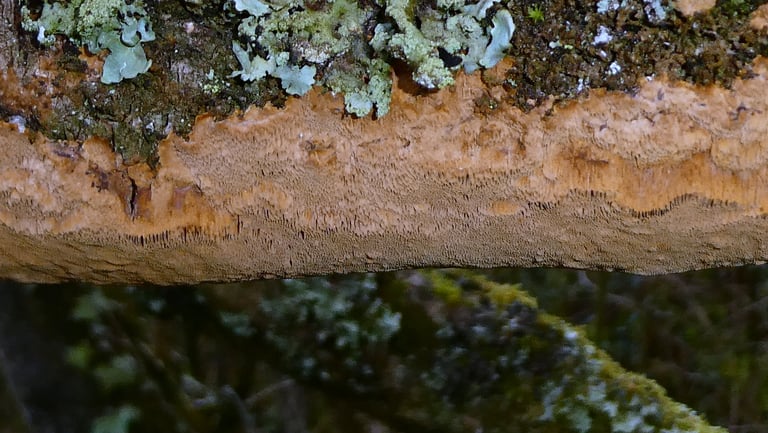
Only after the tree, or part of it, dies does Inonotus obliquus enter its sexual stage, forming a whitish mass under the bark that darkens to brown with age. Because this true fruiting body develops almost entirely hidden from view, it is rarely observed in the field, which is why the black exterior sclerotium is the form almost everyone recognizes. The sclerotium is also notable for containing an unusually high concentration of oxalates, reported between 2,800 and 11,200 mg per 100 g, among the highest levels recorded in any organism.
Several other fungi produce superficially similar dark, crusty growths on wood, including Apiosporina morbosa, Diplodia tumefaciens, Echinodontium tinctorium, and species of Fulvifomes and Fomitiporia.
Distribution and Habitat
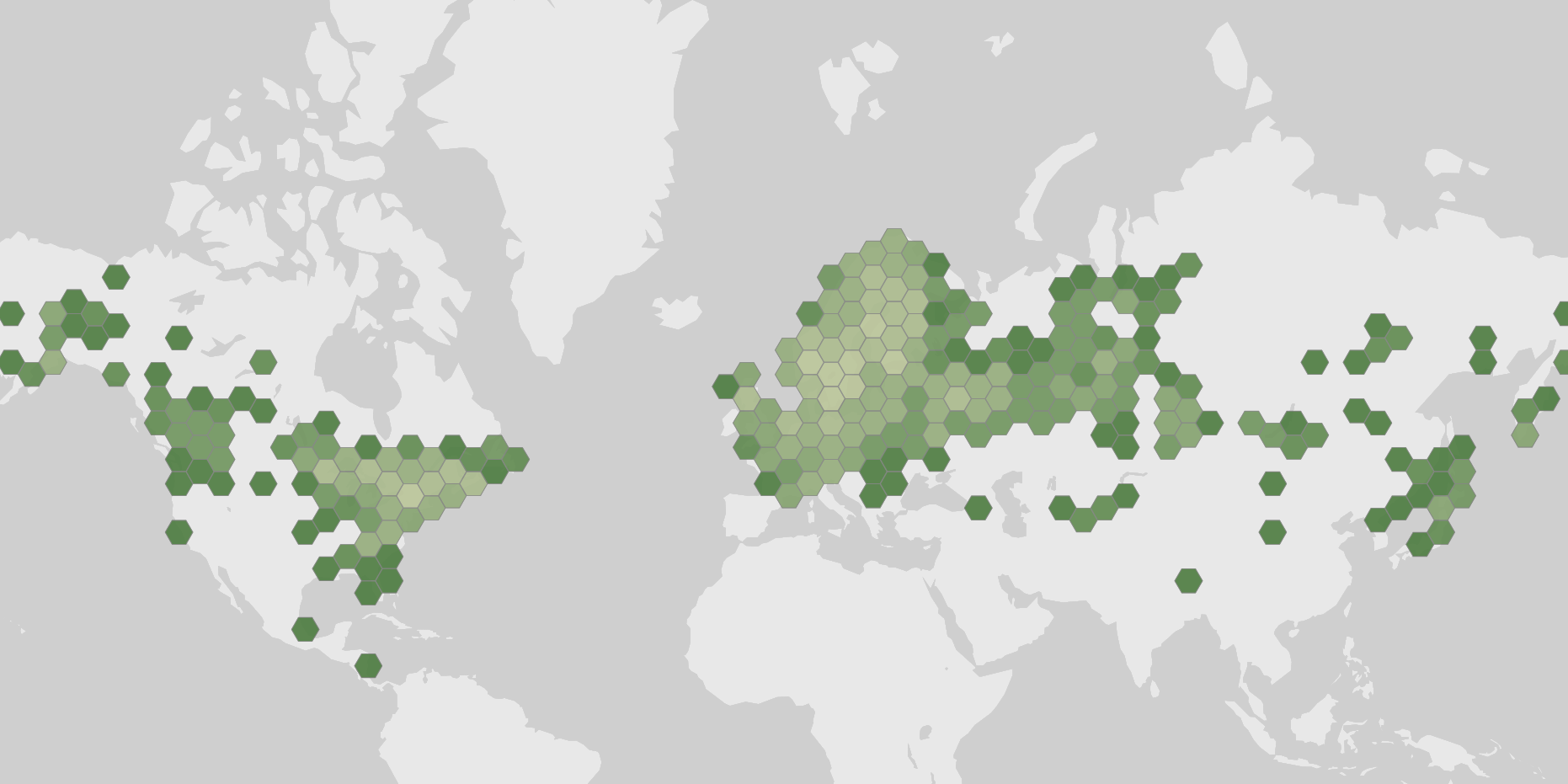
Inonotus obliquus occurs most commonly across the circumboreal region of the Northern Hemisphere, where it is closely tied to birch forests. Birch (Betula species) is its principal host, though the fungus has also been recorded on alder, beech, and poplar.
Monthly observation data compiled from public records show counts rising through summer and peaking in September, with the highest tally recorded that month before dropping sharply toward winter. Since these figures represent presence observations rather than a measure of abundance or a complete picture of the species' native range, the pattern likely reflects when the conspicuous black conks are easiest for people to notice and record, rather than an actual seasonal surge in fungal activity.
Uses and Cultural History
Chaga has a long history of use as a beverage: it is traditionally grated into a fine powder and brewed into a drink that resembles coffee or tea, with a strong flavor compared to Chinese herbal tea. A common preparation involves simmering blocklike pieces of chaga in several quarts of water until the liquid reduces and concentrates the sclerotium's water-soluble compounds, a decoction produced commercially in China and Japan and exported worldwide; pure extracts prepared this way may contain roughly 35% β-D-glucans by content.
Beyond food and drink, the Potawatomi people use the fungus, which they call shkitagen, as a firekeeping tinder. According to Potawatomi biologist Robin Wall Kimmerer, an ember that meets shkitagen "will not go out but smolders slowly in the fungal matrix, holding its heat," so that even the smallest spark landing on a piece of the fungus is preserved rather than lost.
Today chaga is also marketed widely as a dietary supplement, though the context notes it lacks sufficient scientific evidence for safety or effectiveness, and that product quality varies due to inconsistent processing and labeling. Attempts to cultivate the fungus on artificial media such as potato dextrose agar have produced sclerotia with a reduced and markedly different range of metabolites, including fewer phytosterols such as lanosterol, compared to wild specimens.
Fun Facts
- Cultivated chaga grown in a lab on potato dextrose agar develops noticeably fewer phytosterols, including lanosterol, than sclerotia formed naturally on wild birch trees.
- The Potawatomi name for chaga, shkitagen, refers to its traditional role as tinder: a single spark landing on it will smolder for a long time instead of dying out.
- Although chaga is sold worldwide as a tea and supplement, the fungus's actual sexual fruiting body is rarely ever seen, since it forms hidden beneath the bark only after its host tree has died.
Ecology
Habitat
- Forest
- Woodland