Leotia lubrica, widely known as the jelly baby for its squat, rubbery shape, is the type species of its genus, yet its relationship to its own closest relatives remains genuinely hard to untangle.
It is an ascomycete fungus in the family Leotiaceae, order Leotiales, first validly described by Giovanni Antonio Scopoli and later moved into the genus Leotia by Christiaan Hendrik Persoon. It grows from the ground in woodlands across much of the temperate world.
Its gelatinous, olive-tinted fruiting bodies, often crowded together in clumps, make it one of the more distinctive small fungi a forest walker is likely to notice underfoot.
Fruiting Body and Identification
The fruiting body's two-part shape, an irregularly lobed head sitting atop a slender stalk, is the clearest way to recognize Leotia lubrica. The youngest specimens start out as simple cones only about 2 millimeters long; once the tip begins to expand into a head, the fertile surface differentiates from the rest of the body, and growth from that point mostly adds size rather than changing form.
The mature head measures 1 to 3 centimeters across and is olive-greenish ochre in color, gelatinous, and smooth, clammy, or slimy to the touch. Though broadly convex, its surface folds into irregular lobes and undulations, with the margin rolled inward; the underside is paler and smooth. Whole fruiting bodies stand 1 to 6 centimeters tall.
The stalk runs 2 to 8 centimeters long and 3 to 10 millimeters wide, narrowing toward the substrate. It is usually cylindrical but can be flattened or furrowed, shares the head's coloring while leaning more yellow, and is covered in tiny greenish granules. The flesh is gelatinous in the head while the stalk is mostly hollow, sometimes filled with gel, and the fungus has no notable smell or taste. Its club-shaped asci, around 150 by 10 to 12 micrometers, each release eight smooth, slightly curved spores measuring 20 to 25 by 5 to 6 micrometers, divided by five to seven septa and each carrying four small oil droplets.
Leotia lubrica can be confused with Cudonia confusa, which is paler and less sturdy, and with Cudonia circinans, distinguished by its browner color, smaller and thinner spores, and drier, less gelatinous texture. The rarer L. atrovirens is darker overall, while L. viscosa has a distinctly green head, though L. lubrica itself can occasionally show a greenish tint as well.
Distribution and Habitat
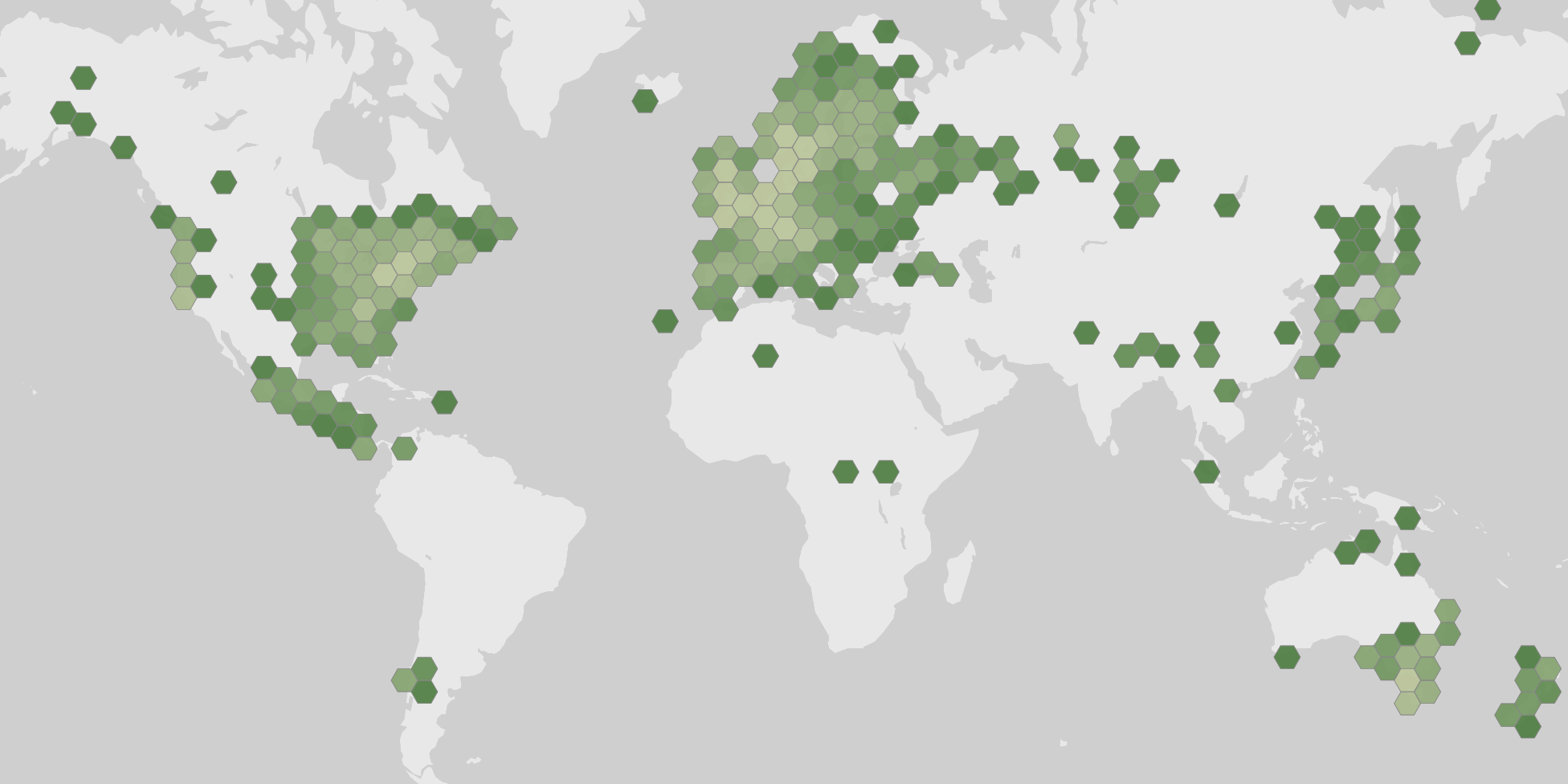
Leotia lubrica has a wide distribution, occurring throughout Europe and North America, where it is the most commonly encountered species in its genus. It has also been recorded in eastern Asia, including China and Tibet, and turns up as far afield as New Zealand and Australia.
The fungus favors damp deciduous woodland but also grows under conifers, often along path sides or beneath bracken. It arises from soil, moss, and decaying plant waste rather than from wood itself.
Fruiting bodies typically appear in large numbers, often in clumps rather than singly, with several sometimes fused at their bases; younger bodies can even sprout directly from the base of older ones.
Fruiting runs from late summer to late autumn in Europe and from late spring through autumn in North America. Presence-only observation records compiled by GBIF, which reflect where and when the species has been recorded rather than its true abundance, show a clear seasonal pattern, with reported sightings climbing sharply from July and peaking in September before tapering off through November.
Ecology and Relationships
Leotia lubrica has traditionally been classified as a saprotroph, breaking down dead plant material in the soil, moss, and litter where it grows.
More recent molecular and isotopic evidence complicates this picture, suggesting the fungus may instead form ectomycorrhizal partnerships with the roots of nearby trees rather than simply decomposing dead matter.
Its fruiting bodies are not immune to parasites of their own: the mold Hypomyces leotiarum, the asexual stage of Hypomyces leotiicola, is known to infect and grow on L. lubrica.
Uses and Cultural History
Leotia lubrica holds little culinary value, and many field guides describe it outright as inedible despite its cheerful "jelly baby" nickname.
Accounts of its edibility conflict: some sources call it edible but insipid, and the mycologist Charles McIlvaine even judged it good, while others simply describe it as bland.
Chemical analysis has found low levels of monomethylhydrazine in its fruiting bodies, the same toxic compound associated with the poisonous false morel, Gyromitra esculenta.
Fun Facts
- Leotia lubrica is the type species of its genus, Leotia, yet its exact relationship to other species in that genus is still debated.
- It was first validly described by Giovanni Antonio Scopoli before Christiaan Hendrik Persoon transferred it into the genus Leotia.
- Nineteenth-century French mycological literature, including Dr. Lucien-Marie Gautier's 1884 work on fungi and medicine, referred to the species under the older name "Léotie impudique."
Ecology
Habitat
- Forest
- Woodland