
Insecta · Odonata
Emperor Dragonfly
Anax imperator
Least ConcernAlso known as: Blue Emperor
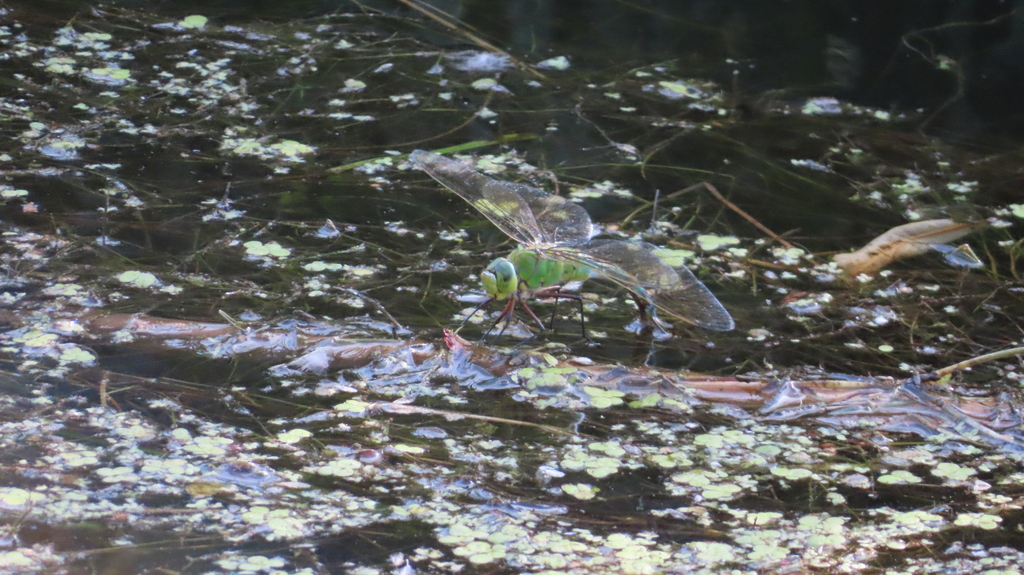
© Adrian Matala · iNaturalist · CC BY-NC 4.0
The Emperor Dragonfly, Anax imperator, is one of Europe’s largest and most formidable aerial predators. With powerful wings and a streamlined body built for speed and agility, this dragonfly hunts with precision across wetlands, ponds, and reed beds throughout its vast range. Its commanding presence and emerald-green coloration make it instantly recognisable to naturalists and casual observers alike.
Classified as Least Concern by conservation authorities, the Emperor Dragonfly demonstrates remarkable ecological resilience across its range. Found in both temperate and subtropical regions, the species adapts readily to various freshwater habitats and even tolerates some degree of human disturbance. Its success as a global predator and its striking appearance make it a flagship species for understanding the health of aquatic ecosystems.
Identification and Appearance
Anax imperator, the Emperor Dragonfly, is a large and conspicuous member of the Aeshnidae family, instantly recognisable by its brilliant colouration and robust build. This species ranks among the largest dragonflies in Europe and temperate Asia, with an unmistakable appearance that makes field identification straightforward even for novice observers.
Colour and Markings
Males display striking blue colouration across much of the body, with a bright turquoise or cyan thorax and an iridescent blue abdomen that gleams in sunlight. The face is pale yellow or greenish, and the wings are generally transparent with dark veins, though some individuals develop amber tints toward the wing bases. Females present a more variable appearance, typically showing green or bronze-green tones on the thorax and a yellow-green or brownish abdomen with dark markings and stripes running along the segmented body. This sexual dimorphism is pronounced and allows reliable sex determination in the field.
Body Structure and Size
The Emperor Dragonfly possesses a thick, muscular body characteristic of strong-flying aeshnids. The compound eyes are large and nearly meet along the top of the head, providing the exceptional vision needed to hunt other insects in flight. The abdomen is elongated and often held straight or slightly curved during flight. Wingspans are substantial, making this species one of the most impressive dragonflies encountered across its range.
Distribution and Habitat
Anax imperator, the Emperor Dragonfly, has a wide distribution across Africa, southern Europe, and the Middle East, recorded from 28 countries worldwide. The species shows a strong concentration in southern Africa, particularly South Africa, which accounts for the vast majority of documented records with 168 sightings. This geographic pattern reflects the species’ tropical and subtropical preferences.
Beyond southern Africa, the Emperor Dragonfly is present across Mediterranean Europe and into western Asia. Spain hosts a significant population with 36 records, followed by France (20), Portugal (16), Italy (7), and Greece (4). The species also occurs in Oman (6 records), Madagascar (7), Mozambique (5), and Senegal (3), indicating a broad tolerance for warm climates across multiple continents. This distribution pattern suggests the species thrives wherever warm water bodies are available.
The Emperor Dragonfly displays a pronounced seasonal presence. Activity peaks dramatically in April with 106 records, following lower activity levels in February and March (63 and 50 records respectively). January records (75) indicate early-season emergence in some regions. From May onward, observations drop sharply to near zero, suggesting either migration, dormancy, or a shift in detectability during warmer months. This strong spring peak is consistent with emergence patterns in temperate and subtropical zones where the species is most active during milder weather periods.
Biology and Behavior
Behavior
Anax imperator is a powerfully aggressive aerial predator that hunts on the wing throughout daylight hours. These dragonflies patrol territories along water bodies with remarkable speed and agility, intercepting prey mid-flight with precision strikes. Males are strongly territorial and will chase away other males, rivals, and even larger insects from their preferred hunting grounds, often perching prominently on plants or hovering in open water to survey their domain.
Activity peaks during warm, sunny days when atmospheric conditions favor insect flight. The dragonfly’s large compound eyes provide nearly 360-degree vision, enabling it to detect movement from considerable distances. Flight behaviour is distinctive: rapid acceleration bursts alternate with hovering, allowing the insect to adjust course instantly and capture prey with its basket-like legs held beneath its body.
Diet
Emperor dragonflies are strictly carnivorous, feeding exclusively on other insects captured in flight. Their prey includes midges, mosquitoes, small flies, and other small to medium-sized flying insects. Larger nymphs may also consume tadpoles and small fish, but adults focus on airborne prey. The dragonfly’s hunting efficiency is high—it may capture and consume dozens of insects daily during favorable conditions.
Reproduction
Breeding occurs during the warmer months when males defend territories along the water’s edge. Males patrol sections of stream, pond, or canal, pursuing females and engaging in aerial displays. Mating is brief and occurs in flight or while perched; the male grasps the female’s thorax with his terminal abdominal segments in a characteristic tandem position before insemination.
Females lay eggs directly into water or on submerged vegetation, sometimes diving below the surface to deposit them. Eggs hatch into aquatic nymphs that undergo multiple instars (moults) over a period of weeks to months, depending on water temperature and food availability. Nymphs are voracious predators themselves, feeding on other aquatic invertebrates, tadpoles, and occasionally small fish. Development culminates in emergence, when the nymph climbs out of the water and molts into a winged adult, which may live for several months during the breeding season.
Conservation and Threats
Anax imperator, the Emperor Dragonfly, holds a conservation status of Least Concern (LC) on the IUCN Red List. This classification reflects a stable global population with no immediate threats driving the species towards decline. The species remains widespread across its range in Europe, Asia, and North Africa, maintaining its position as one of the region’s most successful and adaptable dragonfly species.
Threats and Population Outlook
The Emperor Dragonfly currently faces no documented major threats severe enough to trigger conservation concern. Its population trend is stable, indicating that existing environmental conditions continue to support healthy breeding populations. The species’ resilience stems from its broad habitat tolerance and ability to breed in a wide variety of freshwater systems, from large lakes and rivers to smaller ponds and wetlands. This adaptability insulates it against localized habitat loss in any single ecosystem.
However, indirect pressures linked to wetland degradation remain relevant across much of its range. Agricultural intensification, pollution of freshwater systems, and climate-driven changes to water availability could pose emerging risks in future decades, particularly in arid and semi-arid regions where breeding habitat is already limited. For now, populations remain robust enough that these threats have not yet resulted in measurable range contraction or population decline.
Conservation Status and Protection
The species benefits from general habitat protection measures across Europe through the Habitats Directive and Water Framework Directive, which safeguard freshwater ecosystems within EU member states. Many protected areas established for other biodiversity goals also support Emperor Dragonfly populations. No species-specific conservation programme is currently in place, reflecting the lack of urgent conservation need, though the dragonfly’s presence is monitored in some national biological recording schemes and citizen science initiatives.
Fun Facts
- The emperor dragonfly is the largest dragonfly in most of Europe, including the United Kingdom, with a wingspan reaching up to 11 centimetres and a body length of around 8 centimetres. In a few regions, other species exceed it in size, but Anax imperator remains a dominant aerial predator across the continent.
- Emperor dragonflies can catch and eat prey mid-flight while moving at speeds of up to 50 kilometres per hour, snatching smaller insects from the air with remarkable precision using their basket-like legs. They consume dozens of mosquitoes, gnats, and small flies daily during the breeding season.
- The nymphal stage of the emperor dragonfly lasts one to two years underwater, where the aquatic larvae are voracious predators of tadpoles, small fish, and other insect nymphs. A single nymph can consume hundreds of prey items before finally emerging as a winged adult.
- Males are fiercely territorial and will patrol their breeding ponds for hours, diving and climbing to heights of 20 metres or more to chase away rival males and attract females. Their brilliant blue and green colouration intensifies during the breeding season as testosterone levels rise.
- Emperor dragonflies are partial migrants in northern Europe, with some populations undertaking long journeys of hundreds of kilometres in late summer to escape cold winters and find more stable water bodies. Individuals marked with paint have been tracked moving across entire countries.
- A mated pair performs an unusual egg-laying behaviour called “tandem oviposition,” where the male and female fly together in formation over the water surface, with the female dipping her abdomen repeatedly to deposit eggs into submerged plants or soft mud.
- The compound eyes of Anax imperator contain approximately 30,000 individual lenses and can detect movement as subtle as a single insect wing-beat from several metres away, making them among the most visually acute insects on Earth.
Ecology
Habitats
Diet
Behavior
Conservation Status
LC (Least Concern) · NT · VU · EN · CR · EW · EX
Photo Gallery


Adrian Matala · CC BY-NC 4.0
Related Species
Was this profile helpful?