
Testudines
Hermann’s Tortoise
Testudo hermanni
Near ThreatenedAlso known as: Eastern Hermannu2019s Tortoise [boettgeri], Greek Tortoise, Hermann's Mediterranean Tortoise, Hermannu2019s Tortoise, Mediterranean spur-tailed tortoise

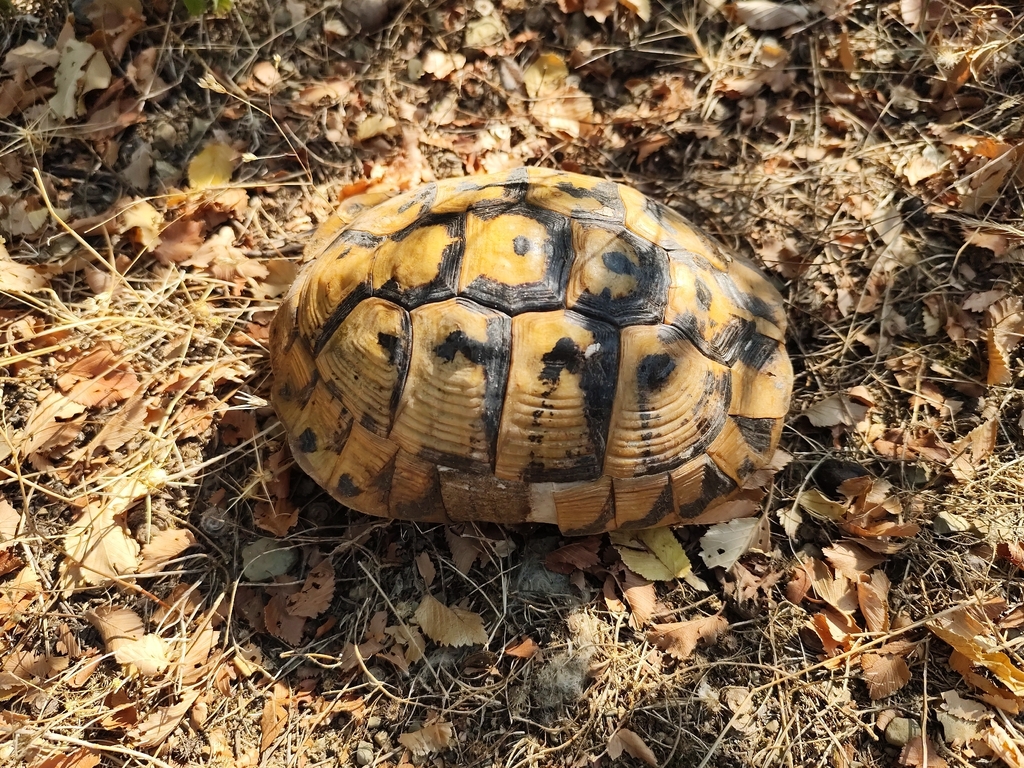
© George Papademetriou · iNaturalist · CC BY 4.0
Scientific Classification & Quick Facts
Classification
At a Glance
Testudo hermanni, the Hermann’s Tortoise, is a small terrestrial reptile native to the Mediterranean region, where it shuffles through scrubland, woodland, and grassland across more than a dozen countries. Named after the German naturalist Jean Hermann, this species has become one of Europe’s most recognizable tortoises—a stocky, slow-moving inhabitant perfectly adapted to the warm, dry climate of southern Europe and northwestern Africa. Despite centuries of human observation and collection for the pet trade, Hermann’s Tortoises remain widespread enough to be classified as Near Threatened rather than critically endangered, though their populations face mounting pressures from habitat loss, climate change, and illegal capture.
What makes Hermann’s Tortoise particularly noteworthy is the stark contrast between its resilience as a species and the fragility of individual populations across its fragmented Mediterranean range. The tortoise’s slow reproduction and extreme longevity mean that recovery from local extinctions is measured in decades, not years. Its appeal as a pet has driven both scientific interest and conservation concern, making it a focal point for understanding how trade, habitat management, and climate adaptation intersect in Mediterranean biodiversity.
Identification and Appearance
Testudo hermanni, commonly known as Hermann’s Tortoise, is a small to medium-sized tortoise native to southern Europe. Adults typically measure 2–2.5 cm in length and weigh 2–2.5 g, making them one of the smaller European tortoise species. Young animals and many adults display striking black and yellow patterned carapaces, though this vibrant coloration often fades with age to duller shades of gray, straw, or pale yellow.
Shell and Head Features
The carapace shows the characteristic dome shape typical of terrestrial tortoises, with the distinctive pattern most pronounced in juveniles. Hermann’s tortoises possess slightly hooked upper jaws and, like all tortoises, lack teeth entirely—instead relying on strong, horny beaks for feeding. Their scaly limbs range from greyish to brown with scattered yellow markings, providing camouflage in their Mediterranean habitat. A notable feature is the horny spur, or spike, at the tip of the tail, which is more pronounced in males.
Sexual Dimorphism
Males and females can be distinguished by several characteristics. Adult males develop particularly long and thick tails with well-developed spurs, features that are less pronounced or absent in females. These differences become increasingly evident as males mature, making sex determination straightforward in adult specimens. Females tend to have shorter, more slender tails and smaller tail spurs.
Distribution and Habitat
Testudo hermanni is endemic to southern Europe, with its range concentrated in the Mediterranean basin. GBIF records show the species occurs across 14 countries, with Greece, France, Italy, and Croatia hosting the largest populations. Greece leads with 66 records, followed by France (57), Italy (47), and Croatia (42). Spain, Albania, Romania, Montenegro, Bosnia and Herzegovina, and Serbia complete the known distribution, though populations in these nations are generally smaller.
The species inhabits the Mediterranean region’s diverse landscapes, from coastal lowlands to inland plateaus. While specific elevation data are not available, T. hermanni typically occupies scrubland, rocky terrain, and mixed deciduous or Mediterranean oak forests. It favours open, sun-exposed areas with sparse vegetation and access to shelter beneath rocks, fallen wood, and vegetation.
Activity patterns show pronounced seasonality. GBIF observations concentrate heavily in April (261 records), with preliminary activity in March (19 records) and February (9 records). Observations drop sharply from May onward, reflecting the species’ characteristic summer dormancy and reduced surface activity during the hot, dry months. This temporal pattern aligns with the tortoise’s spring breeding season and early-summer aestivation behaviour.
Biology and Behavior
Behavior
Hermann’s Tortoises are solitary, diurnal reptiles that spend their days foraging and basking to regulate body temperature. During the warmer months, they are most active in early morning and late afternoon, retreating to shade during peak heat. These tortoises are terrestrial and relatively sedentary, moving slowly across rocky slopes and open grassland in search of food. They establish home ranges and may return to the same burrows or shelters regularly.
In cooler months, particularly from October to March in Mediterranean regions, Hermann’s Tortoises enter hibernation. They dig burrows or use existing refuges to survive winter dormancy, emerging in spring when ambient temperatures rise. Mating occurs shortly after hibernation ends, driven by seasonal temperature changes. Males are notably more aggressive during breeding season, competing for females and occasionally engaging in shell-ramming combat with rivals.
Diet
Hermann’s Tortoises are strict herbivores, feeding on a varied diet of wild plants, grasses, and vegetation found in their Mediterranean habitats. They consume low-growing plants, clover, dandelions, and tender shoots when available. Feeding is opportunistic and depends on seasonal plant growth; they consume more heavily during spring when vegetation is fresh and abundant, then shift to tougher, more fibrous plants as the season progresses and resources become scarcer.
Reproduction
Breeding occurs in late spring and early summer, shortly after females emerge from hibernation. Mating is preceded by courtship behavior in which males pursue females and ram their shells together. Females reach sexual maturity around 12–14 years of age and typically lay eggs once or twice per year, often in June or July.
A clutch typically contains 3–8 elongated, leathery eggs, which the female deposits in a shallow pit dug in loose soil or sand. The eggs incubate in the warm ground for 8–10 weeks, with hatchlings emerging in late summer or early autumn. No parental care occurs after egg deposition; hatchlings are entirely independent from the moment they emerge. Sexual maturity is slow to develop in this species, contributing to low reproductive rates and making populations vulnerable to overexploitation.
Conservation and Threats
Testudo hermanni, the Hermann’s Tortoise, holds a conservation status of Near Threatened (NT) on the IUCN Red List. This classification reflects a species that does not yet qualify as threatened but faces enough pressure to warrant ongoing monitoring and protective action. Encouragingly, the population trend is currently increasing, a result of decades of legal protection and habitat restoration efforts across its Mediterranean range.
Threats
Hermann’s Tortoise faces multiple conservation challenges, though specific quantified threat data remains limited in global assessments. Habitat loss and fragmentation remain the primary concern, as urban development, agricultural intensification, and land use change continue to reduce suitable tortoise habitat across southern Europe. Illegal collection for the pet trade, though restricted by law, still poses a localised threat in some regions. Climate change presents an emerging risk, altering seasonal temperature and rainfall patterns that influence tortoise reproduction and survival, particularly at the range margins.
Conservation Efforts and Legal Protections
Hermann’s Tortoise benefits from strong legal protections across its native range. The species is listed on CITES Appendix II, restricting international trade, and is protected by national legislation in Greece, Bulgaria, France, and other Mediterranean nations. Multiple reintroduction and head-start programmes operate in the Balkans and southern France, breeding captive animals for release into protected areas. The European Union’s Habitats Directive (92/43/EEC) designates key tortoise populations as protected sites, creating legal frameworks for habitat conservation.
Research initiatives across Europe monitor population demographics and genetic diversity, informing adaptive management strategies. Several wildlife centres and zoos participate in coordinated breeding programmes to maintain genetic health in reintroduced populations. These efforts have stabilised populations in key regions and allowed some local populations to recover to breeding densities not seen in decades.
Cultural Significance
Hermann’s Tortoise has limited documented cultural significance in historical records and contemporary folklore. Unlike larger tortoise species that feature prominently in Mediterranean mythology or Asian philosophy, Testudo hermanni remains largely absent from classical texts, religious symbolism, and traditional artistic representations across its native range in southeastern Europe.
In modern times, the species has acquired cultural relevance primarily through the ornamental pet trade and conservation discourse. Its popularity as a captive reptile in European households has made it recognizable to amateur herpetologists and nature enthusiasts, though this association reflects recent decades rather than deep historical roots. Conservation messaging around habitat loss in the Balkans and Mediterranean region has positioned the tortoise as a symbol of threatened European wildlife, particularly in local and regional environmental campaigns.
Fun Facts
- Hermann’s tortoises can live for over 100 years in the wild, making them one of Europe’s longest-lived reptiles. Some individuals recorded in captivity have exceeded 150 years of age.
- These tortoises have a distinctive two-clawed hind foot, a trait shared only with spur-thighed tortoises among Mediterranean species. Most other tortoise species possess three claws on the hind foot.
- Hermann’s tortoises undergo winter hibernation lasting 3–6 months, during which their metabolic rate drops dramatically and they do not eat or drink. They emerge in spring when soil temperatures rise above 10°C.
- Female tortoises can store sperm for several years after mating, allowing them to produce fertile eggs long after the last encounter with a male. This adaptation helps ensure reproduction even in isolated populations.
- The species exhibits temperature-dependent sex determination, meaning the incubation temperature of eggs determines whether hatchlings will be male or female. Temperatures above 30°C typically produce females, while cooler incubation favors males.
- Hermann’s tortoises navigate using the Earth’s magnetic field, which helps them maintain consistent directional movement across their Mediterranean habitat. This magnetic sense guides them to hibernation sites and food sources year after year.
Ecology
Diet
Behavior
Conservation Status
LC · NT (Near Threatened) · VU · EN · CR · EW · EX
Photo Gallery

George Papademetriou · CC BY 4.0
Related Species
![Abingdon Island Giant Tortoise [abingdonii]](https://plantnimals.com/wp-content/uploads/2026/05/chelonoidis-niger-featured.jpg)

Was this profile helpful?