The yellow thornbill carries a color in its name that sets it apart from its close relatives, the striated and brown thornbills, which share its small size and shape but lack its prominent creamy-yellow breast.
This tiny passerine, Acanthiza nana, is endemic to the eastern coast of Australia and belongs to the family Acanthizidae within the order Passeriformes. The IUCN currently lists it as Least Concern, though its population is thought to be decreasing. Its constant foraging chatter and habit of moving in flocks make it a small but noticeable presence in the woodlands and shrublands it calls home.
Identification and Appearance
The most useful field mark is the soft, creamy-yellow breast that blends from a pale buff-orange throat, a color notably more prominent than in the similar striated thornbill or brown thornbill, which share its size and shape.
Yellow thornbills measure about 9 cm (3.5 in) in length, with a wingspan averaging 14 cm (5.5 in) and a weight of just 6 to 7 grams. The back feathers are greenish, while the primary and secondary wing coverts are olive-brown with paler edges on the primaries that contrast against the alula. The upper and under tail are duller than the rest of the body, matching the wing tones except for a dark brown-black subterminal band.
The legs, toes, and bill are all black, and the eyes are dark brown with a grey outer ring, though this ring can appear almost white or pale brown in some individuals. A narrow, cream-colored eye-ring and slightly grey-toned cream lores complete the face pattern.
There is no sexual dimorphism, so males and females look alike. Juveniles resemble adults but appear softer and duller, with a yellow gape visible shortly after fledging, more subdued yellow belly feathers, and browner tones on the back and head.
Distribution and Habitat
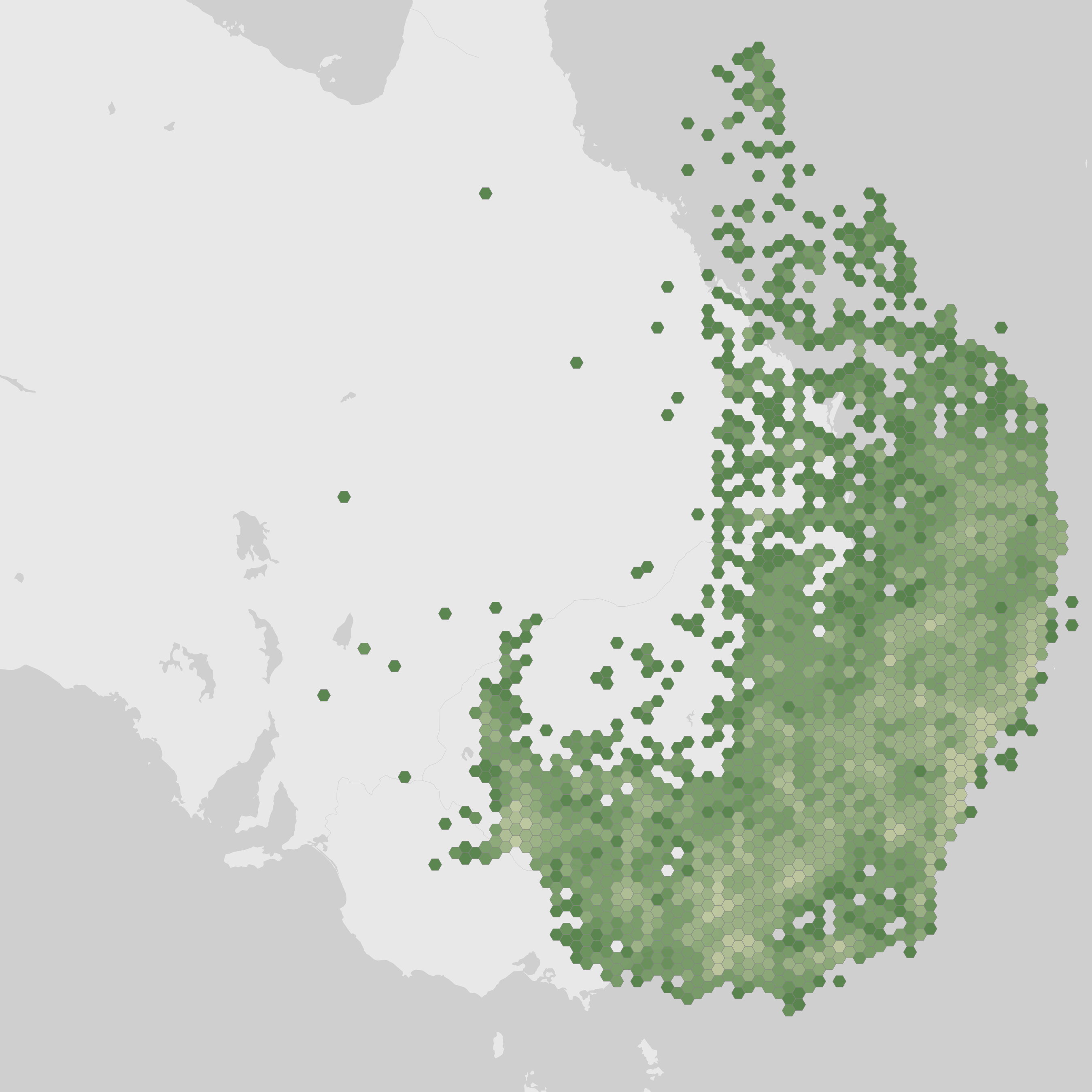
The yellow thornbill occupies a broad range along the eastern coast of Australia, extending from northern and central-west Queensland south through much of New South Wales, across Victoria and the Australian Capital Territory, and into the southeastern corner of South Australia, covering roughly 2,020,000 square kilometers.
It favors temperate and semi-arid zones, with its range just reaching into the subtropics. Within this range it uses a variety of habitats, including shrublands, forests, and thickets, showing a preference for vegetation dominated by casuarinas or eucalypts, particularly in drier climates. The species is associated with semi-open habitat density, fitting its preference for the upper and middle levels of canopy foraging.
Monthly observation patterns show activity across the entire year, with counts rising somewhat toward September and October, though these figures reflect presence records rather than actual abundance or a complete picture of the species' range.
Communication
The yellow thornbill's signature call is a loud, two-note tzid-id, harsher and less insect-like than the call of its close relative, the striated thornbill.
This call is repeated at intervals throughout the day and serves several purposes: maintaining contact between birds while foraging, signaling defense, and advertising territory. Its distinctiveness from similar species' calls makes it a useful tool for identification even when the bird itself is hard to see in dense foliage.
Diet and Nutrition
The yellow thornbill feeds mainly on insects, moving rapidly through the outer foliage of the upper and middle forest canopy in search of prey, or checking under bark for hidden food. It will also catch insects mid-flight, showing an active, agile foraging style.
While invertebrates make up most of its diet, it will occasionally eat seeds as well. The species is often found foraging in small groups or pairs, though it has been observed in feeding flocks of up to 35 individuals and in mixed-species flocks, likely increasing foraging efficiency and predator vigilance.
Nesting and Breeding
Yellow thornbills most likely breed in solitary pairs, though in some areas evidence of cooperative breeding has been recorded, suggesting a degree of flexibility in their breeding system.
Their nests are rounded and domed, with a small entrance near the top, built from bark fiber and grasses matted together with spider web. Nests are typically placed in the upper foliage of shrubs and small trees.
Clutches of two to four eggs are laid soon after the nest is completed, and these are incubated for 16 to 17 days before hatching.
Conservation and Threats
The yellow thornbill is currently assessed as Least Concern by the IUCN, but its population trend is decreasing. In developed areas such as towns and industrial zones, the species has only been recorded in older developments, never in newly developed ones, matching a broader pattern of native bird decline where native vegetation is removed.
Fire is another significant pressure: after fires, only the oldest age class of birds tends to remain present, suggesting younger individuals or breeding success suffer in burned landscapes. The species has also not been recorded in farmland subject to regular harvesting.
Because the yellow thornbill is largely insectivorous, the broader decline in insect populations driven by fire, land development, agricultural insecticides, and climate change could pose serious complications for its future food supply.
Cultural Significance
The genus name Acanthiza, and the related word Acantha, trace back to the Greek word akantha, meaning thorn, a reference shared with the thorny plants and seed capsules that inspired the name. In Greek mythology, Acantha was a minor figure, most likely a nymph loved by Apollo, whose story became linked to the origin of the thorn's name.
This naming tradition reflects a broader pattern in Greek and Phrygian myth-making, where names and stories were tied to specific natural features, preserving a kind of cultural and environmental knowledge even in figures with a minor mythological role.
Fun Facts
- Feeding flocks of yellow thornbills can occasionally grow to as many as 35 individuals, far larger than the small groups or pairs in which they are typically seen.
- The species' genus name, Acanthiza, shares its root with the Greek word for thorn, a link echoed in the ancient myth of the nymph Acantha.
Photos
Photographs from via iNaturalist, licensed under CC0 1.0., by daydreamnathan via iNaturalist, licensed under CC BY 4.0., by Nathan Ruser via iNaturalist, licensed under CC BY 4.0., by Martin Rady via iNaturalist, licensed under CC BY 4.0., by Patrick Connolly via iNaturalist, licensed under CC BY 4.0., by Sam Westbrook via iNaturalist, licensed under CC BY 4.0., by Stella Fish via iNaturalist, licensed under CC BY 4.0., and by TJ Jones via iNaturalist, licensed under CC BY 4.0., credited on each photo.
Ecology and classification
Classification
- Phylum
- Chordata
- Class
- Aves
- Order
- Passeriformes
- Family
- Acanthizidae
- Genus
- Acanthiza
- Species
- Acanthiza nana