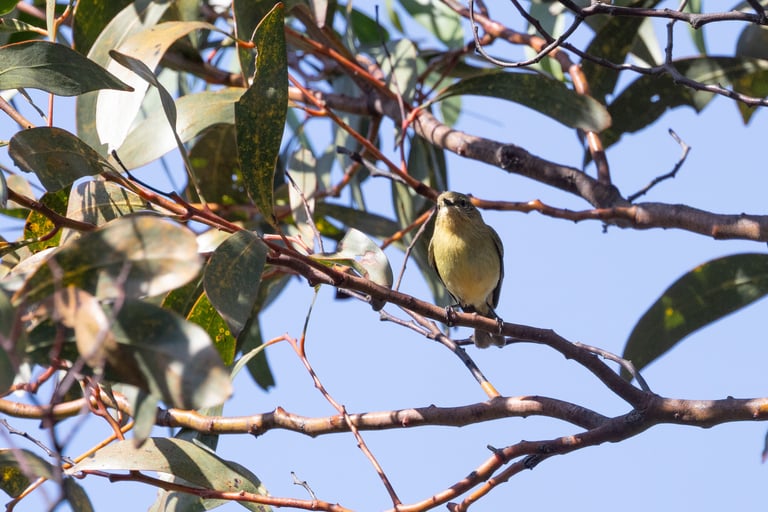
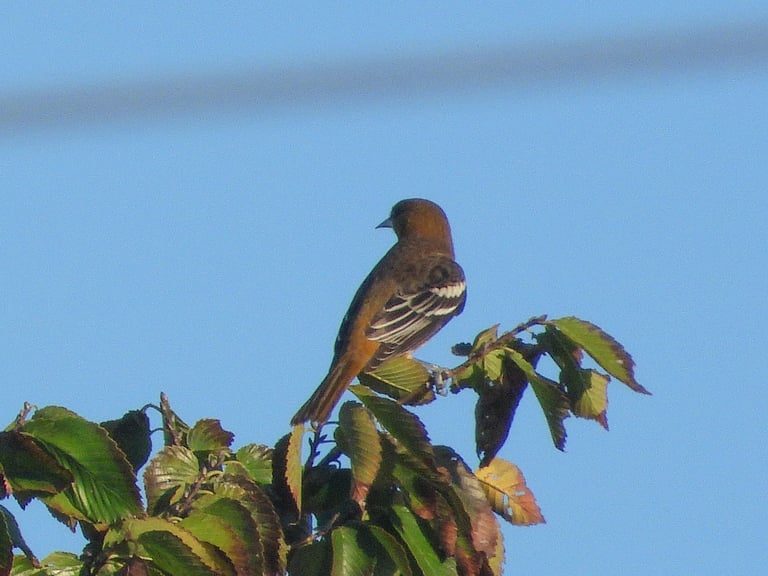
Male African paradise flycatchers carry two central tail feathers stretched into streamers that commonly run more than twice the length of the bird's own body.
This medium-sized passerine belongs to the monarch flycatcher family Monarchidae, within the order Passeriformes. It is classified as Least Concern by the IUCN. Its bold coloring, from glossy black head to chestnut back and wings, combined with the male's dramatic tail, makes it one of the more visually distinctive birds of the African bush.
Identification and Appearance
The single most useful field mark is the combination of a glossy black head and the male's long, streaming central tail feathers, which can double his total length beyond the roughly 17 cm body.
The male has chestnut wings and tail, black underparts, neck and head, and a prominent white wingbar. The female is similar in pattern but shows a browner tint to the underparts and lacks both the white wingbar and the elongated tail streamers, giving her a shorter, more uniform silhouette. Young birds resemble the female but appear duller overall.
Plumage varies considerably among males in some areas: a white morph exists in which the chestnut parts of the plumage are replaced by white, and certain races show black rather than chestnut tail streamers.
The species readily hybridizes with the genetically similar rufous-vented paradise flycatcher, and hybrids with the closely related red-bellied paradise flycatcher show underparts mixed with black and red, which can complicate identification where ranges overlap.
Distribution and Habitat
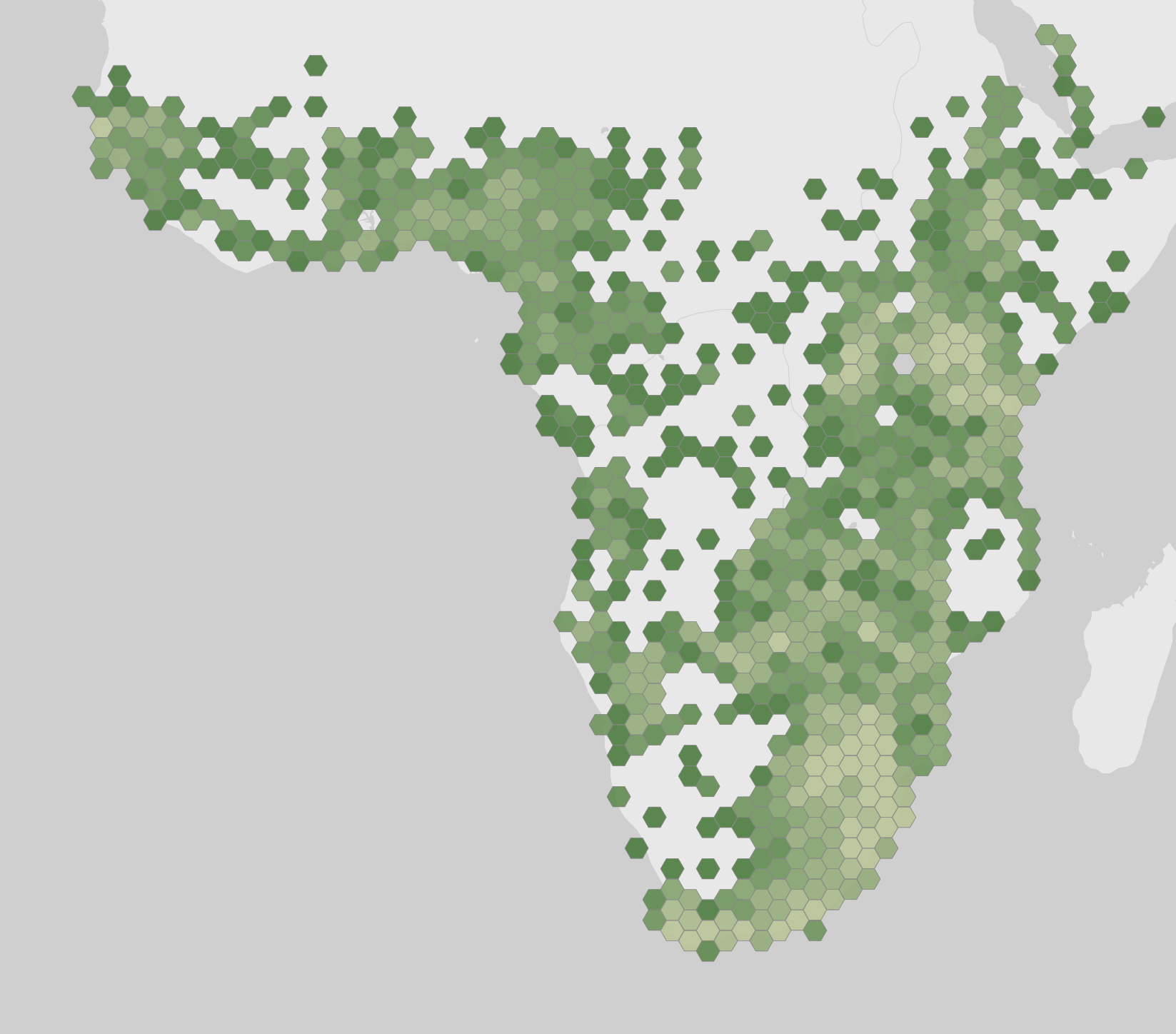
The African paradise flycatcher occupies most of Africa south of the Sahara Desert, extending into the Arabian Peninsula, across a very wide range. It favors savanna woodland of all types, open forest, open grassland with scattered trees, plantations, open woodland and scrubland, generally preferring semi-open habitat structure rather than dense closed canopy.
Monthly observation counts show a dip around April through August and a rise from September through December, which may reflect seasonal presence patterns rather than changes in overall population, since these are presence records rather than a measure of abundance.
Behavior and Lifestyle
This is a noisy, conspicuous bird, giving a harsh scolding call and perching upright and prominently, shrike-like, on exposed branches. It is sedentary rather than migratory, remaining resident within its range year-round.
It hunts mainly by catching flying insects on the wing, taking eggs, larvae and adult insects as well as spiders, and occasionally feeding on berries. Its insessorial lifestyle, spending much time perched and sallying out after prey, fits this hunting strategy.
For breeding, it builds a cup-shaped nest in a tree and lays a clutch of two or three eggs.
Cultural Significance
The scientific name Terpsiphone echoes Terpsichore, the Greek Muse of dance who was later also associated with lyric poetry and the chorus accompanying Greek theater. As one of the nine Muses, Terpsichore was believed to inspire artists and creators, often depicted holding a lyre and linked to the joy of dancing and musical performance.
The naming connection ties the bird's graceful, streaming tail and active, flitting movement to this mythological figure representing the cultural and artistic significance of dance and music in ancient Greece.
Fun Facts
- The species name links to Terpsichore, the Greek Muse of dance, later also connected to lyric poetry and theatrical chorus performance.
- Some males show a white morph in which the usual chestnut plumage is replaced entirely by white feathers.
- It readily hybridizes with the rufous-vented paradise flycatcher, and hybrids with the red-bellied paradise flycatcher show underparts mixing black and red.
Photos
Photographs from via iNaturalist, licensed under CC0 1.0., by Daniel Ghyselinck via iNaturalist, licensed under CC BY 4.0., by Lukas Zangl via iNaturalist, licensed under CC BY 4.0., by Henry de Lange via iNaturalist, licensed under CC BY 4.0., by Jiro Iguchi via iNaturalist, licensed under CC BY 4.0., by Emily Nyenyedzi Davies via iNaturalist, licensed under CC BY 4.0., by avocat via iNaturalist, licensed under CC BY 4.0., by Presha Soogrim via iNaturalist, licensed under CC BY 4.0., and by Justin Ponder via iNaturalist, licensed under CC BY 4.0., credited on each photo.
Ecology and classification
Classification
- Phylum
- Chordata
- Class
- Aves
- Order
- Passeriformes
- Family
- Monarchidae
- Genus
- Terpsiphone
- Species
- Terpsiphone viridis
Sources
- GBIF Species names and classification
- iNaturalist Photos
- Wikidata Common names and conservation status
- Wikipedia Summary extract
- Encyclopedia of Life Habitat, diet and behavior traits
- AVONET Bird mass, habitat, migration, diet and range size