Despite sharing a name and a rust-colored breast with the European robin, Turdus migratorius belongs to an entirely different bird family. The European robin is an Old World flycatcher, while the American robin is a true thrush, placed in the same genus as the blackbird and song thrush of Eurasia.
The species is a common and familiar sight across North America, breeding from Alaska and Canada south to Mexico and wintering from the southern United States to central Mexico. The IUCN lists it as Least Concern, reflecting a huge range and an enormous population. Few birds are as tied to the rhythm of the seasons for so many people, and its early spring song and bright breast have made it one of the continent's most recognized birds.
Identification and Appearance
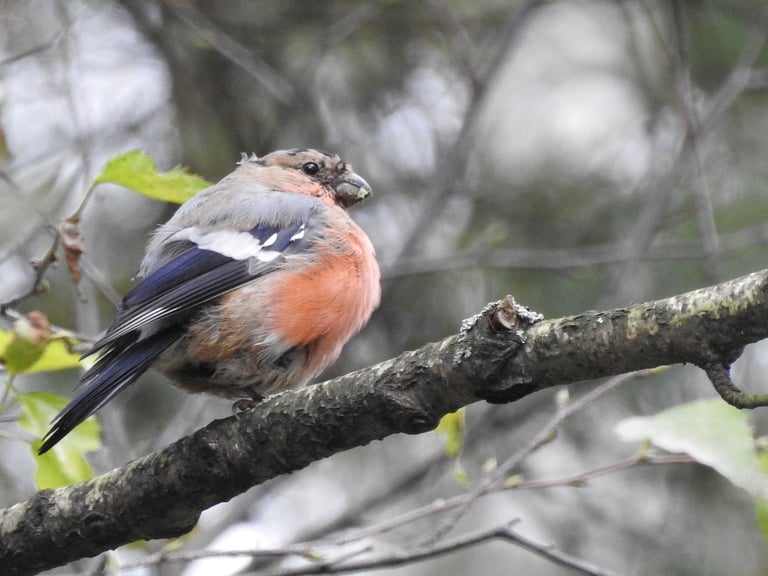
The clearest field mark is the combination of a dark head, brown back, and warm reddish-orange breast, a pattern that gives the species its common name. Eastern birds (T. m. migratorius) measure 23 to 28 cm (9.1 to 11.0 in) in length with a wingspan of 31 to 41 cm (12 to 16 in), and other subspecies fall within similar size ranges. Average weight is about 77 g (2.7 oz), though males can reach 94 g (3.3 oz) and females can be as light as 59 g (2.1 oz).
The head varies from jet black to gray and is set off by white eye arcs and white eyebrow stripes. The throat is white with black streaks, the belly and undertail coverts are white, and the bill is mostly yellow with a dark tip that becomes more extensive in winter. Legs and feet are brown.
Sexes look similar, but females tend to be duller, with a brownish tint to the head and less vivid underparts, though plumage alone cannot always separate the sexes reliably. Juveniles are paler than adult males, carry dark spots across the breast, and show whitish wing coverts, a spotted pattern typical of young thrushes. First-year birds are harder to tell from adults; first-year males often resemble adult females, and some retain a few juvenile wing feathers into their first breeding season.
Distribution and Habitat
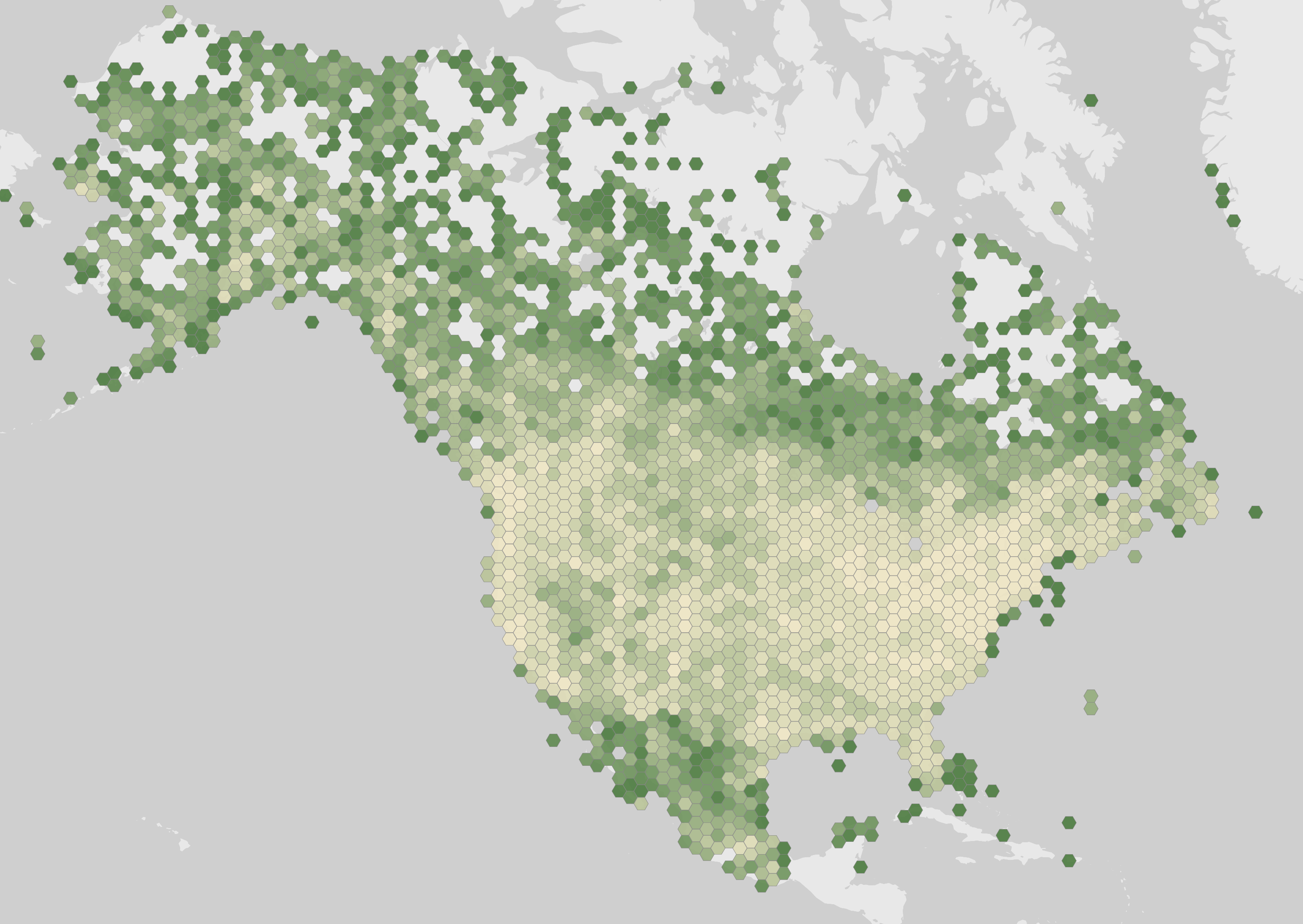
The American robin breeds across most of North America, from Alaska and Canada south to northern Florida and Mexico, and it favors woodlands, gardens, orchards, lawns, and fields. It needs open ground or short grass for foraging together with nearby shrubs or trees for nesting, a combination that suburban yards and agricultural land provide readily, which is why the species is so common around people.
Most robins leave their breeding grounds by the end of August and winter from the southern United States and Gulf Coast south to central Mexico, as well as along the Pacific coast, returning north in February and March. Migration distance depends on where a bird starts out: robins tagged in Alaska have been tracked traveling as much as 3.5 times farther across seasons than robins tagged in Massachusetts. The species is a rare vagrant to western Europe, with about 30 records in Great Britain through 2024, and has also turned up in Greenland, Sweden, Jamaica, Hispaniola, Puerto Rico, and Belize.
Monthly observation counts show a sharp rise from winter lows of around 1.2 to 1.4 million toward a peak of roughly 5.8 million in May, consistent with birds returning to breeding grounds and becoming highly visible during the nesting season; counts fall back through the summer and autumn as birds disperse and migrate south. These figures are presence records rather than true population counts, so they should be read as a seasonal visibility pattern, not as a measure of abundance.
The species also plays an unusual role as a carrier of West Nile virus. Because robins survive infection longer than birds like crows and jays, they can spread the virus to more mosquitoes over time, and are suspected to be a key host bridging the virus to humans and other animals in areas where it circulates.
Behavior and Lifestyle
American robins are active by day and shift sharply in sociability between seasons. During the breeding season, males defend territories and become far less social, while in winter, robins gather in large flocks that roost together at night in secluded swamps or dense vegetation.
These winter roosts break apart each morning, with birds dispersing into smaller groups to feed on fruits and berries before regrouping at dusk. Young robins stay near their nest site for about four months after hatching before joining mixed-age flocks ahead of the southward migration that nearly all populations undertake.
Males begin singing in late winter and early spring, often from a high perch, marking the start of the breeding period and the return of territorial behavior. Even during the competitive nesting season, robins will temporarily band together to drive off a shared predator, a rare cooperative moment in an otherwise territorial time of year.
Communication
Song is the robin's most prominent signal, a nearly continuous string of short phrases often rendered as "cheerily, cheer up, cheer up, cheerily, cheer up." Males sing frequently through the day but especially at dawn, usually from a high perch in a tree, and the song period runs from late February or early March into late July or August, with some eastern birds singing occasionally into autumn. The style varies by region and by time of day.
Beyond song, robins use a set of distinct calls to convey specific alarms: a chirping or chucking sound warns of a predator nearby, and sharper calls signal that a nest or another robin is under direct threat. Nestlings begin chirping to beg for food within days of hatching, well before they can sing.
Diet and Nutrition
American robins eat a mix of animal and plant food that shifts with what is available, drawing on roughly 40% invertebrates and 60% fruits and berries overall. Animal prey includes earthworms, beetle grubs, caterpillars, grasshoppers, and other terrestrial insects and arthropods, foraged mainly from open ground and short grass.
Fruit and berries, both wild and cultivated, make up the larger share of the diet and become especially important outside the breeding season, when robins gather in flocks to feed in trees and shrubs. The species is flexible rather than a specialist, switching to whichever food source is most readily accessible at a given time and place.
Nesting and Breeding
Pairs form a monogamous bond for the breeding season, which runs from April through July, and robins are among the first North American birds to begin laying eggs each year. Most pairs raise two to three broods in a season, building an entirely new nest for each one.
The female alone builds the cup-shaped nest, weaving an outer foundation of coarse grass, twigs, paper, and feathers, then lining the bowl with mud smeared on with her breast and cushioning it with fine grass. Nests sit most often 1.5 to 4.5 m (4.9 to 14.8 ft) above ground in a dense bush or the fork of tree branches, though robins nest readily on window ledges and other structures close to people; early-season nests in northern areas tend to be placed in evergreens, with later broods moved to deciduous trees.
Each clutch holds three to five cyan-colored eggs, incubated by the female alone for about 14 days. The naked, altricial chicks hatch with their eyes closed and are brooded closely at first, with the female shifting to nighttime and bad-weather brooding only as they grow. Parents keep the nest clean by removing waste rather than letting it accumulate.
Chicks fledge roughly two weeks after hatching, with the entire brood usually leaving within a day of each other, and continue to follow their parents begging for food while staying under ground cover. About two weeks after fledging they become capable of sustained flight, and both sexes reach reproductive maturity at one year old; even so, bird-banding studies find that only about 25% of young robins survive their first year.
Population and Ecological Role
The American robin holds an extensive range estimated at 16,000,000 km2 (6,200,000 sq mi) and a large population put at roughly 370 million individuals, with the western subspecies (T. m. propinquus) in central California considered to be expanding its range further. Because there are so many robins, they are an important prey item for a wide range of predators, and the species also helps control populations of the insects it eats, such as beetles.
Robins are significant seed dispersers, spreading the seeds of the fruits and berries that make up much of their diet as they move between feeding areas. They also show notable resistance to brood parasitism, routinely rejecting eggs laid in their nests by brown-headed cowbirds, which keeps that form of nest parasitism rare in the species.
Conservation and Threats
The IUCN lists the American robin as Least Concern, reflecting its enormous population and range; the species does not come close to the population-decline thresholds that would trigger a higher threat category, and its trend is considered stable. Climate change and severe weather are identified as threats, though they have not translated into a measurable decline so far.
Historically, robins were killed for meat in some southern U.S. states, where they were considered a delicacy, but the species is now protected across its range under the U.S. Migratory Bird Treaty Act. It carries no special status under the U.S. Federal List, CITES, or state-level lists beyond that federal protection.
Natural predation pressure is heavy but appears to be sustainable at the population level: eggs and juveniles are taken by squirrels, snakes, and some birds, adults are hunted by Accipiter hawks, cats, and larger snakes, and at least 28 raptor species are known to hunt American robins, with adults most vulnerable during breeding activities.
Conservation status
- LC
- NT
- VU
- EN
- CR
Least Concern
Cultural Significance
The American robin is the state bird of Connecticut, Michigan, and Wisconsin, and it once appeared on Canada's 1986 series $2 note before that note was withdrawn. In Native American traditions, a story tells of how the robin got its red breast by fanning the dying flames of a campfire to save a man and a boy, echoing similar tales told of the European robin, while the Tlingit people regarded it as a culture hero created by Raven to please people with its song.
The bird is widely treated as a symbol of spring, most famously in Emily Dickinson's poem "I Dreaded That First Robin So," and in William Henry Drummond's "The First Robin," said to draw on a Quebec superstition that whoever sees the first robin of spring will have good luck. That association has carried into modern popular culture, including a 1990 Calvin and Hobbes strip built around the same superstition, and into everyday language through the color name "robin egg blue," taken from the bird's distinctive egg color.
The robin has also inspired popular song, including "When the Red, Red Robin (Comes Bob, Bob, Bobbin' Along)," and indirectly lent its name to the comic book character Robin, whose mother is said in one version to have nicknamed him for his birth on the first day of spring.
Fun Facts
- In a University of California, Berkeley study, psychology students rated the robin as the single most typical example of what a "bird" looks like.
- Although banding studies show only about a quarter of young robins survive their first year and average lifespan is roughly two years, the longest known wild robin lived to 14 years old.
- In a study of 105 juvenile robins, over 77% carried endoparasites, most commonly a roundworm of the genus Syngamus.
- Robins reliably reject brown-headed cowbird eggs laid in their nests, making successful brood parasitism by cowbirds rare in this species.
- A family of robins nesting on the Canadian side of the Peace Bridge between Buffalo, New York, and Fort Erie, Ontario, drew minor public attention in the mid-1930s as the "Peace Bridge robins."
Ecology
Habitat
- Wetland
- Woodland
- Grassland
- Urban
Behavior
- Territorial
- Social
- Diurnal
- Migratory
Diet
- Omnivore
Photos
SourcesGBIFiNaturalistWikidataWikipediaEncyclopedia of LifeAnimal Diversity WebAnAge