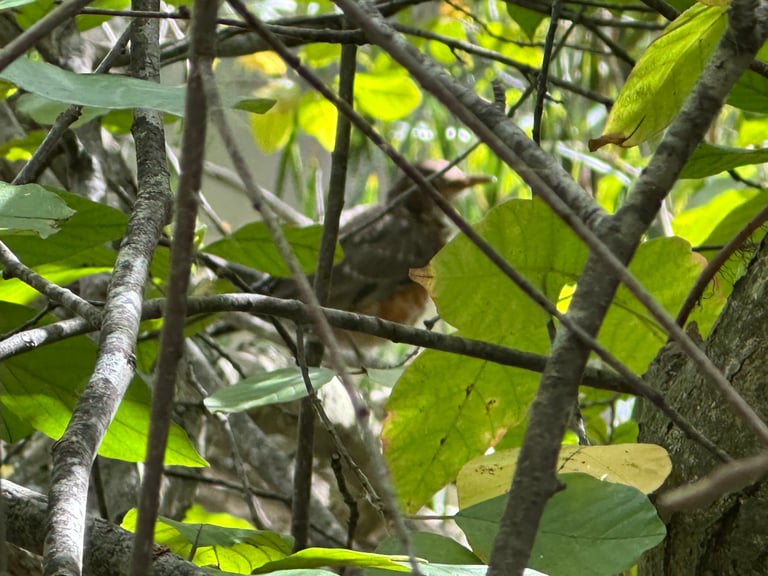
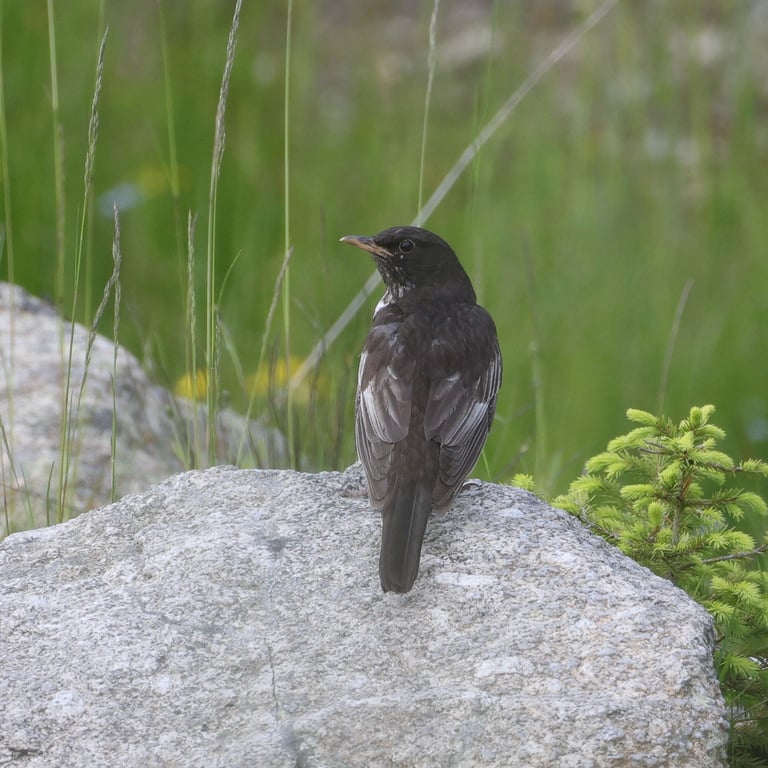
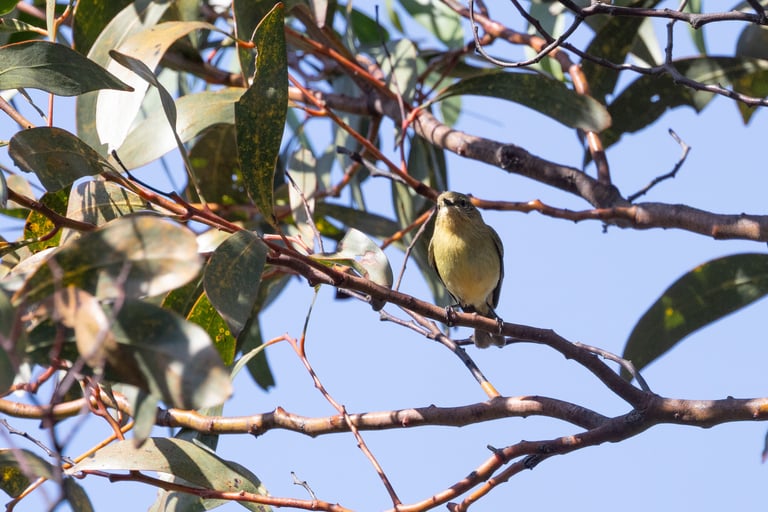
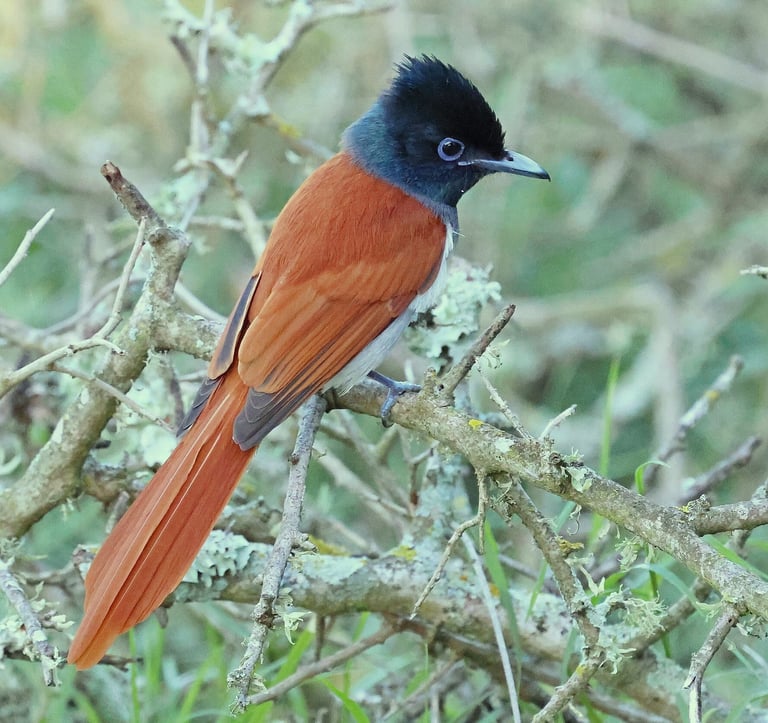
Of all the American spotted thrushes, the gray-cheeked thrush breeds farther north than any other, nesting all the way to the edge of the Arctic tundra.
This medium-sized member of the thrush family (Turdidae) breeds across the boreal forests of Canada, Alaska, and into eastern Siberia, and is currently assessed as Least Concern. Its subtle plumage and secretive habits make its voice, rather than its looks, the real key to knowing it.
Identification and Appearance
The clearest field mark is the bird's grayish face combined with a faint, partial pale eyering, since it lacks the buffy spectacles seen in some relatives. It measures about 15 to 17 cm in length with a wingspan of roughly 32 to 34 cm and weighs between 26 and 30 g, making it slightly larger than other Catharus thrushes.
The upperside is drab gray-brown, the flanks are extensively marked with dusky streaking, and the area between the eye and bill is grayish while the stripe from the bill to above the eye is grayish white. Like other Catharus thrushes it shows the characteristic white-dark-white pattern on the underwing.
Two subspecies are recognized. The nominate C. m. minimus, confined to Newfoundland, is overall browner with a buffier wash on the breast and a brighter yellow patch at the base of the lower bill. C. m. aliciae, breeding from Labrador west to Siberia, is grayer olive above with duller flanks and a lightly washed cream breast.
The species is nearly identical to Bicknell's thrush, and the two are best told apart by voice and the gray-cheeked's slightly larger size.
Distribution and Habitat
The gray-cheeked thrush breeds across the boreal forest of northern Canada, Alaska, and eastward across the Bering Sea into eastern Siberia, with its range extending north past the treeline into low Arctic willow and alder thickets. It favors low coniferous woods, including young regenerating stands, open-canopy old-growth forest with a dense shrub and small-conifer understory, and stunted, windblown spruce and fir near the tree line.
The two subspecies occupy distinct breeding areas: C. m. aliciae breeds from Labrador west to Siberia, while the nominate C. m. minimus is restricted to the island of Newfoundland and possibly adjacent coastal Labrador.
This is a long-distance migrant, traveling on average about 3,000 km and crossing the Caribbean Sea and Gulf of Mexico during spring migration. Birds are believed to winter in the Amazon basin, though little is known about their winter habitat there; during migration they may turn up in nearly any wooded habitat, including scrub bordering streams, open groves, tall second growth, and old cacao plantations. They are present on the breeding grounds from May to August and remain uncommon to rare across most of their North American range despite covering over 5,000,000 km².

Behavior and Lifestyle
This species is terrestrial and strongly migratory, moving between its northern breeding grounds and wintering areas believed to lie in the Amazon basin. During migration it is often found in small numbers mixed among larger waves of Swainson's thrush, a species with very similar habits.
Males sing from the top of a low tree or shrub, mainly at dawn and dusk, and largely stop daytime singing once the breeding season begins. The species relies on visual, tactile, acoustic, and chemical perception channels in its daily life.
Communication
Voice is the most reliable way to identify this species, especially since it is nearly identical in appearance to Bicknell's thrush. The song is a complex series of burry, flute-like notes that usually inflects downward at the end, described as "ch-ch zreeew zi-zi-zreeee zizreeew"; it resembles the descending spiral song of the veery but is higher, thinner, nasal, and punctuated by stuttering pauses.
Its flight call is a high, penetrating, nasal "queer," and a distinct nocturnal flight note drops in pitch as a one- or two-note "whe-eer." Because the bird is secretive and hard to observe on the ground, hearing this nocturnal flight call during spring and fall migration is often the most likely way to detect its presence.
Diet and Nutrition
The gray-cheeked thrush feeds mainly on insects, including beetles, weevils, ants, wasps, and caterpillars, placing it firmly among the invertivores. It also takes spiders, crayfish, sow bugs, and earthworms as opportunities allow.
Fruit supplements this animal diet, with grapes, wild cherries, blackberries, and raspberries all recorded as food sources. By eating berries and passing the seeds undigested, the species plays a role in dispersing the plants it feeds on to new locations.
Nesting and Breeding
Courtship leads to a monogamous pairing, and birds are presumed to begin breeding at one year of age. Nesting pairs are secretive and well-spaced, rarely occurring at high densities, with nests built on the ground or in low shrubs typically under 2 meters high.
The female alone builds the nest from dried grasses mixed with a supporting layer of mud. She lays an average of four eggs, though clutches range from three to five; the eggs are greenish blue with light brown dots and blotches, oval to short-oval in shape.
Incubation lasts 13 to 14 days, and nestlings fledge 11 to 13 days after hatching. Both parents care for the young. Pairs typically raise only one brood per season, but will lay a second clutch if the first nest fails early in the season.
Conservation and Threats
The gray-cheeked thrush is assessed as Least Concern by the IUCN Red List, reflecting its large range and large population size. In the United States it is protected under the Migratory Bird Act, though it holds no special status under the US Federal List, CITES, or Michigan's state list.
Cultural Significance
Human interaction with the gray-cheeked thrush centers on a practical benefit: the species feeds on insects that people consider pests or nuisances, offering a form of natural pest control wherever it forages.
Fun Facts
- Gray-cheeked and Bicknell's thrush were once considered the same species, and the two remain so alike that voice is often the only reliable way to separate them in the field.
- During migration, this thrush is often found traveling in small numbers embedded within much larger flocks of Swainson's thrush.
- Its nocturnal flight call, a dropping "whe-eer," is heard far more often than the bird itself is seen, since it migrates mostly under cover of darkness.
Photos
Photographs from via iNaturalist, licensed under CC0 1.0., by northerly via iNaturalist, licensed under CC BY 4.0., by Andrew Lai via iNaturalist, licensed under CC BY 4.0., by Dan MacNeal via iNaturalist, licensed under CC BY 4.0., by Isaac Larkin via iNaturalist, licensed under CC BY-SA 4.0., and by Dave Menke via Wikimedia Commons, licensed under Public Domain., credited on each photo.
Ecology and classification
Classification
- Phylum
- Chordata
- Class
- Aves
- Order
- Passeriformes
- Family
- Turdidae
- Genus
- Catharus
- Species
- Catharus minimus
Sources
- GBIF Species names and classification
- iNaturalist Photos
- Wikidata Common names and conservation status
- Wikipedia Summary extract
- Encyclopedia of Life Habitat, diet and behavior traits
- Animal Diversity Web Animal habitat, behavior and diet
- AnAge Longevity
- AVONET Bird mass, habitat, migration, diet and range size
- Wikimedia Commons Photos
- GloBI What it eats, what eats it, parasites and pollinators
- HWML Parasite Collection