In 2009, researchers documented that some populations of this small Pacific flycatcher had diverged so much in song and plumage that individuals from different groups no longer recognized each other as potential mates — a rare real-time glimpse of a new bird species possibly being born.
The chestnut-bellied monarch (Monarcha castaneiventris) is a passerine bird in the monarch-flycatcher family Monarchidae, found only on the Solomon Islands archipelago in the tropical Pacific. The International Union for Conservation of Nature lists it as Least Concern, indicating a stable overall population across its island range.
Its scientific interest lies less in rarity than in what it can reveal about how new species arise, making this island flycatcher a small but significant case study in evolutionary biology.
Identification and Appearance
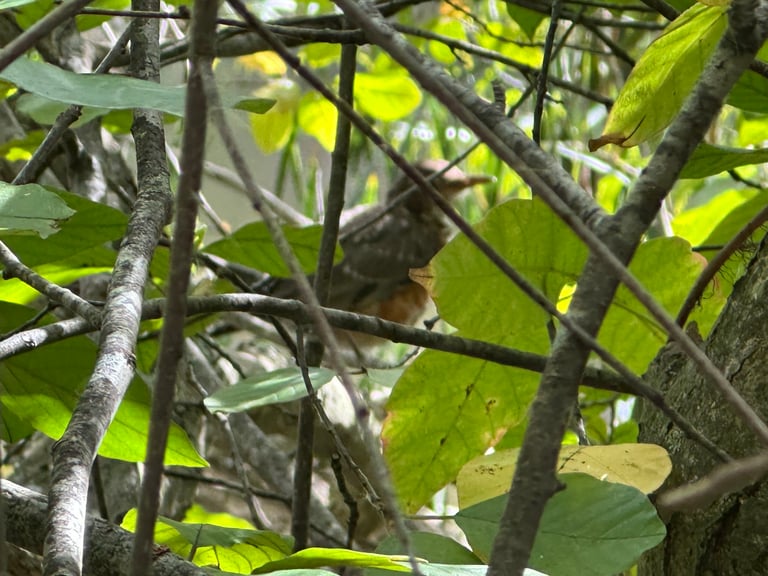
The most distinctive feature named in its common name is a chestnut, reddish-brown belly, which contrasts with the darker plumage typical of monarch flycatchers in the genus Monarcha.
Beyond this coloration, detailed measurements of body size, wing shape or bill structure are not documented in available records for the species.
Some populations show marked differences in plumage color and song from others within the species, a divergence linked to the incipient speciation event discussed further under behavior.
Distribution and Habitat
The chestnut-bellied monarch is endemic to the Solomon Islands, an archipelago in the southwestern Pacific, and does not occur naturally anywhere else.
Monthly presence-observation counts show notable peaks in March, April, June, September and especially July, when reported sightings reach 168, more than ten times the February low of 15. Because these figures come from GBIF occurrence records, they reflect observation effort and presence rather than true abundance or population size.
The pattern of scattered peaks across the year suggests the species is present and detectable through much of it on its home islands, though the data cannot confirm true seasonal movement or migration.

Behavior and Lifestyle
The chestnut-bellied monarch's most notable documented behavior is not a daily habit but an evolutionary one: in 2009, researchers reported that a genetic change in some populations altered both plumage coloration and song.
Birds carrying the altered traits no longer recognized individuals from other populations as potential mates, effectively cutting off interbreeding between the two groups. This reproductive isolation is considered a case of behavior-driven divergence, since it is differences in appearance and voice, not geography alone, that keep the groups apart.
Scientists suggested that if this separation persists, it could eventually lead the isolated population to become a distinct species, offering a rare, observable example of evolution in progress rather than a process inferred only from fossils or genetics after the fact.
Cultural Significance
No documented mythology, folklore or traditional use specific to the chestnut-bellied monarch appears in available records. The species is best known within ornithological and conservation circles as a case study in evolutionary biology rather than as a cultural symbol, and any cultural associations tied to the word "monarch" more commonly reference the unrelated monarch butterfly of North America, not this Solomon Islands bird.
Fun Facts
- It was formally described by French naturalist Jules Verreaux in 1858, giving rise to its scientific name, Monarcha castaneiventris.
- It belongs to the family Monarchidae, the monarch flycatchers, a group named independently of and unrelated to the monarch butterfly.
- It is found only in the Solomon Islands, an archipelago in the southwestern Pacific, making it a true island endemic.
Conservation status
- LC
- NT
- VU
- EN
- CR
Least Concern