Every other flowering plant on Earth, from oak trees to orchids, shares a more recent common ancestor with each other than any of them share with Amborella trichopoda. Molecular phylogenetic studies consistently place this unassuming shrub as the sister lineage to all other angiosperms, making it the most basal living flowering plant known to science.
This plant grows as an understory shrub or small tree found only on Grande Terre, the main island of New Caledonia in the southwest Pacific. The IUCN lists it as Least Concern, but its scientific value far outweighs its modest stature. For botanists trying to reconstruct how flowers first evolved, Amborella offers a rare glimpse into the deep past, preserved in a single, still-living genus.
Identification and Appearance
The most telling feature of Amborella trichopoda lies inside its stems rather than on its surface: its xylem tissue contains only tracheids, with no vessel elements at all. This trait, long regarded as primitive among flowering plants, sets it apart from nearly every other angiosperm, which typically rely on more efficient vessel-based water transport.
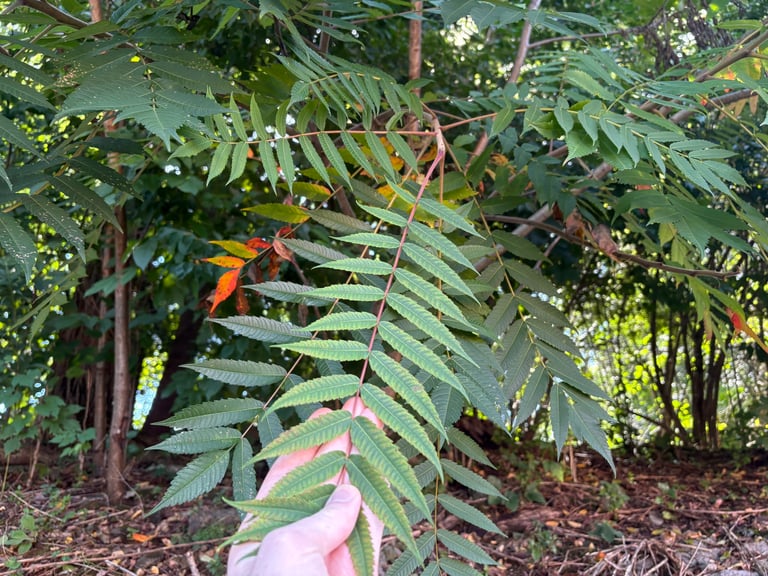
The plant itself is a sprawling shrub or small tree reaching up to 8 meters in height. Its leaves are alternate, simple, and evergreen, arranged in two flat ranks along the stem, each leaf measuring roughly 8 to 10 centimeters long with distinctly serrated or rippled margins and no stipules.
Amborella is dioecious, meaning individual plants bear either male or female flowers, never both at once. Male flowers are slightly larger, at 4 to 5 millimeters across, with 6 to 15 tepals and 10 to 21 spirally arranged stamens bearing triangular anthers. Female flowers, by contrast, measure 3 to 4 millimeters, carry 7 or 8 tepals, and produce a spiral of 4 to 8 free carpels alongside a few non-functional staminodes that resemble stamens but never produce pollen. Curiously, individual plants can switch reproductive roles between flowering events: in one study, cuttings from a male plant that flowered as staminate the first time produced female flowers the next time around.
After pollination, one to three carpels typically develop into small ovoid red drupes, each about 5 to 7 millimeters long, with a papery skin covering a thin fleshy layer of red juice around a single lignified seed.
Distribution and Habitat
Amborella trichopoda is endemic to Grande Terre, the main island of New Caledonia, where it grows in the understory of tropical forest. It occurs nowhere else in the wild, making its entire global range a single island in the southwest Pacific.
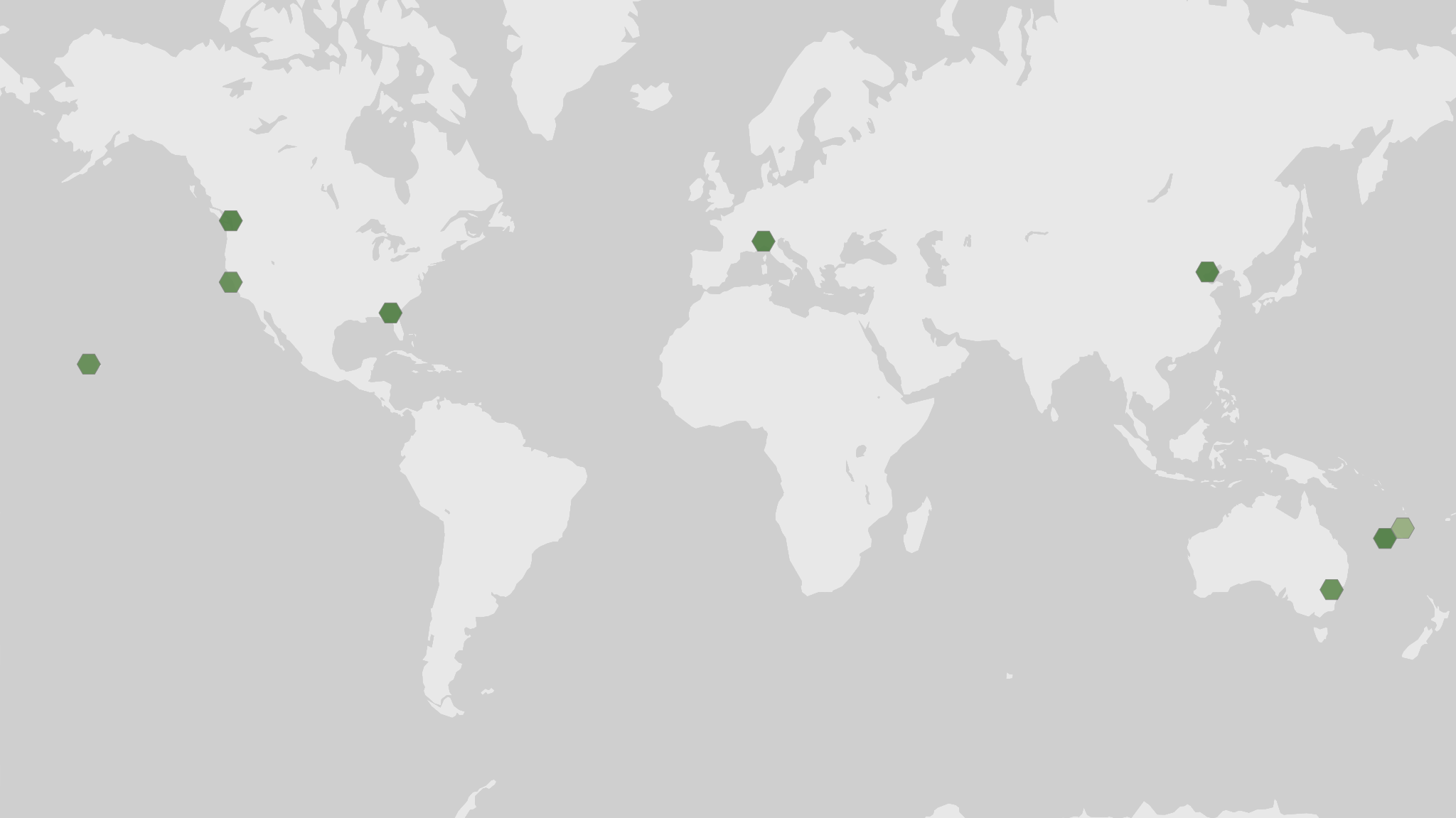
Monthly observation records from GBIF show occurrence counts spread across the year, with a strong peak of 133 observations in November and secondary peaks of 98 and 85 in April and March, respectively. Lower counts appear in January, February, June, July, and December. These figures reflect presence observations tied to fieldwork and reporting activity rather than actual abundance, seasonal flowering, or the plant's complete range, so the November peak likely says more about survey timing than about the plant's biology.
Uses and Human Relationships
Beyond its scientific significance, Amborella trichopoda holds cultural meaning for the people of New Caledonia, who use the plant in traditional medicine and regard it as a symbol of their cultural heritage. This dual role, as both a subject of global botanical research and a locally meaningful plant, ties the species directly to the identity and traditions of the island it calls home.
Conservation and Threats
Amborella trichopoda is currently classified as Least Concern by the IUCN, reflecting its stable status within its native range on Grande Terre. This favorable standing owes much to New Caledonia's unusual climate history: since the Tertiary period, spanning roughly 66 to 3 million years ago, the islands have enjoyed unusual climate stability that allowed tropical forests, and the ancient plant lineages within them, to persist even as Australia's climate turned toward drought.
That stability is now under pressure. The main threats to Amborella and the broader New Caledonian biodiversity hotspot include fires, mining, agriculture, invasion by introduced species, urbanization, and global warming. Because Amborella is the sole survivor of its entire genus, family, and order, its loss would carry disproportionate evolutionary weight. As botanist Yohan Pillon has put it, the disappearance of the species would mean the disappearance of a genus, a family, and an entire order, along with the only living witness to at least 140 million years of evolutionary history.
Conservationists recommend strategies focused on relict species like Amborella, combining the protection of diverse habitats across New Caledonia with ex situ conservation through cultivation.
Conservation status
- LC
- NT
- VU
- EN
- CR
Least Concern
Fun Facts
- Amborella trichopoda is the only species in its genus, family, and order, making it entirely alone on its branch of the flowering plant family tree.
- Molecular studies place it as the earliest diverging lineage among all living angiosperms, effectively marking the point where the ancestors of every other flowering plant split away.
- New Caledonia's long-term climate stability since the Tertiary period, roughly 66 to 3 million years ago, is credited with allowing ancient plant lineages like Amborella to survive there while similar lineages vanished elsewhere, including in Australia.
- Local communities in New Caledonia use Amborella in traditional medicine and regard it as a symbol of their cultural heritage, tying a globally significant scientific plant to everyday island life.
Ecology
Habitat
- Forest
Growth habit
- Shrub