Bondarzewia mesenterica is a polypore fungus in the family Bondarzewiaceae, part of the order Russulales within the class Agaricomycetes and the phylum Basidiomycota, all under the kingdom Fungi.
This taxonomic placement sets it apart from the gilled mushrooms most people picture when they think of fungi. Polypores like B. mesenterica produce their spores inside pores rather than on gills, a structural difference that runs through the whole Bondarzewiaceae family.
The species' scientific name carries its own small history: first described by Schaeffer and later revised by Kreisel, a lineage of naming that many long-studied fungi share.
Fruiting Body and Identification
The most reliable way to recognize Bondarzewia mesenterica is by its habit of growth: a contiguous fruit body mass, made of many fan-shaped caps growing from a shared base, that can reach up to 1 meter (3.5 feet) across in maturity.
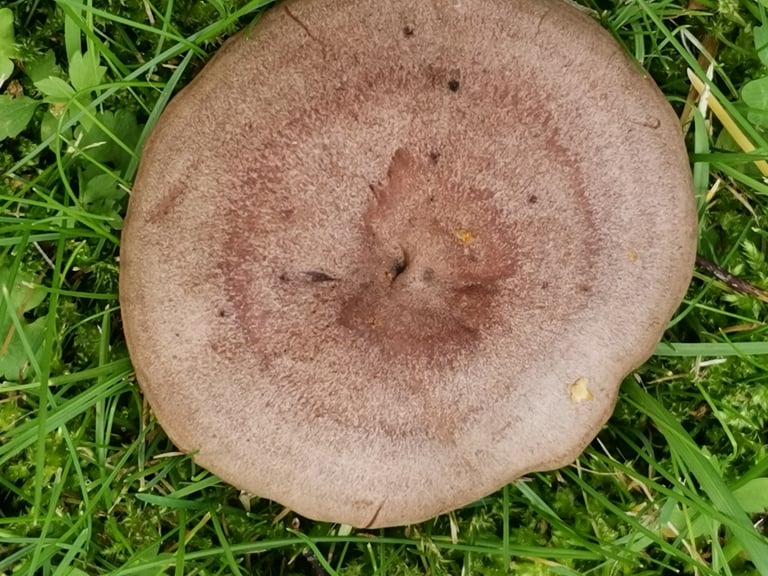
Each individual cap grows up to 25 cm (10 in) wide, is tomentose in texture, and shows brownish zones across its surface. The caps are fan-shaped and often overlap, radiating outward as if from a single point of origin. On the underside, the pore surface is buff-colored, with pores no more than 2 millimeters (about 1/16 in) wide.
The flesh is whitish and gives off a pleasant odor when fresh. The stalks are continuous with the caps rather than separate structures, and they rise from an underground base called a sclerotium, which can measure up to 12 cm long and 5 cm thick.
Outside its own genus, Bondarzewia mesenterica resembles Meripilus giganteus, another large, clustered polypore that grows at the base of trees. Distinguishing the two relies on close comparison of pore size, cap texture, and the underground sclerotium, since general similarity in overall shape can make field identification tricky.
Distribution and Habitat
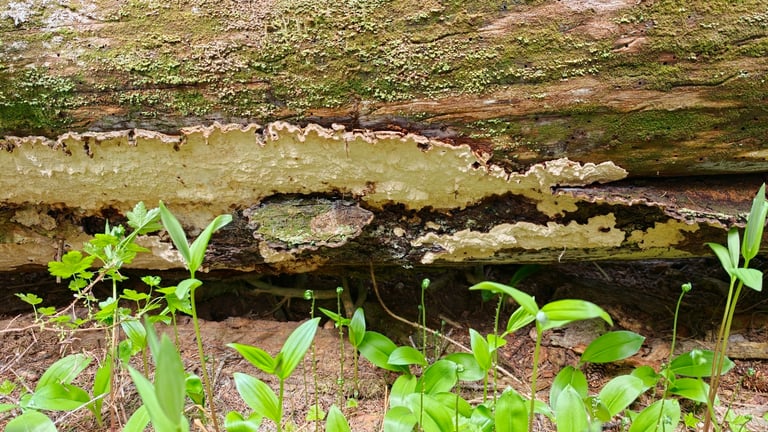
Bondarzewia mesenterica grows at the base of conifers, where it attacks the tree's roots and lower trunk and causes a white rot. This root- and base-level growth habit ties the fungus closely to its host trees rather than to open ground or dead wood scattered through a forest.
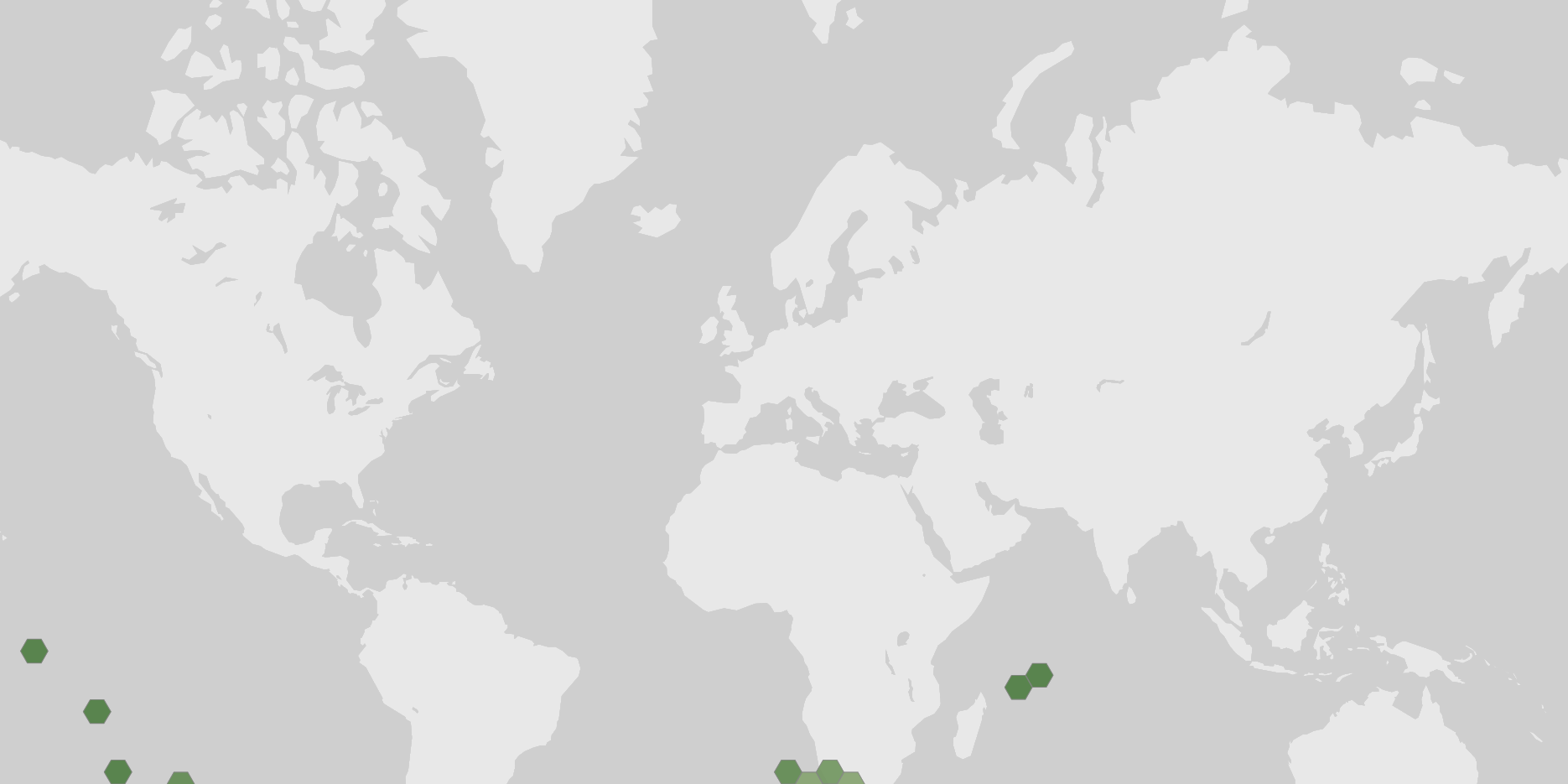
Observation records compiled through GBIF show a strong seasonal pattern, though these figures reflect presence sightings rather than actual abundance or a complete picture of the species' range. Sightings are rare from January through June, then rise sharply, peaking in August and remaining high through September, before tapering off by November and December.
This pattern suggests the fruiting bodies are most visible to observers in late summer, which likely corresponds to when conditions at the base of conifers favor fruiting, though the underlying mycelium and sclerotium persist in the soil year-round.
Uses and Cultural History
Bondarzewia mesenterica is considered edible, though it has a reputation for being tough and often bitter. This combination of firm texture and bitter taste sets it apart from more sought-after wild mushrooms and likely limits its appeal as a culinary find, even where it is not avoided outright.
No further culinary, medicinal, or traditional uses are documented for this species beyond its basic edibility.
Fun Facts
- The genus Bondarzewia contains only four described species worldwide, each one causing a white rot in a different, geographically separated type of forest.
- Bondarzewia mesenterica is also known by the synonym Bondarzewia montana.
- Despite belonging to the order Russulales, which also contains the mycorrhizal genus Lactarius, Bondarzewia mesenterica is more closely related to Echinodontium and Hericium than to Lactarius.
- Researchers confirmed the species' saprotrophic (decay-based) nutritional strategy by growing a culture from a wild specimen under laboratory conditions.
Photos
Photographs from by Gabriel Mayrhofer via iNaturalist, licensed under CC BY 4.0., by Katrin Simon via iNaturalist, licensed under CC BY 4.0., by Valentin Moser via iNaturalist, licensed under CC BY 4.0., by Paula Nimigean via iNaturalist, licensed under CC BY 4.0., by Atsushi Nakajima via iNaturalist, licensed under CC BY 4.0., by W Rao via iNaturalist, licensed under CC BY 4.0., by Felicia Seichter via iNaturalist, licensed under CC BY 4.0., and by Conrad Altmann via iNaturalist, licensed under CC BY 4.0., credited on each photo.
Ecology and classification
Habitat
Classification
- Phylum
- Basidiomycota
- Class
- Agaricomycetes
- Order
- Russulales
- Family
- Bondarzewiaceae
- Genus
- Bondarzewia
- Species
- Bondarzewia mesenterica
Sources
- GBIF Species names and classification
- iNaturalist Photos
- Wikidata Common names and conservation status
- Wikipedia Summary extract