Few mushrooms broadcast their presence as clearly as Lactarius deliciosus: cut or bruise it and the orange flesh bleeds a matching orange-red latex before staining green. Known as the saffron milk cap or delicious milk cap, it belongs to the large genus Lactarius in the order Russulales, and it lives only in partnership with pine trees, whose roots it wraps in a mycorrhizal relationship that benefits both organisms.
The species is native to Europe, especially the Mediterranean basin and the southern Pyrenees, but it has traveled far beyond that range wherever people have planted pines.
That unplanned global journey, combined with its striking color-change reaction and its long culinary history across several continents, makes it one of the most recognizable and closely watched members of its genus.
Fruiting Body and Identification
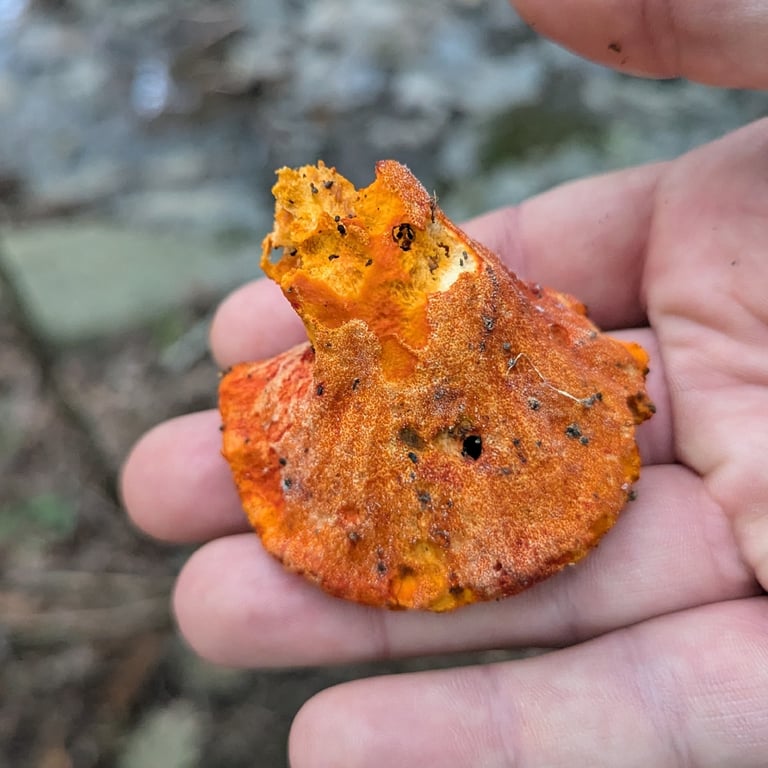
The most reliable field mark is color change: the orange flesh and gills of Lactarius deliciosus turn a deep green wherever they are cut, bruised, or handled, while the latex that oozes from a fresh cut stays orange-red and does not itself change color. This combination of reactions separates it from most other milk caps.
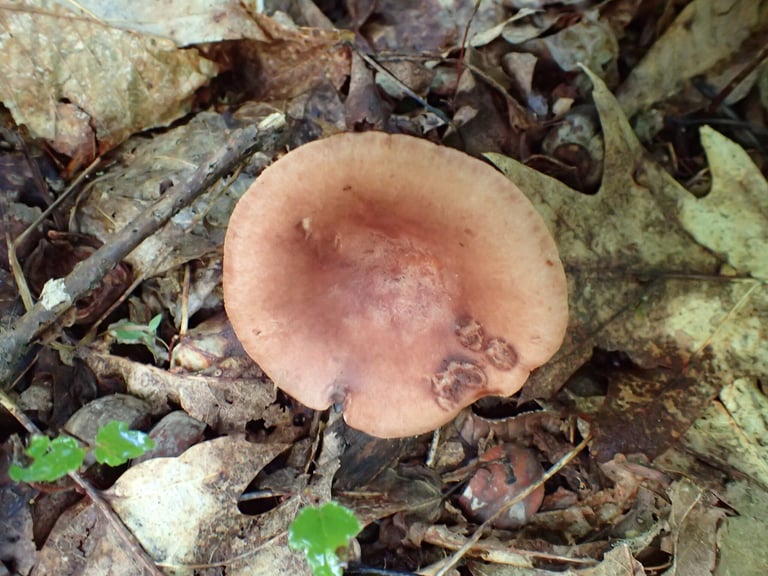
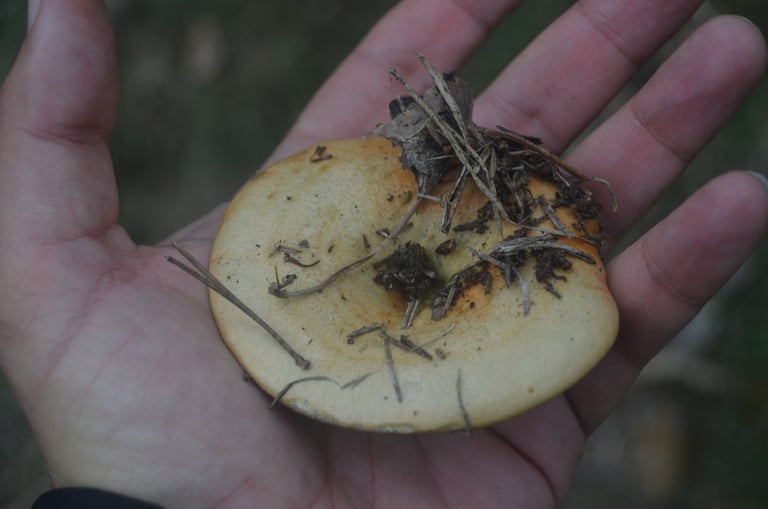
The cap is carrot-orange, 3 to 20 centimeters across, and shifts shape as it matures: convex and inrolled at the margin when young, becoming vase-shaped with age. Darker orange lines often form concentric circles across the surface, and the cap is sticky and viscid when wet but frequently dries out. Beneath it, the gills are crowded and decurrent, running down onto a squat, often hollow stipe that measures 2 to 8 centimeters long and 1 to 2.5 centimeters thick, colored the same orange as the cap. The spore print is cream-colored.
Several related species can be confused with it. Lactarius rubrilacteus stains blue rather than green and exudes red latex. Lactarius olympianus has white latex and an unpleasant taste. Lactarius thyinos is orange but does not stain greenish, and Lactarius salmoneus has a white cap rather than an orange one. Chemically, mycelium grown in liquid culture has been shown to produce fatty acids and compounds such as chroman-4-one, anofinic acid, 3-hydroxyacetylindole, ergosterol, and cyclic dipeptides.
Distribution and Habitat
Lactarius deliciosus is native to Europe, where it is closely tied to Mediterranean pines. It occurs across the southern Pyrenees and throughout the Mediterranean basin, including Portugal, Spain, France, Italy, Greece, Bulgaria, and Cyprus, and it is also gathered commercially in the İzmir and Antalya provinces of Turkey. On Cyprus, it grows abundantly in the high-altitude Pinus nigra and P. brutia forests of the Troodos mountains, where it is prized as a local delicacy.
The fungus always grows under conifers on acidic soils, forming a mycorrhizal relationship with its host pine. Genetic analysis by mycologists Jorinde Nuytinck, Annemieke Verbeken, and Steve Miller found that European populations are a genetically, morphologically, and ecologically distinct species from the milk caps found in North and Central America.
Beyond its native range, it has established itself in Pinus radiata plantations in Chile, Australia, and New Zealand, and it has also been introduced to South Africa. In Australia, foragers, especially from Polish communities, seek it out around Macedon in Victoria, Mount Crawford in the Adelaide Hills, and the Oberon area of New South Wales, where specimens can reach the size of a dinner plate. It also grows in Argentina, Chile, and Uruguay under local names such as níscalo, callampa rosada, and hongo delicioso.
Monthly observation counts peak sharply from August through October, consistent with its Northern Hemisphere fruiting season, before dropping through winter; these figures reflect where people have recorded seeing the mushroom, not its actual abundance or full range.

Uses and Cultural History
Lactarius deliciosus has a long history as an edible mushroom, though its epithet is something of a misnomer: the flavor can be mild or even bitter, and it has been suggested that Linnaeus applied the name after mistaking it for a different species. Traditional harvest runs from August to early October in the Northern Hemisphere and April to June in the Southern Hemisphere, with the mushrooms commonly salted or pickled for preservation.
Culinary traditions vary widely by region. In the Iberian Peninsula it is a fixture of Spanish cuisine, often fried whole with the cap facing down in olive oil and a little garlic, then served drenched in raw olive oil and parsley. In Russia and Poland it is typically salted, or in Poland fried in butter, served with cream, or marinated. In Cyprus, saffron milk caps are grilled over charcoal and dressed with olive oil and lemon or bitter orange, or sautéed or stewed with onions. Further north, the mushroom features in Provençal cuisine in France. In India, it ranks among the ten most widely consumed wild mushrooms among indigenous tribes of Meghalaya.
Beyond the kitchen, the species has been described as a nutritious edible and medicinal mushroom, with reported antihyperglycemic, immune-regulatory, and anti-tumor activities linked to its symbiotic relationship with host tree roots.
Fun Facts
- Grown in liquid culture, the mycelium of Lactarius deliciosus produces an unusual chemical mix, including chroman-4-one, anofinic acid, 3-hydroxyacetylindole, ergosterol, and cyclic dipeptides.
- Eating large quantities of the mushroom can temporarily turn a person's urine orange or red.
- In parts of the Oberon area of New South Wales, Australia, specimens have reportedly grown as large as a dinner plate.
- Amid growing interest in foraging and sustainable food, the species has been described as a culturally rich ingredient tied to people's reconnection with their local landscapes.
Ecology
Habitat
- Forest