Oriental bittersweet is a woody vine whose stems can twist around a tree trunk as high as 12 m (40 feet). Its vines are strong enough to strangle the host tree or snap its branches under their weight.
This deciduous perennial belongs to the family Celastraceae and is native to temperate parts of eastern Asia, including Japan, Korea, northern China and the Russian Far East. It is also known as Chinese bittersweet, Asian bittersweet, round-leaved bittersweet and Asiatic bittersweet.
The plant is best known in North America, where it has spread widely across the East as an invasive species. Its growth habits, its effect on native trees and its tolerance of many soils make it a useful case for understanding how a climbing plant can reshape woodland edges.
Identification and Appearance
The vines are the easiest feature to recognize. They are thin and spindly, with silver to reddish-brown bark, and most stems measure between 1 and 4 cm (0.4 and 1.6 inches) in diameter.
The leaves are round and glossy, measuring 2 to 12 cm (0.8 to 4.7 inches) long. They have toothed margins and grow alternately along the vines.
The small green flowers are borne in axillary cymes, clusters that arise from the leaf axils. The fruit is a three-valved capsule that splits open to reveal bright red arils covering the seeds.
The American bittersweet (Celastrus scandens) is a close relative that also girdles trees. It grows more slowly than Oriental bittersweet.
Distribution and Habitat
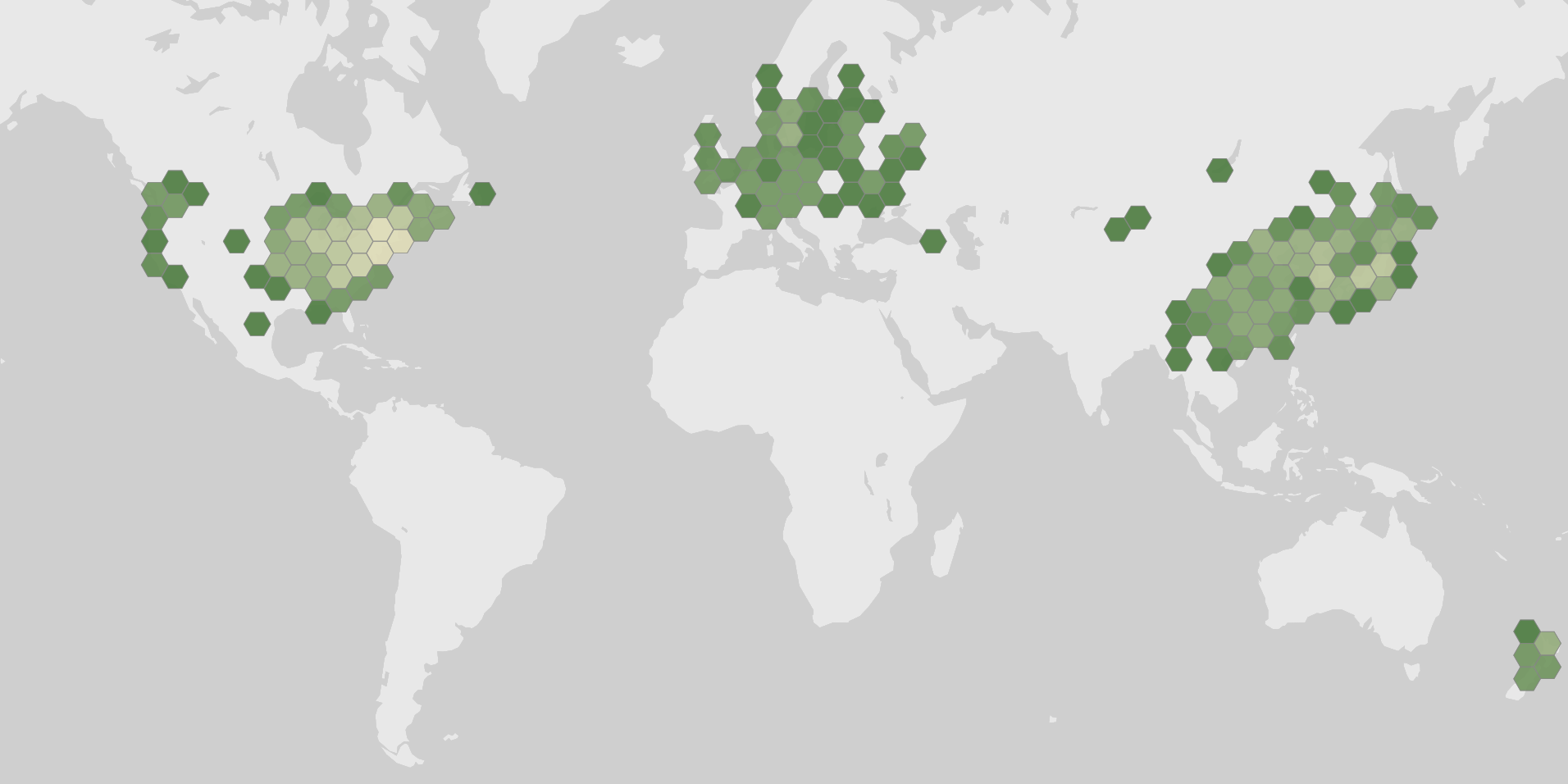
In the eastern United States, Oriental bittersweet ranges as far south as Louisiana, as far north as Maine and as far west as the Rocky Mountains. It is most abundant in mesic, mixed-hardwood forests and along forest edges.
The vine also grows in coniferous forests, woodlands, shrublands and old fields. It is common on disturbed sites such as roadsides, logged forests and urban areas, from which it may spread into wildlands. Coastal beaches, duneland and saltmarsh edges are also among its habitats.
Soils that suit it are mostly acidic, with a typical pH of 5.6 to 6.5, and they are often loam, sand or silt. It favors moist soils, although it does not tolerate saturated or very dry ground. In the United States it grows from sea level to about 1,400 m (4,600 feet).
Outside North America, it has become established in New Zealand, where it occurs from sea level to about 540 m (1,800 feet), and in parts of Europe.
Growth and Form
Oriental bittersweet is a perennial vine that grows rapidly. When it grows without interference, its vines can exceed 10 cm (3.9 inches) in diameter.
When it grows alone it forms dense thickets. Where it meets a tree, it climbs to heights of about 12 m (40 feet), and its mature height is about 9.1 m (30 feet).
Cut stems show annual rings, and the rings in old vines can exceed 20 years, which indicates how long a single plant can persist.
Ecology and Relationships
Oriental bittersweet depends heavily on arbuscular mycorrhizal fungi to absorb phosphorus. In one study, plants grew better in low-phosphorus soil with these fungi than in high-phosphorus soil without them. The partnership lets the vine put less energy into its roots and more into its stems and leaves.
Its growth form gives it an advantage over neighboring plants. A 2006 study found that, compared with the American bittersweet, Oriental bittersweet grew taller and produced more aboveground biomass and total leaf mass. Its extra height lets it capture light and shade the plants beneath it.
The vine can also weaken trees. Its weight can make trunks more vulnerable to ice damage, and it can break branches. Another study found that it can siphon nutrients from neighboring plants in a range of environments. Its insect partners include the moth Yponomeuta sociatus, which is a main parasite, and the invasive spotted lanternfly, which uses it as a host plant.
Cultivation and Care
Oriental bittersweet is grown as an ornamental vine. It has low shade tolerance, so it needs open light, and it has medium drought tolerance. It tolerates soil from about pH 5.0 to 7.5.
It is hardy to a minimum temperature of about -38.9 °C (-38 °F). Its growth is rapid, and it blooms in spring with white flowers.
Uses and Human Relationships
Oriental bittersweet is cultivated as an ornamental plant. In the United Kingdom, it has received the Royal Horticultural Society's Award of Garden Merit.
Its vines are durable and tough, which makes them a good source of material for weaving baskets. The fibrous inner bark can be made into strong cordage.
Some livestock browse the leaves without ill effect, even though the fruit is modestly toxic.
Photos
Photographs from via iNaturalist, licensed under CC0 1.0., by Sandy Wolkenberg via iNaturalist, licensed under CC BY 4.0., by Alex Day via iNaturalist, licensed under CC BY 4.0., by Alec McClay via iNaturalist, licensed under CC BY 4.0., and by ivansemenkov via iNaturalist, licensed under CC BY 4.0., credited on each photo.
Ecology and classification
Growth habit
- Vine
Classification
- Phylum
- Tracheophyta
- Class
- Magnoliopsida
- Order
- Celastrales
- Family
- Celastraceae
- Genus
- Celastrus
- Species
- Celastrus orbiculatus
Sources
- GBIF Species names and classification
- iNaturalist Photos
- Wikidata Common names and conservation status
- Wikipedia Summary extract
- Encyclopedia of Life Habitat, diet and behavior traits
- Plants of the World Online Native range, life form and climate (WCVP)
- USDA Plants US plants: growth habit and growing conditions
- GloBI What it eats, what eats it, parasites and pollinators
- Wardeh et al. 2015 (EID2)