Chamaerops humilis is one of only two palm species native to continental Europe, an unusual distinction in a family otherwise built for the tropics. Known as the European fan palm or Mediterranean dwarf palm, it grows as far north as 44°N near Genoa, Italy, making it one of the most cold-hardy palms in the world.
This clumping, shrub-like palm belongs to the family Arecaceae and grows across the Mediterranean Basin and North Africa. The IUCN lists it as Least Concern, a status that reflects its wide, if increasingly fragmented, distribution.
What makes this palm worth a closer look is its tightly bound relationship with a single weevil species that pollinates it and lives out its life cycle nowhere else, and its ability to resprout from underground rhizomes after wildfire sweeps through its scrubland home.
Identification and Appearance
The clearest field mark is the petiole: each leaf stalk is armed with rows of sharp, needle-like spines, a defense that likely evolved to keep browsing animals away from the stem's growing point.
Chamaerops humilis grows slowly into a multi-stemmed clump, its several stems rising from a single base to reach 2–5 m (10–20 ft) tall with trunk diameters of 20–25 cm (8–10 in).
As a fan palm, it carries palmate leaves up to 1.5 m (5 ft) long, each ending in a rounded fan of 10 to 20 leaflets, individually 50–80 cm (20–30 in) long.
The species is usually dioecious, with male and female flowers borne on separate plants in dense, short inflorescences at the stem tips. Unripe fruits are bright green, turning dull yellow to brown as they mature between September and November.
Distribution and Habitat
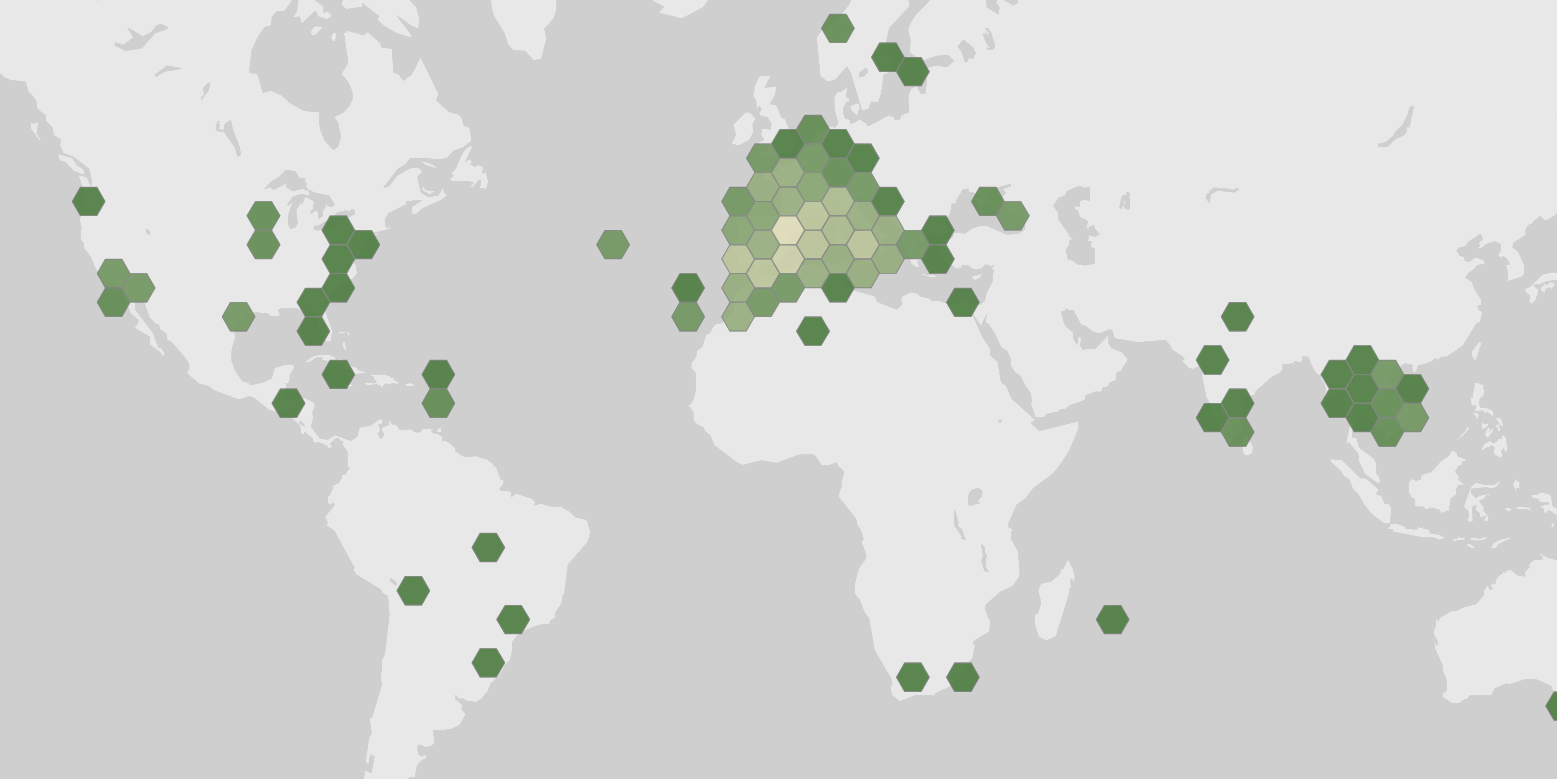
Chamaerops humilis occurs across southwestern Europe and North Africa, along the southern coasts of Spain and Portugal, in central and southern Italy, the southern Mediterranean coast of France, Monaco, and on Malta, Sicily, Sardinia, Corsica, and the Balearic Islands. In North Africa it grows in Morocco, Algeria, and Tunisia.
It is one of the northernmost naturally occurring palms anywhere, with its northernmost native stand at Genoa, Italy, at 44°N. Cultivated plants extend this range further still, growing successfully as far north as southern England, though not as a native population there.
Monthly observation counts show a clear seasonal pattern, peaking in spring, with around 2,500 to 3,000 records from January through May, before dropping by more than half through the summer and autumn months. This pattern likely reflects when the plant flowers and when observers are active, not a shift in where the species actually grows; GBIF occurrence data record presence, not abundance or the full extent of its range.
Ecology and Relationships
Chamaerops humilis is adapted to the frequent burning common in Mediterranean scrubland, surviving fire by resprouting from its underground rhizomes and from fire-damaged stems. This resilience gives the palm outsized ecological importance, helping to prevent erosion and desertification while providing shelter and food to many animals.
Its flowers, produced from April to May, are pollinated partly by wind but depend heavily on a single weevil species, Derelomus chamaeropsis, in a relationship known as nursery pollination mutualism. Weevils settle on one plant, male or female, for the whole flowering period, sheltering, feeding, and laying eggs in the inflorescences; unusually, the plant releases its attractant scent from its leaves rather than its flowers. Weevil larvae complete their development only in the dry inflorescences of male plants; those laid in female flowers die once seed development begins, protecting the palm's seed crop from destruction.
Ripe fruit pulp smells strongly of rancid butter, a cue that draws nocturnal, largely carnivorous foragers such as foxes and badgers. The pulp also blocks premature germination and shields seeds from invertebrate predators like weevils, so losing the pulp to a mammal both helps the seed germinate and exposes it to greater risk from insect pests. Because Mediterranean palm populations are often small and isolated, the mobility of these mammal seed dispersers matters for the species' long-term persistence.
Uses and Human Relationships
Gardeners and landscapers value Chamaerops humilis for its drought tolerance and cold hardiness down to -12°C (10°F), even though it grows slowly and prefers hot summers. It is cultivated across the Mediterranean and the southern United Kingdom, along the west and east coasts of the United States from southern California to the Pacific Northwest and from Georgia to Maryland, in the drier American Southwest, and in New Zealand and parts of Australia. The species holds the Royal Horticultural Society's Award of Garden Merit.
Traditionally, the leaves of adult plants have been woven into brooms, mats, and carrier baskets. For finer work, young unopened leaves were treated with sulphur to soften them into a supple fiber.
The husk, called 'higa' in southern Spain, is edible while young, before it toughens with age. The mature fruit itself is not eaten, being bitter and high in tannins, though traditional medicine has used it as an astringent. Beyond these material uses, the palm carries emotional value as a defining, charismatic plant of the Mediterranean coastline's garrigue and macchia scrublands.
Conservation and Threats
Chamaerops humilis is classified as Least Concern by the IUCN, indicating that the species as a whole is not currently at risk of extinction across its range.
The greatest pressure on wild populations comes from urbanization and other human development, which is rapidly consuming the natural habitat the palm depends on. In the northern parts of its range, the introduced South American moth Paysandisia archon poses a serious threat to the species.
A related problem stems from the ornamental palm trade: introducing related ornamental palm species has also brought in seed predators such as Coccotrypes dactyliperda and Dactylotrypes longicollis, which attack both the newly introduced palms and native Chamaerops humilis.
In response, regulations protecting the palm's stands and other Mediterranean endemic plants have been increasing.
Conservation status
- LC
- NT
- VU
- EN
- CR
Least Concern
Fun Facts
- The genus name comes from the Greek words chamai (dwarf) and rhops (bush), describing its low, shrubby habit.
- Its only known pollinator, the weevil Derelomus chamaeropsis, spends its entire larval life inside the dry inflorescences of male plants.
- Ripe fruit smells like rancid butter, an odor that lures nocturnal mammals such as foxes and badgers into dispersing its seeds.
- A blue-leaved form native to Morocco's Atlas Mountains may be more than 12°C (22°F) hardier than the ordinary green-leaved plant.
- The species has earned the Royal Horticultural Society's Award of Garden Merit.
- Young, unopened leaves were once softened with sulphur and woven into fine mats and baskets.
Ecology
Habitat
- Coastal
- Shrubland
- Mountain
Growth habit
- Shrub