Each flower of Commelina erecta opens for only a single day before withering, a trait that earned the plant its evocative common name, widow's tears, alongside the more descriptive dayflower.
This perennial herb belongs to the dayflower family, Commelinaceae, and is recognized worldwide by its two showy blue petals paired with a smaller white one. It is native across an unusually broad range spanning the Americas, Africa, and western Asia, and the IUCN lists it as Least Concern.
Beyond its fleeting blooms, C. erecta is worth a closer look for its unusual floral biology: the species produces three distinct flower forms, an arrangement botanists call polymorphism, which shapes how it reproduces and who visits it.
Identification and Appearance
The clearest field mark is the flower itself: two large blue petals sit at the top of the bloom with a much smaller white third petal tucked between and below them, the whole flower spanning three-quarters of an inch to one and a quarter inches across. Because the flower has three petals, it is readily recognized as a monocot in the field.
Inside the flower, between the petals, are the staminoide, a central stamen, lateral stamens, and the style. Commelina erecta shows enantiostyly, meaning individual flowers come in two mirror-image forms with the style curving either left or right. A third floral form exists as well: a male flower that lacks a style entirely, giving the species three distinct flower morphs in total.
The leaves are lance-linear, long and thin with a pointed tip and rounded base, sometimes edged in red, and marked with parallel longitudinal veins. They sheath the stem at their base, where small hairs are found. Below each flower sits a folded, leaf-like spathe, sealed along its length except for an opening at the top through which the bloom emerges; the spathe's surface is covered in short hairs.
The stems typically grow laterally across the ground, reaching up to three feet long, though the plant can climb upright if it finds structural support from neighboring vegetation. Stems are usually rough-textured but occasionally smooth, and they branch freely. After flowering, the plant sets a three-carpellate fruit, green and smooth to slightly granular, capable of producing up to three seeds.
Distribution and Habitat
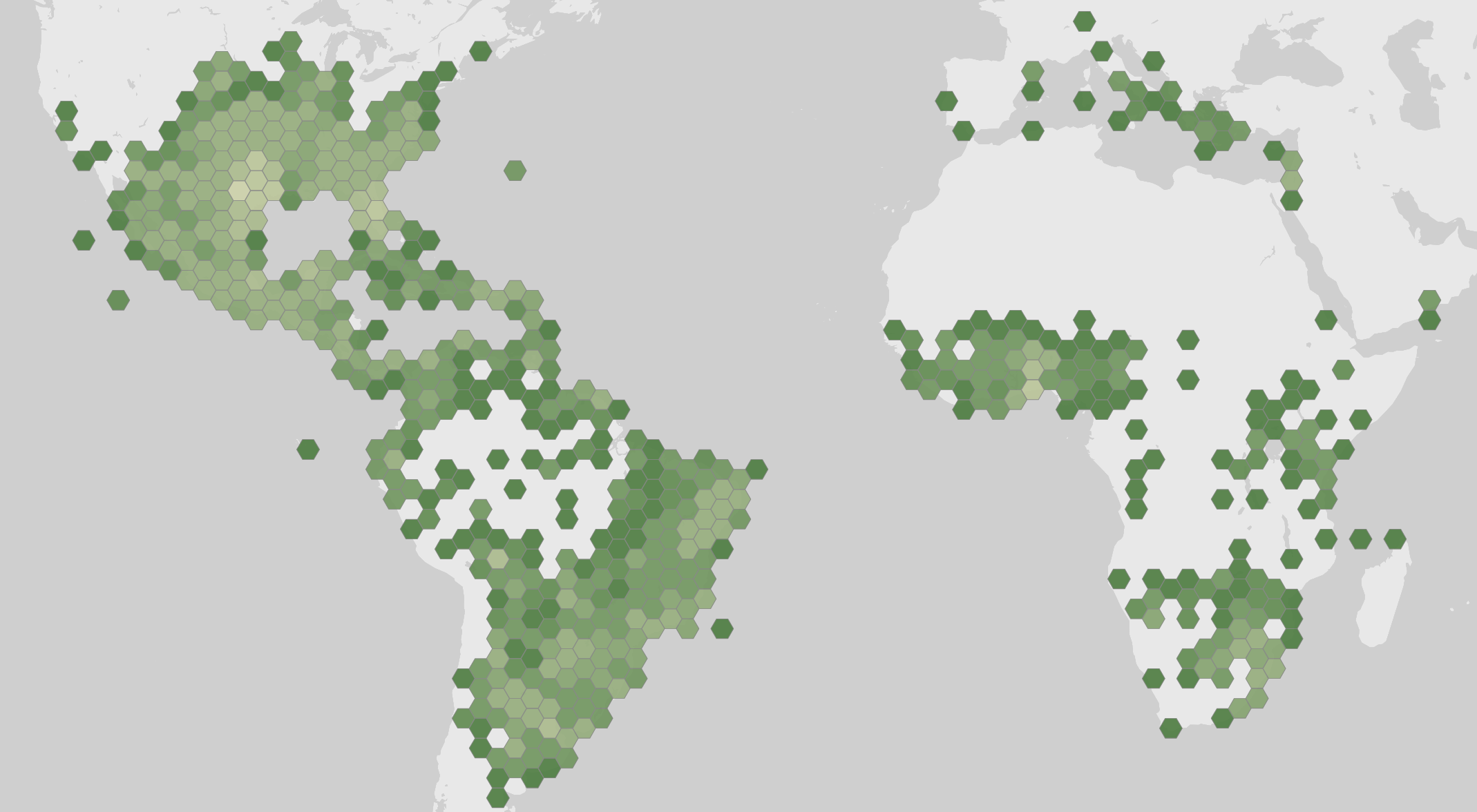
Commelina erecta has one of the broadest native ranges of any dayflower, spanning the Americas, Africa, and western Asia. In the Americas it occurs throughout the United States, the West Indies, every country of Central America, and south through the tropics into Argentina; within the United States it ranges from South Dakota and Pennsylvania down to Florida and Texas. In the West Indies it is documented on Puerto Rico and several Virgin Islands, including Saint Croix, Saint Thomas, Saint John, Tortola, and Water Island. In West Africa it spans Senegal, Guinea, Guinea-Bissau, Sierra Leone, Liberia, the Ivory Coast, Ghana, Burkina Faso, Benin, Nigeria, and Bioko.
The species tolerates a wide range of both natural and disturbed settings: rocky woods and hillsides, scrub oak and pine woods, sand dunes, shale barrens, prairies, and streambanks, alongside roadsides, railroad rights-of-way, fields, and cultivated ground where it sometimes turns up as a weed. It flowers from spring through fall across much of its range.
Monthly presence observations rise sharply from spring, peak in June and July, and taper off through the fall and winter months. This pattern likely reflects the species' spring-to-fall flowering period, when plants are most conspicuous and most often recorded, rather than a true measure of population size.
Ecology and Relationships
Commelina erecta draws a varied group of pollinators, including syrphid flies, two-spotted long-horned bees, Lasioglossum nymphale, pure green augochlora bees, and green metallic sweat bees, which visit and pollinate its short-lived flowers.
The plant also serves as a food source for wildlife: in North America it is eaten by the northern bobwhite quail, the lesser prairie-chicken, white-tailed deer, and cattle. It is host to at least one specialized parasite, the leaf-mining fly Liriomyza commelinae.
Its ability to thrive in both undisturbed habitats like prairies and rocky woods and in disturbed ground such as roadsides and fields lets it fill an ecological niche across a wide range of conditions, connecting pollinators, grazing wildlife, and leaf-mining insects within a single, widespread plant.
Uses and Human Relationships
People across much of its range treat Commelina erecta as a wild edible, and it also has a long history as a traditional medicine in several cultures. In Brazil it is commonly consumed and used medicinally, and analysis of its bioactive compounds indicates antioxidant, antibacterial, antifungal, and anti-inflammatory properties.
In Uruguay, the plant is commonly made into a juice used to treat eye infections. The Seminole have used it to soothe irritation. These uses vary regionally, however: in the Lucayan Archipelago, where the species is not native and occurs only outside natural areas, it is not known to be used medicinally at all.
Because it is widely considered a weed and can become invasive, any cultivation of the species calls for care in siting and containment.
Fun Facts
- A single flower of Commelina erecta lasts only one day, but successive buds open three to four days apart, keeping the plant in bloom for an extended stretch.
- The species produces three distinct flower forms: two mirror-image types where the style curves left or right, and a third, male-only form that has no style at all.
- Stems normally sprawl along the ground for up to three feet, but the plant can grow upright if it finds another plant to lean on for support.
- Each flower is tucked beneath a folded, hair-covered leaf-like structure called a spathe, sealed shut except for a small opening at the top.
- After flowering, the plant forms a three-carpellate fruit capable of producing up to three seeds, one from each ovule.
Conservation status
- LC
- NT
- VU
- EN
- CR
Least Concern
Ecology
Habitat
- Woodland
- Shrubland
- Grassland
- Disturbed Ground
Growth habit
- Herb