Common Buzzards that breed in the coldest parts of the Palearctic or in the eastern half of the range abandon their territories every autumn, and some travel as far as South Africa before returning north to breed again.
The Common Buzzard (Buteo buteo) belongs to the family Accipitridae within the order Accipitriformes, the group that also holds hawks, eagles and kites. It occupies most of Europe and extends east across the Palearctic to northwestern China, far western Siberia and northwestern Mongolia, making it one of the most widely distributed birds of prey on the continent. The IUCN lists the species as Least Concern, a reflection of its enormous range and population.
Few raptors show such contrast in appearance and movement within one species, from largely resident populations in Britain to long-distance migrants that cross continents, a variability that makes the buzzard a rewarding bird to watch throughout the year.
Identification and Appearance
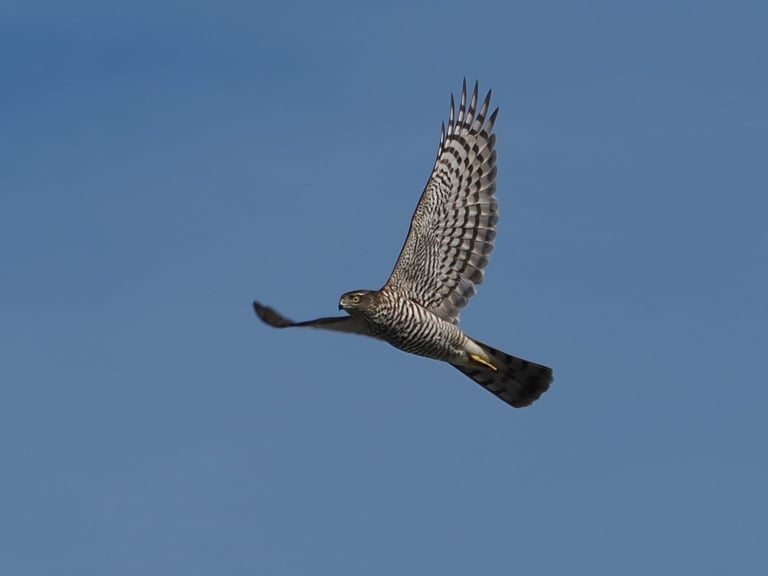
The single most reliable field mark on a Common Buzzard is the broad, dark band near the tip of the tail, set against narrower grey-brown and dark bars, visible both on perched birds and from above in flight.
Adults measure 40 to 58 cm in length with a wingspan of 109 to 140 cm. Females average 2 to 7 percent larger than males in linear measurements and about 15 percent heavier. In Great Britain, males weigh between 427 and 1,183 grams and females between 486 and 1,370 grams, though body mass varies considerably by region.
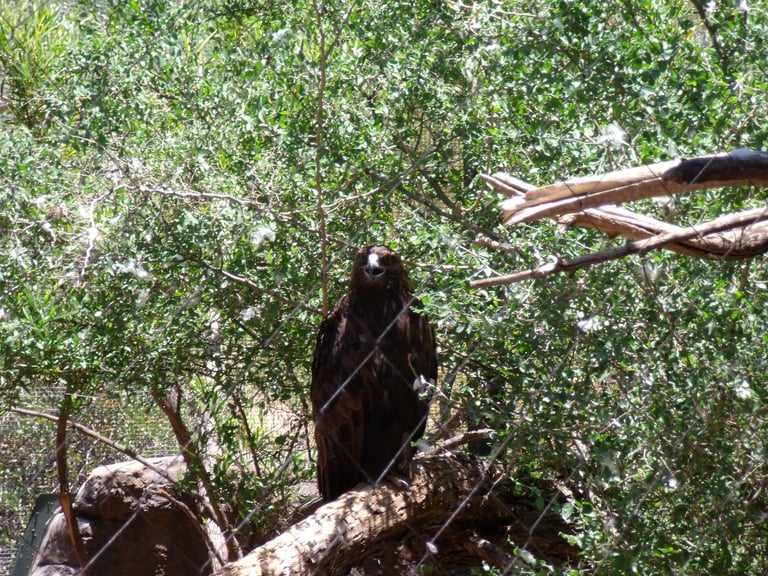
Most European buzzards are dark brown above with a round head, a fairly slender bill, long wings that reach or nearly reach the tail tip when perched, and a short tail. The underside is typically brown-streaked white on the throat with a darker chest, often broken by a pale U across the breast and a pale line down the belly. In flight, birds show a dark trailing edge to the wings and, on paler individuals, dark carpal patches that look like blackish commas. Plumage is extremely variable, ranging from near-uniform blackish-brown to almost pure white, a diversity that may stem from reduced genetic variation at a single gene locus.
Juveniles resemble adults but have a paler eye, a narrower dark band on the tail, and streaked rather than barred underparts. They also lack the sharp blackish trailing wing edge seen on adults, showing a softer brownish tone instead.
Distribution and Habitat
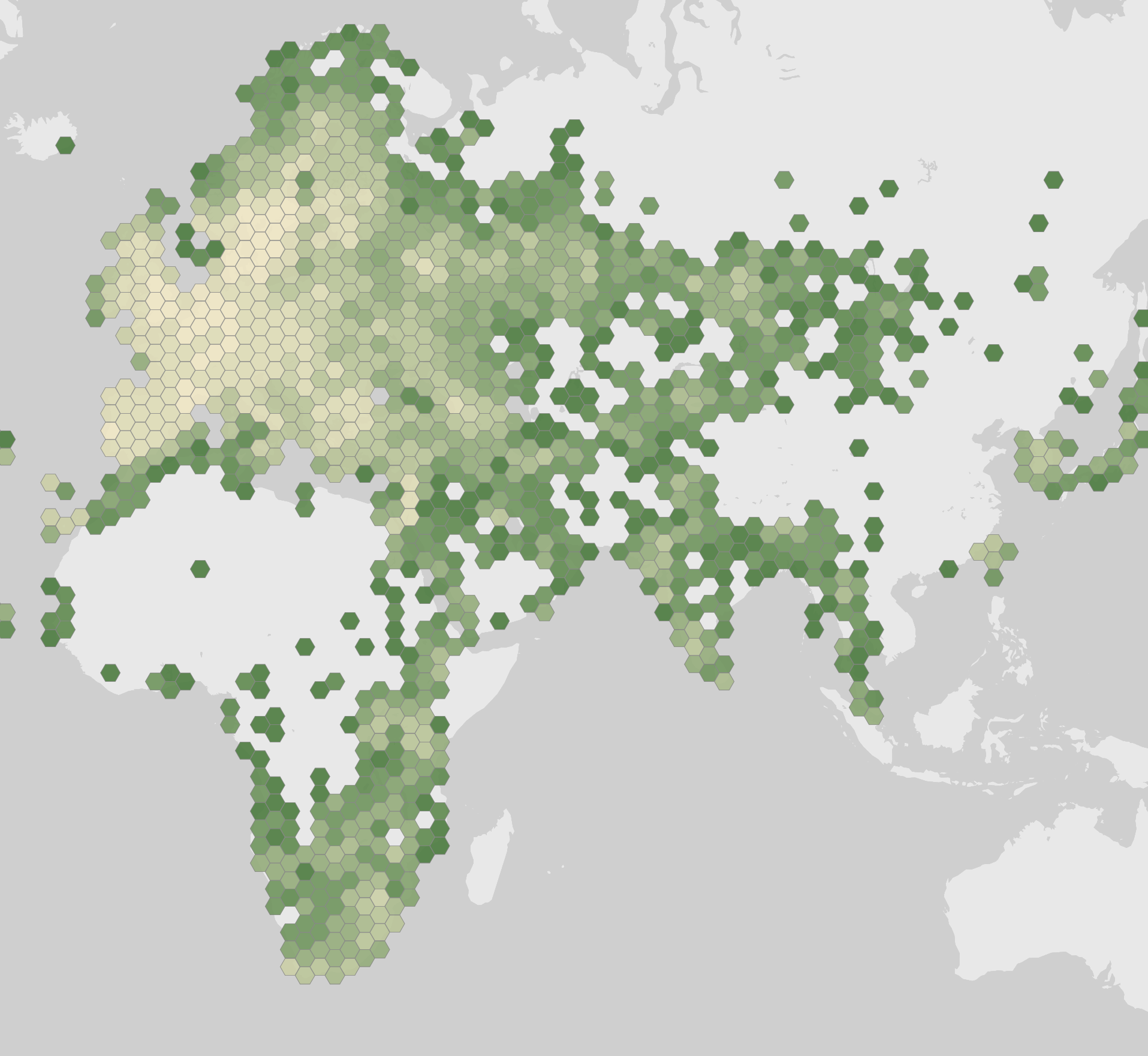
The Common Buzzard occupies nearly all of Europe without major gaps, from Portugal and Spain to Greece, Estonia, Belarus and Ukraine, along with the Canary Islands, the Azores and the larger Mediterranean islands such as Corsica, Sardinia, Sicily and Crete. It reaches Ireland, Scotland, Wales and England, and its breeding range extends east across northern Turkey, much of western Russia, northern Kazakhstan, Kyrgyzstan, far northwestern China and northwestern Mongolia. Non-breeding birds winter as far afield as southwestern India, the Middle East, northern Africa, West Africa's coastal fringes, and much of eastern and southern Africa.
The species favors the interface between woodland and open ground, most typically forest edges, small woods or shelterbelts bordered by grassland, arable land or other farmland. It also uses open moorland where scattered trees provide perches for hunting and nesting, and occurs in both flat and mountainous country. It is largely absent from treeless tundra and the Subarctic, where the rough-legged buzzard takes over, and is only sporadic in open steppe.
Monthly observation counts peak in January and again in March and April, before dropping to their lowest point in July. These figures are presence records rather than a measure of abundance, so the pattern most likely reflects seasonal visibility and observer activity rather than a true population swing, though it is consistent with the species' partial migration.
Behavior and Lifestyle
Common Buzzards spend more than half of a typical day simply perched, on tree tops, bare branches, telegraph poles, fence posts or ledges, and have been described as sluggish and not especially bold. When active, they are strong soarers capable of staying aloft for long periods, though their level flight can look heavy and labored, especially in the nominate subspecies compared with the more migratory steppe buzzard.
Most populations are partial migrants, and the extent of movement depends on food supply, competition, disturbance and weather. Juveniles disperse only short distances: in England, 96 percent of first-year birds settled less than 100 km from their birthplace. Wintering densities vary widely by region, from 2.12 individuals per square kilometer in southwestern Poland to 0.34 per square kilometer in Bulgaria and 0.334 to 0.539 per square kilometer in northeastern Romania, with birds generally favoring agricultural land over dense forest in winter.
Scandinavian buzzards are more strongly migratory than most central European populations, and as many as 41,000 individuals have been counted in a single season at the Falsterbo migration site in southern Sweden. Within Sweden, white-plumaged birds are more common in the south and migrate earlier than darker individuals from farther north, and more juveniles than adults undertake the journey.
The steppe buzzard population is entirely migratory, traveling in loosely gregarious flocks and never using the same grounds for breeding and wintering.
Hunting and Diet
The Common Buzzard hunts mainly by dropping onto prey from a perch, gliding down gently before accelerating near the ground with its wings held above its back, rather than performing a dramatic stoop. It also hunts in low flight, forages on foot, and outside the breeding season groups of 15 to 30 birds, often juveniles, may forage together on the ground in a single large field. Hovering is the least common hunting method and, according to a British study, does not improve success; hunting in open ground works better than hunting over dense shrub cover.
As a generalist predator, the buzzard takes well over 300 recorded prey species, including mammals, birds of any age from eggs to adults, reptiles, amphibians, rare fish, and invertebrates such as beetles, caterpillars and ants. Prey size spans from tiny insects to grouse and rabbits weighing nearly twice the buzzard's own body mass, and in Belarus the mean vertebrate prey item weighed 179.6 g. Carrion, usually from dead mammals or fish, supplements the diet at times.
Small rodents, especially voles, dominate the diet across most of Europe. The 28.5 g common vole and the 40 g field vole are the most frequently cited prey: field voles made up 32.1 percent of pellets in southern Scotland and, in peak years, 40.8 percent of prey items in southern Norway, with rodents overall reaching 67.6 percent of the diet in such years. Common voles accounted for 19.6 percent of prey in a large Dutch study and 26.5 percent in central Slovakia, with figures ranging up to 41.8 percent in Russia's Privolshky Steppe Nature Reserve.
When vole numbers crash, rodents contribute far less to the diet, and buzzards shift toward the wider range of birds, reptiles, amphibians and invertebrates available locally, showing how closely their feeding tracks the boom-and-bust cycles of their main prey.
Nesting and Breeding
Courtship centers on territorial flight displays that generally begin in February, though resident pairs, especially males, may perform them year-round. Pairs engage in high circling, spiraling upward on slightly raised wings, sometimes joined by two or three neighboring pairs at once, with as many as 14 adults recorded together over an established display site. Males also perform rollercoaster-style sky-dances, climbing up to 30 meters before diving as much as 60 meters on nearly closed wings, occasionally adding loops or rolls at the top, almost always accompanied by calling.
Home ranges typically span 0.5 to 2 square kilometers, with size closely tied to local food supply; a German study found an average of 1.26 square kilometers. Nesting densities vary enormously across the range, from just 0.6 pairs per 100 square kilometers in Russia's Kerzhenets Nature Reserve to 96 to 129 pairs per 100 square kilometers in central Slovakia, and as many as 32 to 51 pairs within a single 22-square-kilometer wooded area in the Czech Republic, likely driven there by fragmented forest management that concentrates vole prey.
Nest sites can remain in use for decades: in Estonia's Neeruti landscape reserve, researchers found nine occupied nests in 1989 and 1990, including one first recorded in 1982 that is thought to be the oldest known buzzard nest still in use today.
Individual Common Buzzards can live up to 28.8 years, a long lifespan for a medium-sized raptor and one that allows established pairs to reuse the same territory and nest sites across many breeding seasons.
Conservation and Threats
The Common Buzzard is classified as Least Concern by the IUCN, consistent with its status as likely the most numerous diurnal bird of prey in Europe. Conservative estimates put the European population at no fewer than 700,000 pairs, more than double the next most common raptors, the Eurasian sparrowhawk, common kestrel and northern goshawk combined figures suggest, while the IUCN estimates the global population, excluding the Himalayan and eastern buzzard, at 2.1 to 3.7 million birds.
Despite this abundance, buzzards face ongoing threats. At least 238 individuals were recovered as victims of persecution in England between 1975 and 1989, mostly through poisoning, and this pressure showed no significant decline over that period. Power-line collisions are also a major hazard: in Spain, the buzzard was found to be the raptor species most vulnerable to electrocution, and together with the common raven it accounted for nearly a third of all recorded cases.
Where data exist, trends are often positive. Britain's population grew to between 44,000 and 61,000 pairs by 2001 after past persecution and habitat loss, making it the country's most abundant diurnal raptor, and the population in Westphalia, Germany, nearly tripled in recent decades, possibly aided by a warming climate that makes voles more vulnerable. Ireland's buzzards, extinct as a breeder after 1910, recolonized the country in the 1950s and grew to 26 pairs by the 1990s, helped in places by supplemental feeding as rabbit numbers declined. Because it sits on a short, largely land-based food chain, the species is also considered a useful bioindicator, absorbing pesticide and metal contamination without the population-level harm seen in raptors that feed more on aquatic prey or other birds.
Conservation status
- LC
- NT
- VU
- EN
- CR
Least Concern
Fun Facts
- According to an old European folktale, when the world was created every bird dug its own well to bathe in—except the buzzard, which refused.
- The genus name Buteo comes directly from the Latin word for buzzard, būteō.
- White-plumaged buzzards are far more common in southern Sweden than farther north, and they migrate south earlier than their darker-plumaged neighbors.
- A Common Buzzard can live for up to 28.8 years in the wild, an unusually long lifespan for a medium-sized raptor.
- The species' huge range of plumage colors, from near-black to almost pure white, may stem from reduced genetic diversity at a single gene locus.
- Buzzards perform rollercoaster-style sky-dance displays, climbing up to 30 meters before diving as much as 60 meters, sometimes adding loops or rolls at the top.
Ecology
Diet
- Carnivore
Behavior
- Predator
- Territorial
- Diurnal
- Migratory
Habitat
- Forest
- Woodland
- Mountain
- Grassland