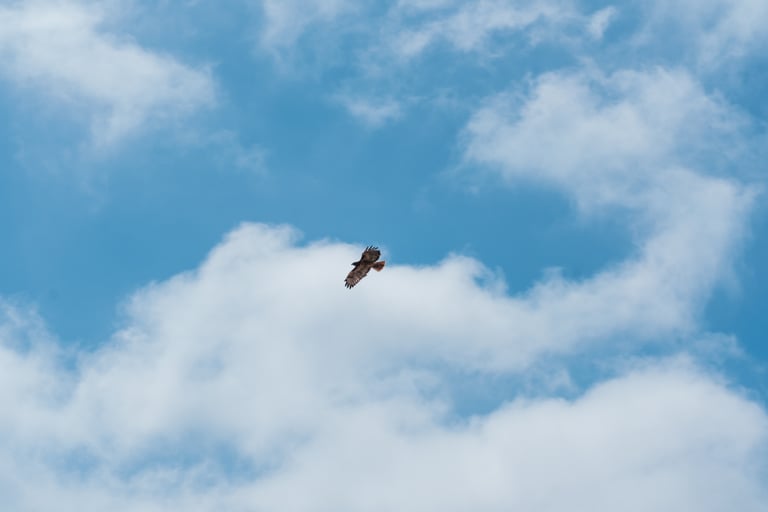
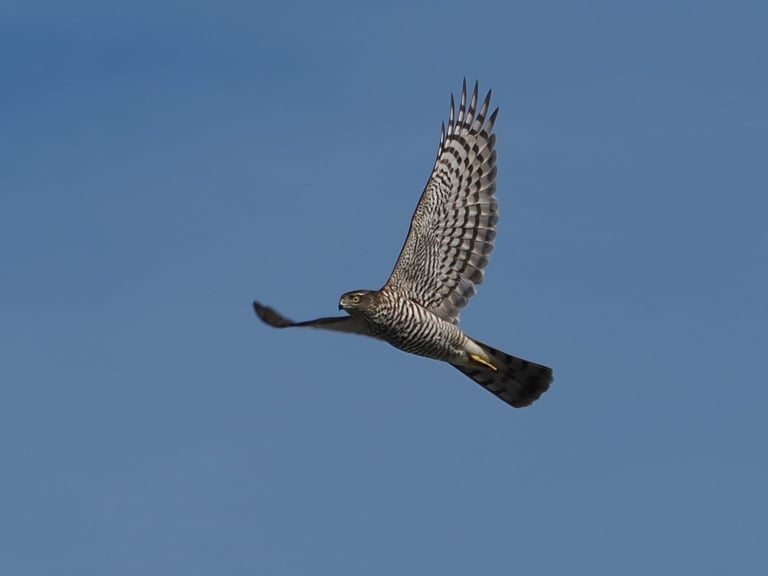
Golden eagles can stoop at speeds up to 200 mph (322 km/h) when diving on prey, making them among the fastest animals alive, even though their average cruising speed is a modest 28 to 32 mph.
This large bird of prey belongs to the family Accipitridae and ranges across open and mountainous country throughout the Northern Hemisphere, from the Arctic edge of Siberia to the deserts of North Africa and the western United States. It is the most widely distributed eagle species on Earth and is currently assessed as Least Concern by the IUCN.
Few raptors combine size, speed and hunting cooperation as effectively as the golden eagle, which pairs its powerful talons with tactics such as hunting in pairs to bring down prey far larger than itself.
Identification and Appearance
The clearest field mark is the golden-brown plumage on the back of the crown and nape, which contrasts with the otherwise dark brown body and gives the species its name. This coloring is present in adults of both sexes and is visible even at a distance in good light.
Golden eagles are very large raptors, measuring 66 to 102 centimeters in length with a wingspan of 1.8 to 2.34 meters, the fifth-largest wingspan among living eagle species. Females outsize males considerably; in the largest subspecies, females can weigh over a third more than males and have noticeably longer wings, while the size gap is smaller in the smallest subspecies. The wings are broad and held flat and horizontal in flight rather than angled upward, a posture that helps distinguish soaring golden eagles from many other large raptors.
Adults show gray mottling on the inner wing and tail, pale tarsal feathering that can range from light gold to white, and in some North American birds, pale "epaulette" patches on the shoulders. The bill is dark at the tip fading to a lighter horn color, with a yellow cere, and the bare feet are also yellow.
Juveniles are darker overall and can look almost black on the back, with a tail that is white for roughly two-thirds of its length ending in a broad black band; some also show white crescents on the wings formed by pale patches at the base of the flight feathers. This white patterning fades progressively as the bird matures past its first year, and by full adulthood, most of the white has been replaced by uniform dark brown plumage accented by the golden nape.
Distribution and Habitat
Golden eagles occupy an enormous range across the Northern Hemisphere, from Arctic tundra edges in Siberia and Alaska through the mountain chains of Europe and Central Asia to semidesert canyons and prairies in North America. They are recorded from sea level up to 3,600 meters elevation, and the highest confirmed sighting placed one circling above 6,190 meters in the Himalaya.
The species favors open and semi-open country over dense forest, since it hunts most efficiently where wind and thermal updrafts aid soaring flight and where prey is visible and reachable. Typical habitats include alpine meadows, tundra, shortgrass prairie, sagebrush steppe, oak and pinyon-juniper woodland, and rugged mountain terrain, with nests placed on secluded cliff ledges or in large trees overlooking grassland. In mountainous regions such as the Alps, Carpathians, Caucasus and Himalaya, pairs nest near the tree line and hunt the alpine pastures above, while in lowland Scandinavia and Russia they occur more sparsely along the edges of taiga forest.
The species generally avoids heavily developed agricultural and urban land, though in remote areas such as the southern Yukon it will visit roadkill and garbage dumps opportunistically. Some populations, particularly in Alaska and Canada, migrate south in autumn as prey becomes scarce, while pairs breeding in the continental United States, southern Canada and much of temperate Eurasia tend to remain on the same territory year-round.
Monthly observation counts peak in March, at over 91,000 records, and again in January near 89,000, before dropping to their lowest point in July and August, around 45,000 to 47,000. This pattern likely reflects seasonal changes in observer activity and visibility as much as any true shift in eagle numbers, and it should not be read as a measure of population size or a complete picture of the species' range.

Behavior and Lifestyle
Golden eagles are largely solitary or found in pairs, defending home ranges of 20 to 33 square kilometers during the breeding season with undulating flight displays rather than physical confrontation. Non-mated juveniles sometimes gather in loose groups, and wintering adults may cluster where food is unusually abundant or weather is severe.
Activity is strictly diurnal, with the birds flying on slow, powerful wingbeats alternated with long glides and soaring passes over open terrain. Their flight style, wings held flat rather than angled, distinguishes them in the air from many other large raptors and reflects an anatomy built for sustained, energy-efficient searching over wide territories.
Movement patterns vary by population: eagles breeding in Alaska and much of Canada migrate south each autumn as northern prey supplies decline, while most pairs in the continental United States, southern Canada and other temperate regions stay on the same territory throughout the year. Pairs that remain resident may begin refurbishing nests and courting as early as December, well ahead of the main breeding season.
A striking cooperative behavior is joint hunting: one eagle in a pair chases prey to the point of exhaustion while its partner swoops in to make the kill, a tactic that allows the pair to take prey too fast or too large for a lone bird to catch alone.
Communication
Golden eagles are unusually quiet birds, staying largely silent outside the breeding season and relying instead on visual signals to defend their territory. Rather than calling to mark boundaries, a pair patrols the edges of its home range with a distinctive undulating flight display that signals ownership to rivals.
When vocalizations do occur, they cluster around the nesting period and researchers in western Montana identified nine distinct calls, including a chirp, a seeir, a pssa, a skonk, a cluck, a wonk, a honk and a hiss. Most of these sounds accompany food delivery to nestlings or begging by the chicks themselves, rather than serving as territorial warnings.
Descriptions of the eagle's voice call it weak, high and shrill, even "puppy-like," a striking mismatch with the bird's size and hunting power. Calls mainly function as contact signals between adults and their offspring, and only occasionally pass between territorial birds confronting intruders or between members of a breeding pair.
Hunting and Diet
Golden eagles hunt using a combination of agility, speed and powerful feet armed with large, sharp talons, and pairs often work together to bring down prey. One bird chases the quarry to exhaustion while its partner swoops down to finish the kill, a tactic that lets the pair tackle animals too large or fast for a single eagle to handle alone.
The bulk of the diet is made up of small to medium mammals: rabbits, hares, ground squirrels, prairie dogs and marmots are the staple prey across most of the range. Birds, reptiles and fish are taken in smaller numbers when available.
Occasionally golden eagles capture far larger animals, including seals, ungulates, coyotes and badgers, as well as large flying birds such as geese and cranes. These outsized kills likely depend on cooperative hunting and favorable terrain that lets the eagles use speed and surprise to their advantage.
Unlike many raptors, golden eagles rarely cache prey for later consumption, generally consuming or delivering food to the nest soon after a kill.
Nesting and Breeding
Courtship begins with elaborate aerial displays in which one or both birds fly in undulating patterns, chase each other, dive and perform mock attacks; the male may pick up a stick or stone and drop it, only to stoop and catch it in midair, repeating the maneuver several times, while the female performs a similar display with a clump of earth. Pairs are monogamous and often remain bonded for years, with resident pairs sometimes beginning nest refurbishment as early as December, well before egg-laying.
Nests, called eyries, are usually built on cliff ledges but may also be placed in large trees, on riverbanks or on man-made structures such as electrical towers and windmills. A pair typically maintains several nest sites within its territory and reuses favored ones year after year, adding sticks and vegetation each season; the largest nest on record measured 6.1 meters tall and 2.59 meters wide. Building or refurbishing a nest takes both parents four to six weeks.//nn The female lays 1 to 4 eggs, usually 2, spaced three to four days apart, and begins incubating as soon as the first egg appears; incubation lasts 35 to 45 days, averaging 42. Because the eggs hatch several days apart, the older chick is often much larger than its younger sibling and will sometimes kill it, a pattern of chick competition documented in this species. Chicks are covered in whitish down until about 25 days of age, when dark contour feathers begin to appear, and are brooded by the female with decreasing frequency for roughly the first 45 days.
Both parents feed the nestlings, though the male provides the large majority of food, delivering around 80 percent of food items and 90 percent of food biomass in the weeks after hatching. Young eagles fledge between 45 and 81 days of age, taking their first flight with stiff, abrupt wingbeats, and remain dependent on their parents for another 32 to 80 days before becoming fully independent. They do not begin breeding themselves until reaching adult plumage at 4 to 7 years old.
Population and Ecological Role
Global numbers are estimated at 170,000 to 250,000 individuals, including 60,000 to 100,000 breeding pairs, spread across a range of roughly 140 million square kilometers, the largest of any member of the eagle family. Despite this vast distribution, the species has been extirpated from some parts of its former range and has declined sharply in others even where it remains widespread overall.
As an apex predator over much of its range, the golden eagle exerts a measurable check on populations of the small mammals it hunts, particularly rabbits, hares and ground squirrels. It also competes for prey and territory with other predators, including bald eagles, coyotes, California condors and white-tailed eagles, and likely competes for nesting and hunting territory with common ravens, gyrfalcons, peregrine falcons and rough-legged hawks.
Conservation and Threats
The golden eagle is assessed as Least Concern by the IUCN, reflecting its enormous global range and total population, though this global picture masks serious regional declines and even local extirpations. In parts of the United States the picture is more troubled: Washington and Montana list it as a species of special concern, while Maine, New Hampshire and New York classify it as endangered.
Historically, the greatest threat was direct persecution: an estimated 20,000 golden eagles were shot, mostly from aircraft, before the Bald Eagle Protection Act extended coverage to golden eagles in 1962, largely on the mistaken belief that the birds preyed heavily on young livestock. Subsequent studies found livestock made up little of the diet, with nearly 70 percent consisting of rabbits. Today the leading threats are electrocution on power lines, poisoning, and capture in steel traps set for coyotes and other animals, compounded by disturbance near nests and the loss of prey through habitat alteration; eagles are known to abandon nests if disturbed during incubation.
The species is now protected under the Bald Eagle Protection Act, the Migratory Bird Act, and CITES Appendix II. A recent conservation initiative in England has identified eight sites with potential to support reintroduced golden eagles, backed by roughly £1 million in funding, aiming to restore a breeding presence the country lost 150 years ago.
Conservation status
- LC
- NT
- VU
- EN
- CR
Least Concern
Cultural Significance
In ancient Greek religion, the golden eagle was closely tied to Zeus, serving as his sacred bird and messenger; myths describe it carrying the youth Ganymede to Olympus and acting as a divine agent that sought out the most beautiful mortals. The species' scientific name, chrysaetos, comes from Greek roots emphasizing its status as a symbol of power, nobility and majesty, and its golden coloring led to a long-standing association with the sun; in Roman mythology it appears as the companion of Jove, echoing its role beside Zeus in Greek tradition.
The eagle's association with keen, far-reaching sight also gave rise to the expression "eagle-eyed," describing someone who observes from a distance with unusual clarity. Beyond European mythology, golden eagles hold deep religious and cultural significance for Native American communities; in the United States, the National Eagle Repository serves as a clearinghouse that provides eagle feathers and parts for Native American religious and cultural use.
The species also has a practical relationship with people beyond symbolism: because a large share of its diet consists of rabbits, which compete with livestock for grazing, some observers consider golden eagles beneficial to livestock production by helping control pest populations.
Fun Facts
- A golden eagle can carry up to 8 pounds of prey during flight, even while reaching cruising speeds of 28 to 32 mph.
- In a hunting dive, the species can reach speeds of up to 200 mph, among the fastest recorded for any animal.
- Golden eagles almost never vocalize to defend territory, relying instead on undulating flight displays to warn off rivals.
- The largest known golden eagle nest measured 6.1 meters tall and 2.59 meters wide, built up over years of reuse.
- When chicks hatch several days apart, the older, larger nestling sometimes kills its smaller sibling in the nest.
- Before legal protection began in 1962, an estimated 20,000 golden eagles were shot in the United States, largely on the mistaken belief they preyed heavily on livestock.
- A conservation project in England has identified eight potential sites to reintroduce golden eagles, aiming to restore a breeding presence lost some 150 years ago.
Ecology
Diet
- Carnivore
Behavior
- Predator
- Solitary
- Territorial
- Migratory
Habitat
- Woodland
- Mountain
- Grassland
- Tundra
Photos
SourcesGBIFiNaturalistWikidataWikipediaEncyclopedia of LifeAnimal Diversity WebAnAge