What sets Dicranum scoparium apart from most other mosses is immediately visible: its narrow leaves all sweep to one side, giving each shoot the look of a tiny, wind-combed broom.
Known commonly as the broom forkmoss, this is a member of the Dicranaceae family within the class Bryopsida. It grows across most of the Northern Hemisphere and into Oceania, forming rounded clumps and mats on soil in forests that range from dry to moist. It rarely grows in isolation, instead mingling with other broom mosses and bryophytes to build the tangled, springy carpets typical of forest floors. Its wide range and distinctive silhouette make it one of the more approachable mosses for anyone learning to look closely at the ground beneath the trees.
Identification and Appearance
The single best field mark for Dicranum scoparium is the way its leaves curl and sweep to one side, sometimes wavy but almost always pointing in a common direction along the shoot, an effect that gives the species its "broom" name. Plants form robust, coarse, shiny tufts with woolly-looking stems standing 2 to 8 centimeters (0.79 to 3.15 inches) tall.
Individual leaves are lance-shaped with a long, slender point and measure 3.5 to 8 millimeters (0.14 to 0.31 inches) long, with strong teeth along the upper third of the leaf margin. The midrib runs all the way to the leaf tip and typically carries four ridges along its back, a detail visible under magnification.
Reproductive structures add another layer of distinction. Capsules are urn-shaped and curved, 2.3 to 5 millimeters long, carried on mostly erect stalks 18 to 35 millimeters (0.71 to 1.38 inches) long, with an operculum, or capsule lid, that is usually longer than the capsule itself. Male plants are less common than females and are noticeably dwarfed by comparison, a sexual dimorphism worth watching for when capsules are present.
Like other bryophytes, this moss lacks true roots. Instead it relies on multicellular rhizoids that anchor it to the substrate and assist with water absorption, a structural feature that helps explain its ability to hold onto soil, rock, and wood surfaces alike.
Distribution and Habitat
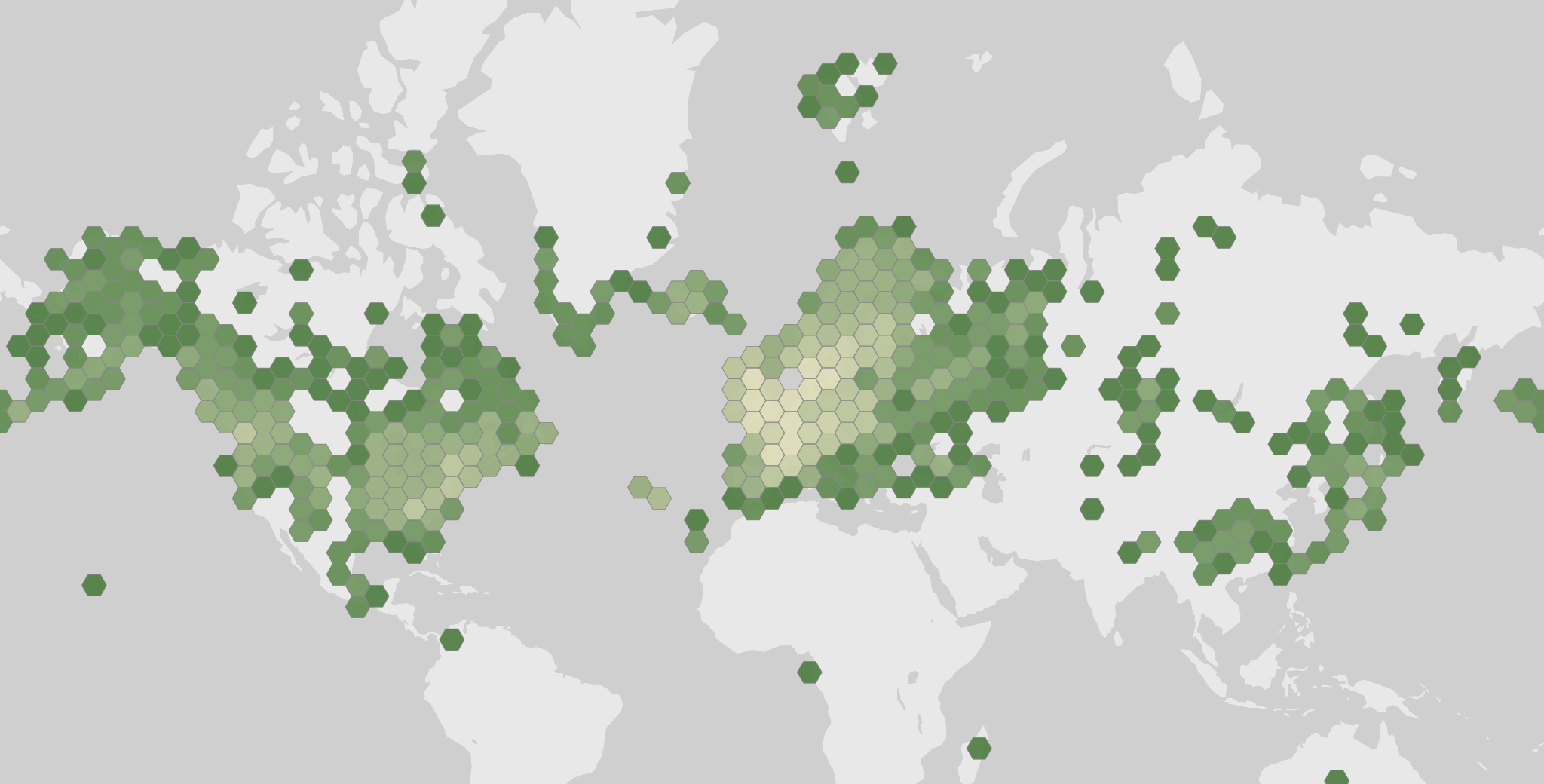
Broom forkmoss occurs across nearly all of North America, with the notable exceptions of Labrador, North Dakota, Texas, and Nevada, and extends through Europe, Asia, and northern Africa, as well as into Australia and New Zealand. This breadth makes it one of the more widely distributed mosses in the Northern Hemisphere.
Within that range it settles on humic soil, rocks, and rotten wood, favoring forested settings that span dry to moist conditions rather than any single narrow habitat type.
Monthly observation counts show a clear seasonal pattern, rising from a low near 6,700 to 8,900 records in November, December, and February to a peak above 33,000 in July and staying high through August. Since these figures come from presence observations rather than population counts, the pattern likely reflects when people are out recording mosses rather than when the moss itself is absent, and the plant should be present on its substrates year-round even where winter records are scarce.
Fun Facts
- The common name "broom forkmoss" comes directly from its leaves, which all curve to one side like the bristles of a broom.
- It seldom forms pure stands on its own, typically growing intermixed with other broom mosses and bryophytes in the same forest-floor carpet.
- Its native range is unusually broad for a moss, spanning most of the Northern Hemisphere and reaching as far as Australia and New Zealand in Oceania.
Ecology
Habitat
- Forest
Growth habit
- Moss