The English sundew, also called great sundew, is a carnivorous flowering plant in the sundew family Droseraceae. It is thought to have originated when a sterile hybrid between Drosera rotundifolia and Drosera linearis doubled its chromosomes, giving rise to fertile offspring that became the current Drosera anglica.
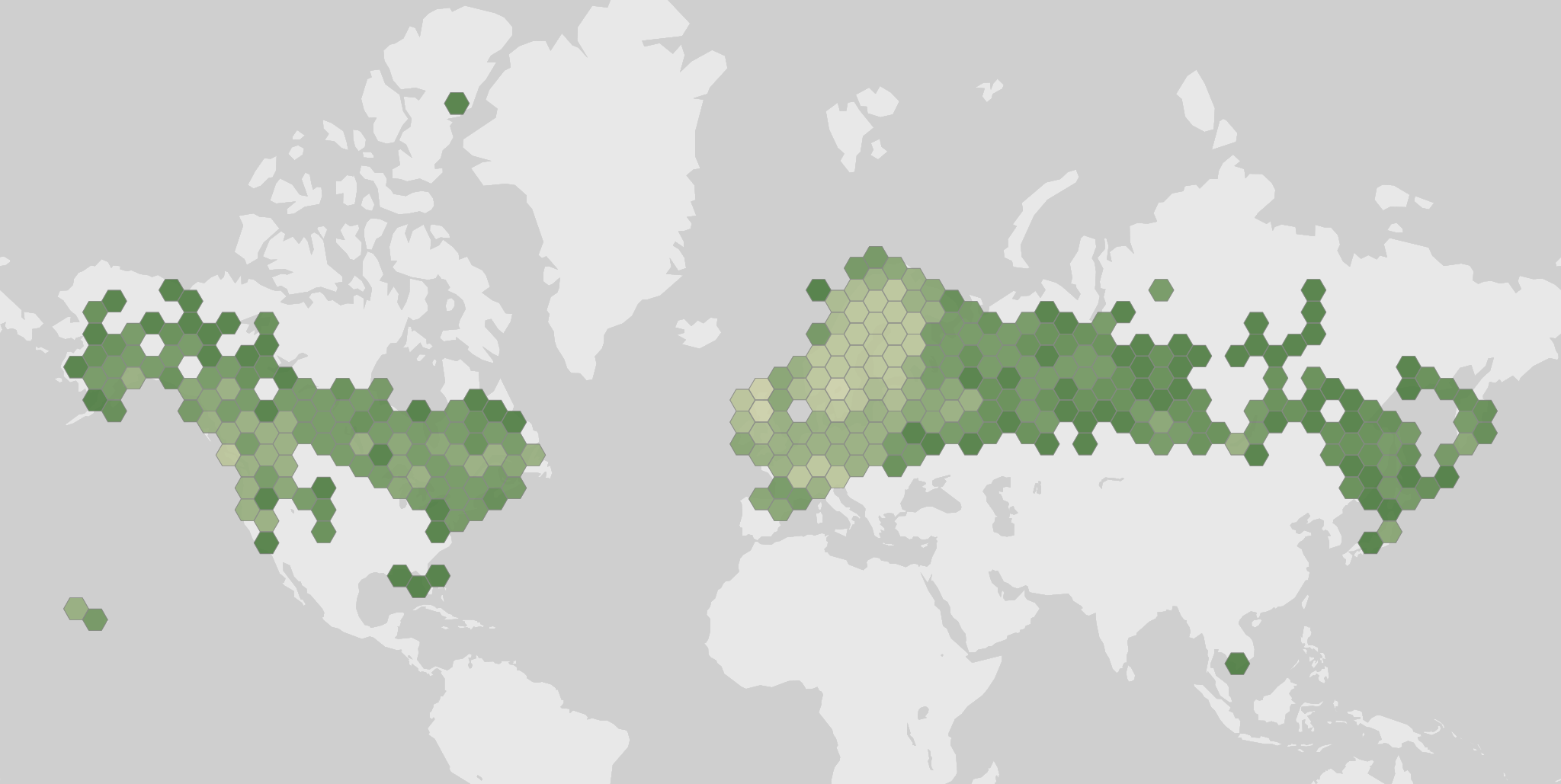
This is a temperate species with a circumboreal range, found at high latitudes around the Northern Hemisphere. It also occurs farther south, in Japan, southern Europe and the island of Kauai in Hawaii, where it grows as a tropical sundew.
Identification and Appearance
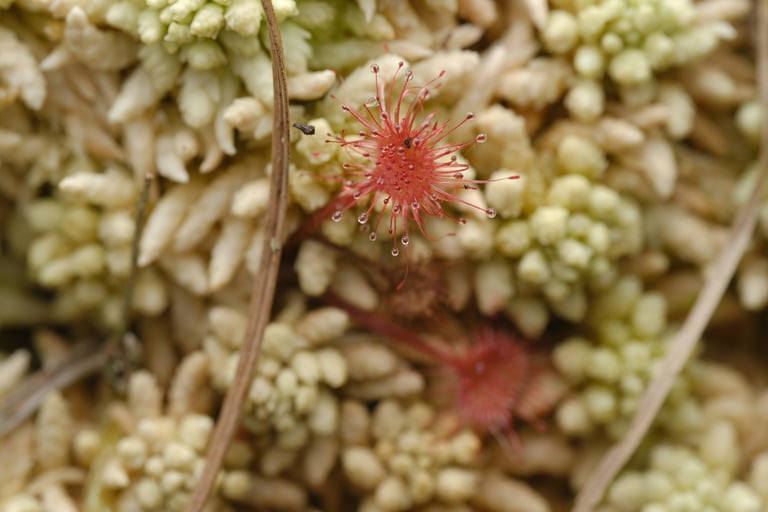
The most useful field mark is the leaf surface. Each leaf blade is densely covered with stalked, reddish, mucilaginous glands, and each gland is tipped with a clear droplet of sticky fluid that glistens in the sun.
The leaves form a stemless rosette. Each blade is linear to spatulate and measures 15–35 mm (0.6–1.4 inches) long, held semi-erect on a long petiole so that the whole leaf reaches 30–95 mm (1.2–3.7 inches). Plants are green, turning red in bright light.
In summer, the plant sends up flower stalks 6–18 cm (2.4–7.1 inches) long, each bearing several white flowers that open one at a time. Each flower has five sepals, five petals and five stamens, with three styles that are branched and two-lobed. The petals are 8–12 mm (about 0.3–0.5 inches) long.
The flowers are odorless and produce no nectar, so they do not attract insect pollinators.
Distribution and Habitat
The English sundew grows in open, non-forested habitats with wet soils that are often rich in calcium. These include bogs, marl fens, quaking bogs, cobble shores and other calcareous habitats. Calcium tolerance of this kind is uncommon in the rest of the genus.
The plant is often found growing among sphagnum mosses, and sometimes in a substrate made up almost entirely of living, dead or decomposed sphagnum. The moss keeps the surface wet and acidifies it, so nutrients are scarce and other plants compete less for space.
It is one of the most widely distributed sundews in the world. Its range is generally circumboreal, and it occurs across 12 U.S. states, including Alaska, and 11 Canadian provinces and territories. Its altitudinal range runs from 5 meters (16 feet) to at least 2,000 meters (6,600 feet).
Outside the north, it is found in Japan, southern Europe, the Hawaiian island of Kauai and California. Plants on Hawaii, where the species is known as mikinalo, are generally smaller than normal and have no winter dormancy period.
Growth and Form
The English sundew is a perennial herb. It forms a low, stemless rosette of leaves, with no aboveground stem beyond the leaves themselves.
In most populations, the plant survives winter as a hibernaculum, a knot of tightly curled leaves at ground level. These leaves unfurl in spring at the end of the dormancy period, so the plant renews its rosette each year.
The root system is weak and penetrates only a few centimeters into the soil. Its main jobs are to anchor the plant and to absorb water, while the leaves supply most of its nutrients through trapping.
Ecology and Relationships
The leaves are the plant's main tool for feeding. Each gland tentacle produces a sugary scent that draws small arthropods, which stick to the mucilage droplets when they land. Most prey are small insects such as flies, but bulkier insects with large wings are also caught, including small butterflies, damselflies and even dragonflies.
When prey touches the leaf, the nearby tentacles bend toward it and toward the center of the leaf, which can happen within minutes. The blade itself can bend around the prey over hours or days. The touched tentacles also release more mucilage that holds the insect fast, and it usually dies of exhaustion or suffocation as the sticky fluid clogs its breathing tubes.
After digestion, the plant absorbs the nutrient solution, and the leaf unfurls, leaving only the insect's exoskeleton behind. This matters because nitrogen is in short supply in bogs, and trapping insects provides an alternative source.
Moths in the order Lepidoptera are the main animals that feed on the plant. Buckleria paludum is one such moth, though it feeds on the plant only occasionally.
Photos
Photographs from via iNaturalist, licensed under CC0 1.0., by Dustin Snider via iNaturalist, licensed under CC BY 4.0., by Matt Berger via iNaturalist, licensed under CC BY 4.0., by J. H. via iNaturalist, licensed under CC BY 4.0., by Andreas Schneider via iNaturalist, licensed under CC BY 4.0., by Ewan Shilland via iNaturalist, licensed under CC BY 4.0., and by Caleb Catto via iNaturalist, licensed under CC BY 4.0., credited on each photo.
Ecology and classification
Classification
- Phylum
- Tracheophyta
- Class
- Magnoliopsida
- Order
- Caryophyllales
- Family
- Droseraceae
- Genus
- Drosera
- Species
- Drosera anglica
Sources
- GBIF Species names and classification
- iNaturalist Photos
- Wikidata Common names and conservation status
- Wikipedia Summary extract
- Plants of the World Online Native range, life form and climate (WCVP)
- USDA Plants US plants: growth habit and growing conditions
- GloBI What it eats, what eats it, parasites and pollinators
- trophiCH