Ginkgo biloba is the sole survivor of an order that first appeared on Earth more than 290 million years ago, and fossils virtually identical to the living tree already existed some 170 million years ago, during the Middle Jurassic.
This gymnosperm tree, native to East Asia and commonly called the maidenhair tree, belongs to its own family, Ginkgoaceae, and its own class, Ginkgoopsida. It was cultivated by humans early in history and remains one of the most widely planted ornamental trees today.
What makes ginkgo worth a closer look is its almost unchanged persistence through deep time: a plant that has outlasted dinosaurs, ice ages, and the entire rise of flowering plants, yet still lines streets and temple courtyards across the modern world.
Identification and Appearance
The single most reliable field mark of Ginkgo biloba is its fan-shaped leaf with veins that fork repeatedly outward from the base without ever joining into a network, a pattern called dichotomous venation found in no other living seed plant. The leaves, usually 5–10 cm long but occasionally reaching 15 cm, resemble the pinnae of the maidenhair fern, which gave rise to the tree's common name.
Ginkgo is a large tree, typically reaching 20–35 m in height, with some specimens in China exceeding 40 m. Young trees grow tall and slender with a conical crown and sparse branching; with age the crown broadens and becomes angular and irregular, supported by deep roots that make the tree notably resistant to wind and snow damage.
Leaves come in two forms depending on where they grow. Those on fast-growing long shoots are thicker, photosynthesize more efficiently, and are often notched or lobed along their outer edge; those clustered on the short, knobby spur shoots are simpler and better suited to withstanding drought. Only the spur shoots bear the tree's reproductive structures.
Sexes are separate, so male and female trees look identical until they produce reproductive structures. In autumn the leaves turn a deep saffron yellow and can drop within one to fifteen days. Older trees can sprout new stems from basal lignotubers or grow aerial roots from damaged branches, a resilience linked to specimens estimated at more than 3,500 years old.
Distribution and Habitat
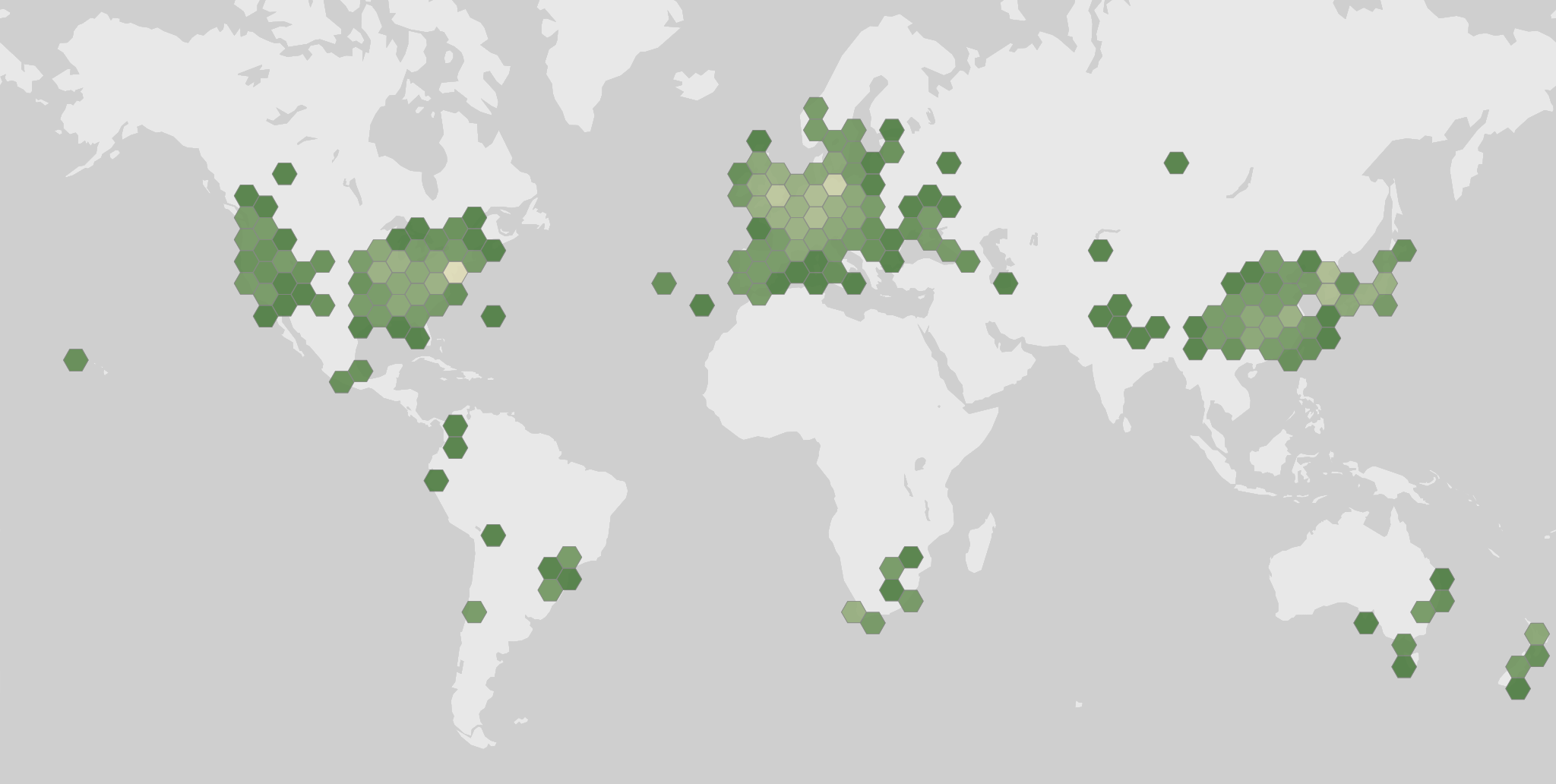
Ginkgo biloba is native to eastern China, where it grows scattered through broad-leaved forests and valleys at elevations of 300 to 1,100 m, rooted in acidic, well-drained yellow loess soil with a pH of 5.0 to 5.5.
Long believed extinct in the wild, the species is now cultivated throughout eastern China, Korea, and Japan, planted extensively as a street tree and adopted as the emblem of institutions such as the University of Tokyo and Sungkyunkwan University. High genetic uniformity among many of these trees has led some Chinese scholars to suggest that Buddhist monks planted and preserved them over roughly 1,000 years.
Greater genetic diversity found in southwestern China, near the eastern Tibetan Plateau, points to possible glacial refugia and has fueled ongoing debate over whether truly wild ginkgo populations still survive there; some of the oldest known trees may predate the human settlements around them.
Monthly observation counts rise steadily from a low of a few hundred in winter to a peak of nearly 5,000 in October, with high numbers also recorded from June through September. This pattern most likely reflects increased outdoor observation during the growing season and autumn foliage display rather than any true measure of ginkgo abundance.
Reproduction and Life Cycle
Ginkgo is dioecious, with individual trees being either male or female. Male trees produce small pollen cones whose sporophylls each carry two microsporangia arranged spirally around a central axis, while female trees never form cones, instead growing two ovules at the tip of a stalk; branches occasionally reverse sex, though this is rare and hard to study.
Fertilization happens through wind-carried pollen releasing motile sperm, a trait ginkgo shares with cycads, ferns, and mosses rather than typical flowering plants. These sperm, about 70–90 micrometers long and propelled by thousands of flagella, were first documented by the Japanese botanist Sakugoro Hirase in 1896. Of the two sperm produced, only one fertilizes the ovule, and this typically happens just before or after the ovule falls from the tree in early autumn.
Once fertilized, the ovule develops into a fruit-like structure 1.5–2 cm long with a fleshy yellow-brown outer layer, the sarcotesta, that smells of rancid butter once it falls due to its butyric acid content. Beneath this lies a hard shell, the sclerotesta, which survives digestion intact. This resilience allows small mammals such as gray squirrels, palm civets, and raccoon dogs, drawn by the smell, to disperse the seeds unharmed through their feces.
Ecology and Relationships
Ginkgo biloba is the only known vascular plant to host a microscopic green alga, a Cocomyxa-like species, living inside its own cells as an endosymbiont. This relationship is passed down from generation to generation and has been documented in ginkgo trees across Asia, North America, and Europe.
The algal cells lack a functional chloroplast in this immature state and are not photosynthetically active, but they may still play a role in the tree's internal metabolic pathways, an unusual partnership among seed plants.
Within its native range, ginkgo favors disturbed ground such as streambanks, rocky slopes, and cliff edges, rooted in acidic, well-drained loess soil. This preference for unstable or exposed sites, paired with its capacity for vigorous vegetative regrowth, likely helps explain how isolated populations have persisted for so long.
Uses and Human Relationships
In Chinese tradition, Ginkgo biloba symbolizes longevity, vitality, and the sacred life force known as Qi. Because it blooms at night and sheds its blossoms quickly, it is also linked to yin-yang symbolism representing balance, and it grows abundantly on the slopes of Mount Qingcheng, regarded as the birthplace of religious Daoism.
In Korea, ancient ginkgos at temple sites are treated as living protectors of sacred ground, with some individually recognized as cultural treasures. Monks in Korea and Japan valued ginkgo leaf tea for the grounded awareness it supported during meditation and sutra study, and the tree has been widely planted in both countries since the 14th century because of its standing in Buddhism and Confucianism.
Ginkgo has been cultivated in China for centuries, with some temple specimens believed to be over 1,500 years old; Europeans first recorded it in 1690 in Japanese temple gardens. It has since become a favored, pollution-tolerant shade tree in cities across North America and Europe, though it has never become significantly naturalized there. Many planted trees are male cultivars, such as 'Autumn Gold', chosen because male trees do not produce malodorous seeds, even though their pollen carries a high allergy rating; female cultivars like 'Liberty Splendor', 'Santa Cruz', and 'Golden Girl' release no pollen at all. Ginkgos are also popular for bonsai and penjing, and six trees that survived the 1945 Hiroshima bombing, charred but alive, still stand today. Since 2016, the International Agency for Research on Cancer has classified ginkgo extract as a possible human carcinogen (Group 2B).
Conservation and Threats
The fossil record shows that ginkgo's diversity peaked during the Jurassic and Early Cretaceous, when the genus spread widely across the ancient supercontinent Laurasia.
Diversity declined steadily through the Cretaceous, a pattern shared with ferns, cycads, and cycadeoids, coinciding with the rise of flowering plants that were better adapted to disturbed environments and likely outcompeted these older lineages.
By the Paleocene, only Ginkgo adiantoides remained in the Northern Hemisphere, alongside a distinct and poorly documented form in the Southern Hemisphere. By the end of the Pliocene, ginkgo fossils had disappeared everywhere except a small area of central China, where the modern species survived and from which it was later spread by cultivation.
This extreme contraction from a once near-global range to a single refuge illustrates how narrowly the species avoided extinction, a fragility that persists in the uncertainty over whether any truly wild populations remain today.
Fun Facts
- Since 2016, the International Agency for Research on Cancer has classified ginkgo extract as a possible human carcinogen (Group 2B).
- In Chinese tradition the tree is said to bloom only at night before quickly shedding its blossoms, a trait tied to yin-yang symbolism of balance.
- Six ginkgo trees growing within one to two kilometers of the 1945 atomic bomb explosion in Hiroshima survived, charred but alive, and still stand today.
- Ginkgo leaves serve as the official emblem of the University of Tokyo and Sungkyunkwan University in South Korea.
- At Tsurugaoka Hachiman-gū shrine in Kamakura, a ginkgo nicknamed "kakure-ichō" ("hiding ginkgo") is tied to a 1219 assassination legend; tree-ring analysis in 1990 dated it to about 500 years old, and although it fell in a 2010 storm, its stump has since resprouted.
- Some Korean temple ginkgos are individually recognized as living cultural treasures, considered protectors of sacred ground.
- A single anecdotal medical report once prompted a doctor to suggest people avoid ginkgo entirely over fears of excessive bleeding, though the claim rested on one case with no broader clinical support.
Ecology
Habitat
- Forest
- Mountain
- Urban
Growth habit
- Tree