Though its broad leaves and fruit-like seeds look like those of an ordinary flowering tree, Gnetum gnemon is not an angiosperm at all. It is a gymnosperm, and its flower-like male strobili and fruit-like female strobili arose through convergent evolution rather than true flowering.
Known across its range as melinjo, belinjo, bago, or tulip, this tree grows natively from Mizoram and Assam in India south through the Malay Peninsula, the Malay Archipelago, and the Philippines to islands of the western Pacific. It is currently assessed as Least Concern.
Beyond its unusual botany, Gnetum gnemon is worth knowing for how deeply it is woven into Southeast Asian and Melanesian kitchens, where nearly every part of the plant, from young leaves to ripe seed, ends up on the table.
Identification and Appearance
The clearest way to recognize Gnetum gnemon is by its strobili: the male structures cluster on short stalks and are often mistaken for flowers, while the female structures mature into oval, fruit-like seeds, even though the tree never actually flowers.
Unlike most other species in the genus Gnetum, which grow as woody lianas, this species is a small to medium tree reaching 15 to 22 meters in height with a trunk up to 40 centimeters in diameter. Some varieties, including brunonianum, griffithii, and tenerum, instead take a shrub form.
The leaves are evergreen, opposite, entire-margined, and 8 to 20 centimeters long by 3 to 10 centimeters wide. They emerge a bronze color before maturing into a glossy dark green, a contrast that makes new growth easy to spot against older foliage.
The reproductive stalks are 3 to 6 centimeters long, and the oval seeds they produce measure 1 to 3.5 centimeters long, with a large nut-like endosperm 2 to 4 centimeters long inside a thin, velvety outer layer. A fleshy seed weighs about 5.5 grams, with the endosperm alone accounting for roughly 3.8 grams, and the color shifts from yellow to orange, purple, or pink as it ripens. In Indonesia, fruiting comes in three waves, March to April, June to July, and September to October, while in the northeastern Philippines the main season runs from June to September.
Distribution and Habitat
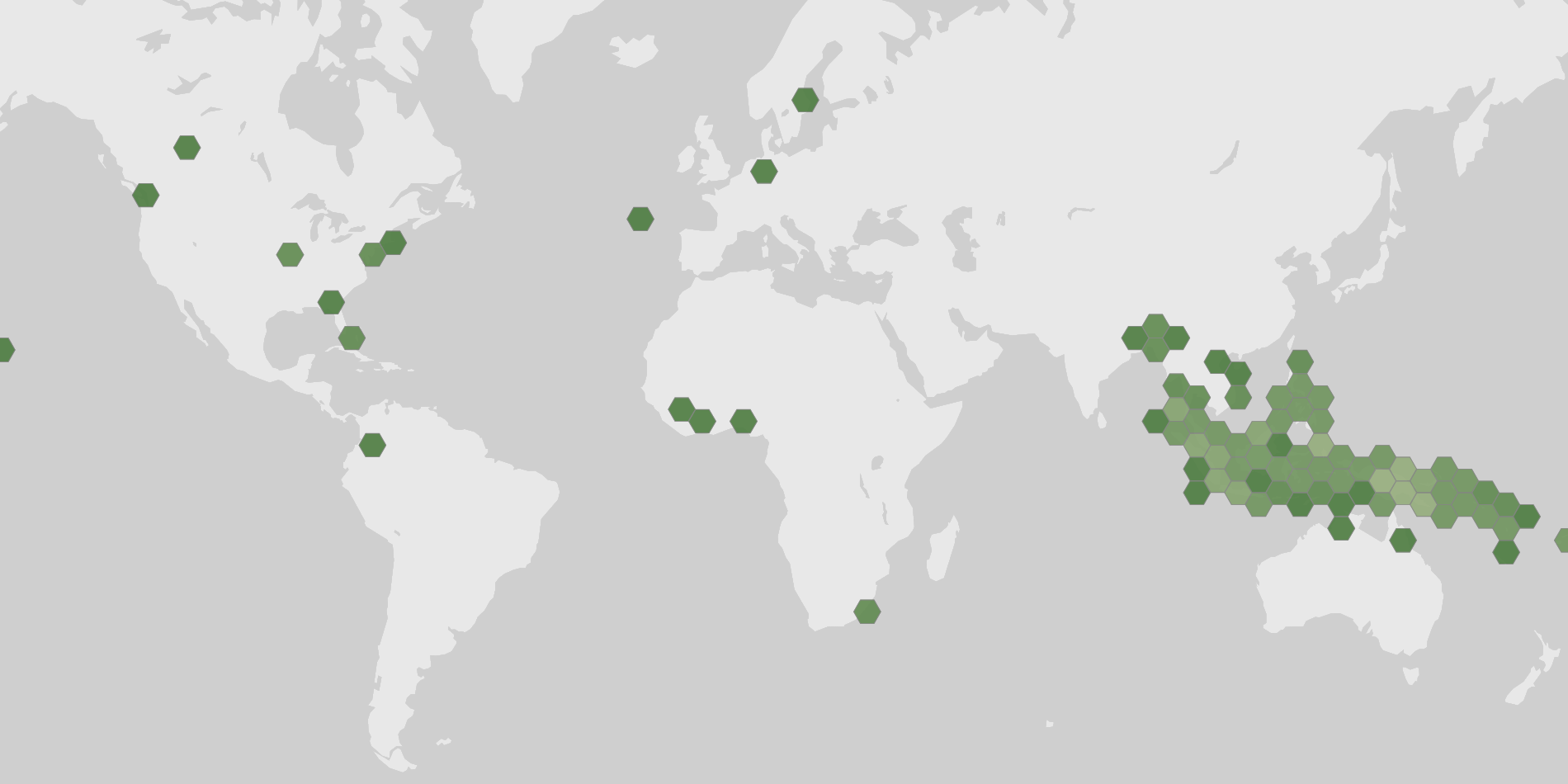
Gnetum gnemon occurs natively across a broad swath of tropical Asia and the western Pacific, from Mizoram and Assam in northeastern India south through the Malay Peninsula and the Malay Archipelago to the Philippines and on to Pacific islands. Its range also extends into southeastern Xizang and western Yunnan, including Yingjiang Xian in China, as well as Myanmar, Thailand, and Vietnam.
Monthly observation counts show records year-round, with the highest number, 375, logged in October and the lowest, 173, in December, alongside a secondary rise in April. These figures come from presence observations rather than measures of abundance or population size, so the pattern should be read only as a cautious hint of seasonal detection rather than a true seasonal peak in numbers.
Across its native area, the species is cultivated and encountered widely enough that occurrence records span the full length of its Asian and Pacific range described above.
Uses and Human Relationships
Gnetum nuts are eaten boiled, roasted, or raw throughout much of Southeast Asia and Melanesia. The young leaves, the male strobili, and the outer flesh of the fruits are also cooked and eaten in Indonesia, the Philippines, Thailand, Vanuatu, Papua New Guinea, the Solomon Islands, and Fiji, typically added to soups and stews for their slightly sour taste.
The plant is most closely tied to Indonesian cuisine, where it is called melinjo or belinjo. The seeds go into sayur asem, a sour vegetable soup, and are also sliced into raw chips that are later deep-fried into emping, a type of krupuk cracker with a slightly bitter taste commonly served as a snack alongside other Indonesian dishes.
In the Aceh region, the tree is commonly cultivated and regarded as a high-status vegetable. Its male strobili, young leaves, and female strobilus are key ingredients in kuah pliek, a traditional curry served at important occasions such as khanduri and keureudja. In the Pidie district, women gather the red-skinned ripe fruit to prepare keureupuk muling.
Fun Facts
- The genus name Gnetum was coined by Carl Linnaeus in 1767, taken from the Moluccan name "ganema" or "gnemo" for the tree as recorded by the naturalist Georg Eberhard Rumphius in his Herbarium Amboinense.
- The species epithet gnemon traces back to Malay and Indonesian dialect names for the plant, underscoring its long cultural presence in the region where it was first described.
- One account traces Gnetum instead to the Latin "gnetus," meaning "to unite," a nod to the mix of plant characteristics the genus displays.
- While most Asian species of Gnetum grow as woody vines, Gnetum gnemon stands apart by growing as an upright tree.
- Beyond its edible seeds, the tree also yields a useful fiber.
Conservation status
- LC
- NT
- VU
- EN
- CR
Least Concern
Ecology
Growth habit
- Tree