A plant with no leaves, no stem, and no chlorophyll, Hydnora africana spends almost its entire life hidden underground, revealing itself only when a fleshy, peach-orange flower pushes up through the soil after heavy rain.
Classified in the family Hydnoraceae within the order Piperales, this obligate root parasite is native to southern Africa. It belongs to a lineage botanists regard as one of the most primitive among flowering plants, and its bizarre biology, from its fungus-like appearance to its trap-door pollination system, makes it one of the more unusual flowering plants on the continent.
Identification and Appearance
The clearest field mark is the flower itself: a thick, succulent, fleshy structure in peachy-orange tones that erupts from bare soil with no stem, leaves, or green tissue anywhere on the plant. Because the vegetative body lives entirely underground as parasitic root tissue, the flower is effectively the only part anyone ever sees.
The above-ground portion is tubular and opens into three pores. Three thick perianth segments, comparable to sepals, fuse together at the top of the flower and are held shut by stiff bristles strong enough to trap visiting insects. Where these segments join, a short internal tube leads down to yellowish-orange anther groups arranged in a triangular pattern, with gaps positioned so that insects tumble past them onto the stigma below.
At the base of the flower lies a cavity holding white ovules that will later develop into seeds. The whole structure has a firm, waxy, almost fungal texture rather than the thin petal tissue typical of most flowers, which is part of why the plant is so often mistaken for a mushroom when first encountered.
Because Hydnora africana lacks any vegetative parts above ground, there is little to compare between individuals beyond flower size and coloration, and no foliage, bark, or stem features are available for identification as they would be in a typical flowering plant.
Distribution and Habitat
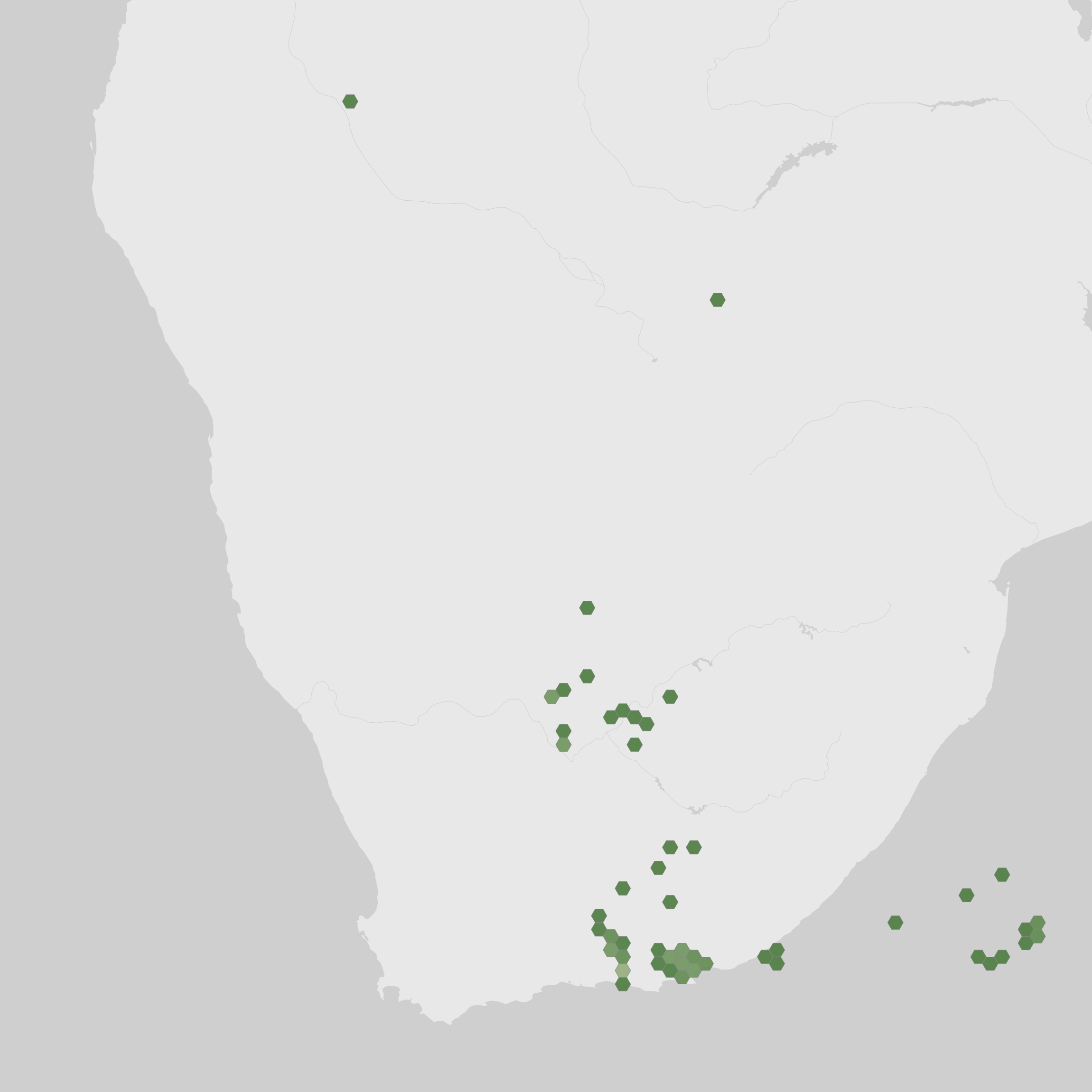
Hydnora africana is native to southern Africa, where it lives as a root parasite attached to host plants in the family Euphorbiaceae. Because the plant itself never grows above ground, its presence is only detectable when flowers surface after rain, making its true range harder to map than that of an ordinary plant.
Monthly observation records show a strong seasonal pattern, with sightings rising sharply through the middle of the year and peaking sharply in September, when counts reach roughly 75 in the available data compared to single digits in the early months of the year. This pattern most likely reflects the timing of flowering after seasonal rainfall rather than a shift in where the plant actually grows underground.
These figures come from presence observations rather than systematic population surveys, so they indicate when and where flowers have been noticed rather than the plant's overall abundance or the full extent of its native range.
Reproduction and Life Cycle
Flowering is triggered by heavy rainfall, after which the fleshy flower pushes up through the soil above the buried root tissue. The flower produces a rotting odor that attracts dung beetles and other insects, which crawl into the floral chamber and become trapped by stiff bristles lining the perianth segments.
Trapped insects fall down the flower tube and land first on the anther groups, where pollen sticks to their bodies, before dropping further onto the stigma, where pollination is completed. After several days inside the flower, the structure finally opens and releases the insects, which then carry pollen to other Hydnora africana flowers nearby.
Growth from seed to flower is remarkably slow: seeds sown experimentally in pots alongside a Euphorbia host did not produce a flower until five and a half years after sowing, underscoring how long this parasite takes to establish a functional connection with its host before it can reproduce.
Uses and Human Relationships
People in southern Africa have long harvested Hydnora africana as a source of food, medicine, and tannin. The fruit is traditionally eaten, and rhizome extracts have been used in South Africa as a treatment for dysentery.
Its value as a wild-harvested medicinal and food resource means demand for the plant persists even though it cannot be cultivated in the ordinary way, since it depends entirely on a living host root system to survive.
Conservation and Threats
No formal population assessment status is noted for Hydnora africana, but the available evidence points to a species under mounting pressure. The most immediate threats come from habitat loss to agricultural land expansion and overexploitation through harvesting for medicinal use, both of which remove plants and their hosts faster than they can be replaced.
Climate change adds a further, more subtle risk. Research on the genus has found that precipitation in the wettest month is the strongest predictor of where Hydnora species can survive, since the plant's soft, fleshy flowers can only break through the soil when ground moisture is adequate. As rainfall patterns shift and warming continues, germination success and the plant's ability to complete its underground life cycle are expected to decline.
No dedicated conservation programs for the species are currently in place, despite documented concerns that its numbers could fall sharply if pollinator populations decline, seed dispersal is disrupted, and land conversion and harvesting continue at their current pace.
Fun Facts
- The species name africana simply means "from Africa," reflecting its origin on the continent.
- Molecular studies place Hydnoroideae among the "basal angiosperms," a group considered among the most primitive lineages of flowering plants alive today.
- Hydnoraceae, the family Hydnora africana belongs to, is the only group of flowering plants known to have no leaves or scales at all.
- The fruit of Hydnora africana is traditionally eaten by the Khoisan people of South Africa.
- Despite its otherworldly, almost extraterrestrial appearance, the plant plays a genuine ecological role in the landscapes where it grows and holds real cultural significance for local communities.