When cut or bruised, Lactarius sanguifluus oozes a blood-red to purple latex that slowly turns green on contact with air — the trait behind its common name, the bloody milk cap.
The species belongs to the family Russulaceae within the order Russulales, and it forms ectomycorrhizal partnerships with pine trees. First described from France in 1811 and renamed by Elias Fries in 1838, it is now known from Southern Europe to Morocco, India, Vietnam, and China. Uncontrolled commercial picking has drawn regional attention: the mushroom is listed in Ukraine's Red Data Book and has appeared in a draft red list for Spain as a vulnerable edible species.
Beyond its striking latex, the bloody milk cap is worth knowing as one of the more prized wild mushrooms in Mediterranean foraging traditions, sold under names like níscalos and rovelló in Spanish and Catalan markets.
Fruiting Body and Identification
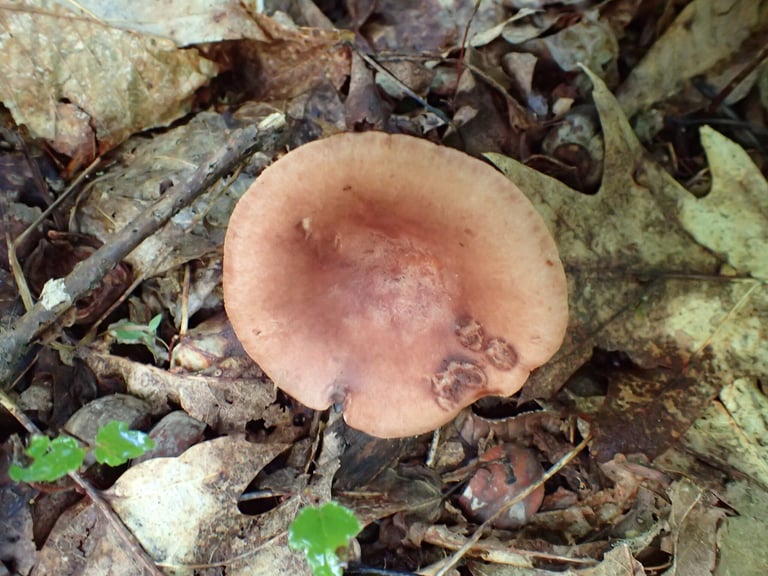
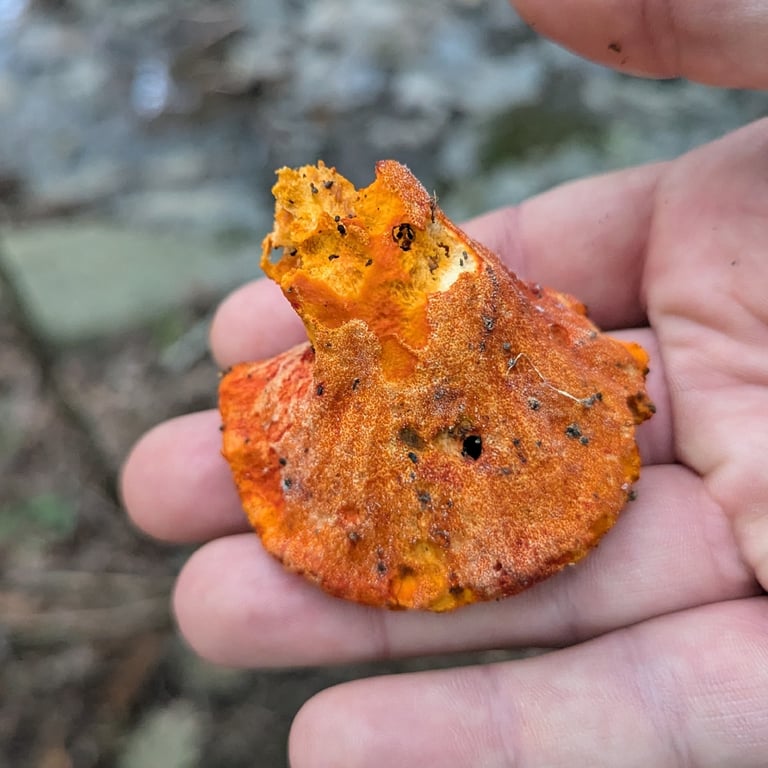
The most reliable field mark is the latex: when the flesh is cut, it bleeds a blood-red to purple fluid that slowly turns greenish where exposed to air, staining the surrounding tissue. The cap itself is convex with a central depression, reaching 4–7.5 cm across; its surface is smooth and sticky, with margins that stay curved downward even in mature specimens. Color ranges from pinkish-buff to orangish, often blotched with gray or pale greenish-gray where bruised.
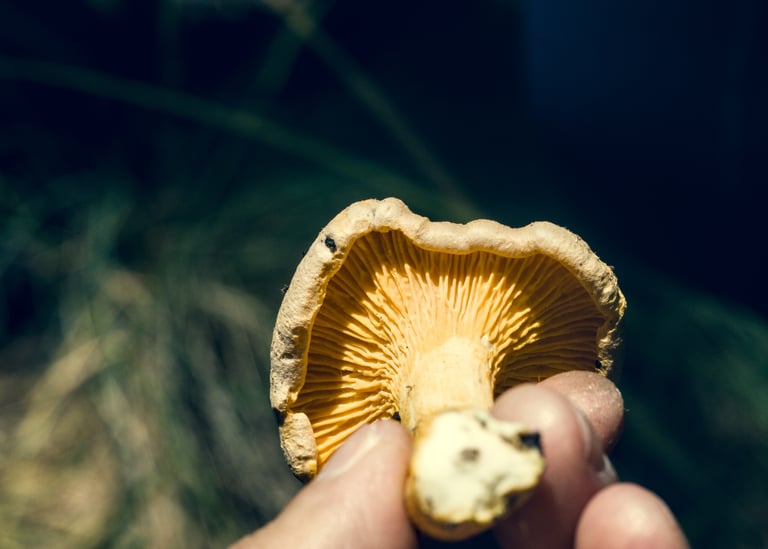
The gills are somewhat crowded and attached to the stipe in an adnate to slightly decurrent fashion, colored pale vinaceous with a pinkish-buff edge. The cylindrical stipe measures 2.0–3.5 cm long by 1–2 cm thick, smooth, and pale pinkish-buff to pale grayish-buff, sometimes marked with brownish dots. Flesh texture varies from firm to fragile: soft and pale pinkish-buff in the stipe, brick-colored beneath the cap cuticle, and brownish-red just above the gills. Taste ranges from mild to slightly bitter, with no significant odor.
Microscopically, the spores are roughly spherical to ellipsoidal, 7.9–9.5 by 8.0–8.8 μm, with ornamentation up to 0.8 μm high forming an almost complete reticulum of broad, rounded ridges. The four-spored basidia measure 50–70 by 9–11 μm, and the cap cuticle is a gelatinous ixocutis up to 60 μm thick, built from branched, interwoven hyphae 2–6 μm wide.
Two related species can cause confusion in the field. Lactarius vinosus, once treated as a variety of L. sanguifluus, has a more vinaceous-red cap lacking orange tones, a stipe that tapers more distinctly downward, and latex that stains cap tissue more intensely; its spores show an incomplete reticulum with more variable ridge thickness. Lactarius semisanguifluus is smaller, shows violet tinges in the cap, develops greenish discoloration with age, and produces an orange latex that only turns wine-red five to ten minutes after exposure to air.
Distribution and Habitat
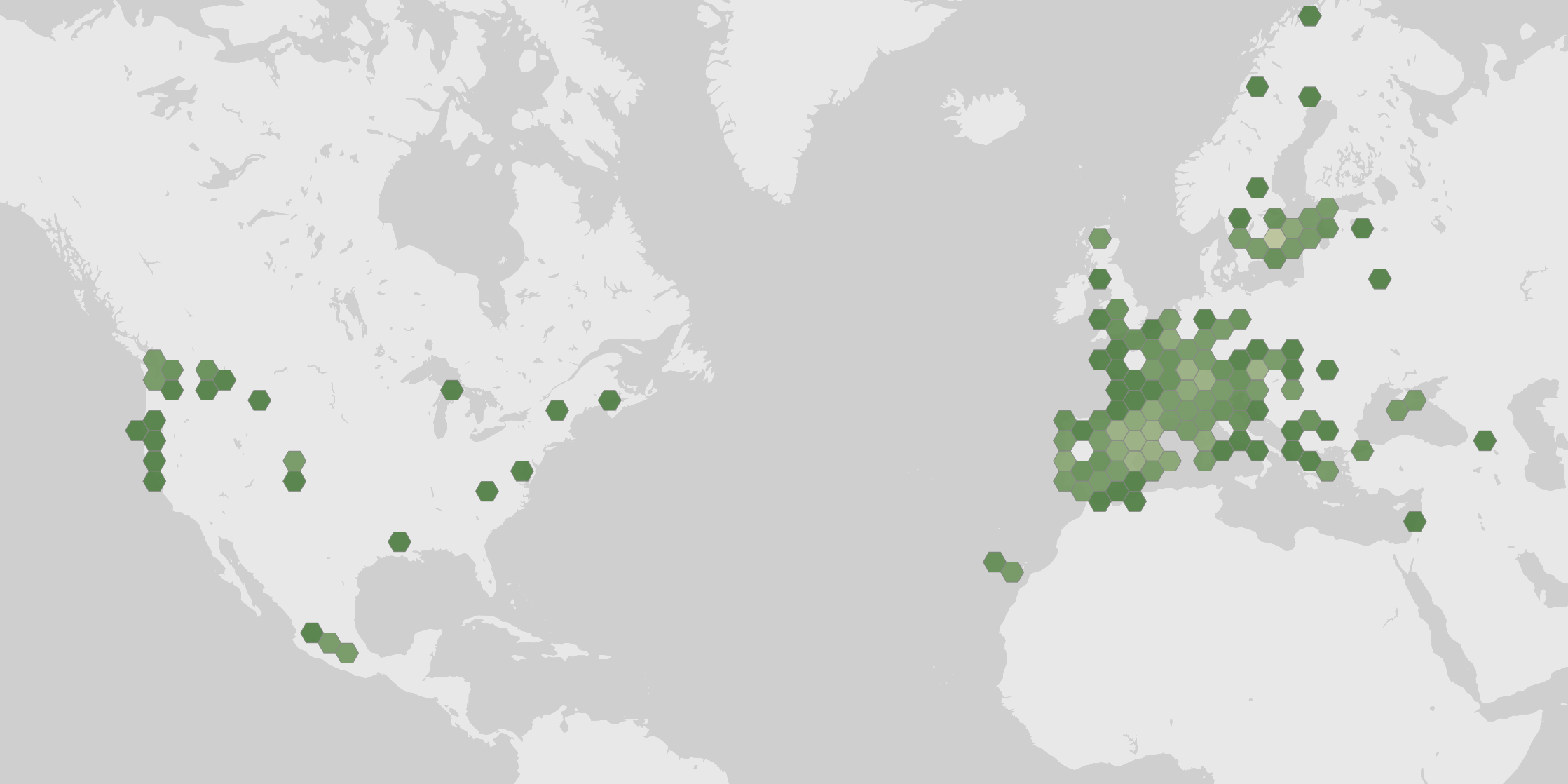
Lactarius sanguifluus is widespread across Southern Europe, recorded from Belgium, Estonia, Greece, Cyprus, France, Germany, Italy, Luxembourg, the Netherlands, Poland, Russia, Spain, Slovakia, Sweden, and Switzerland. Outside Europe it occurs in Himachal Pradesh, India, where it grows in mixed coniferous forests typically under the fern Onychium contiguum, as well as in Morocco, Vietnam, and China.
The species is strictly ectomycorrhizal with pine trees and favors calcareous soils. In the Netherlands it has been found in calcareous dune systems at warm, sunny, sheltered edges of pine-dominated woodland, and comparable pine-and-limestone associations underlie most of its known European localities.
Across Southern Europe it fruits between September and November, extending into December in the continent's southernmost regions. GBIF presence records show a similar pattern, with observations climbing sharply from August, peaking in October, and tapering off by December; as presence data rather than counts of abundance, these figures indicate when the species is being seen rather than how common it truly is.
Uncontrolled commercial harvesting has left a mark on its documented range: it is listed in Ukraine's Red Data Book and was proposed for a Spanish red list as a vulnerable edible species. A September 1998 report described 82.5 kg of the mushroom seized from a van in Poligny, France, hinting at the scale of collection in some regions. Because fruit bodies can bioaccumulate heavy metals such as zinc, manganese, nickel, cobalt, cadmium, and lead from polluted ground, a Turkish study found elevated levels in specimens gathered near roadsides compared with those from forest interiors.
Uses and Cultural History
In parts of Eastern Europe, the mushroom's blood-red secretion carries folkloric weight, sometimes framed in poetic notions of "bleeding nature" that reflect the species' deep roots in folk mycology.
Among foragers and gourmets it is known by names that echo both its biology and its local traditions, sometimes called the "red-blooded saffron milk cap." Its wine-red latex, association with pine forests, and reputation for excellent culinary qualities have made it one of the more sought-after wild mushrooms across the regions where it is collected.
Fun Facts
- Lactarius sanguifluus was first described from France in 1811 and given its current scientific name by Elias Fries in 1838, when he moved it into the genus Lactarius.
- Its blood-red, slowly greening latex has made it a subject of folk symbolism in Eastern Europe, where it is sometimes poetically described as a "bleeding" fungus.
Ecology
Habitat
- Forest
- Woodland