Few mushrooms wear color as boldly as the wood blewit, whose cap and stem can glow lilac to deep purple-pink, fading toward tan in some North American forms. It belongs to the fungal family Tricholomataceae, within the order Agaricales and class Agaricomycetes, and it grows across the forest floors of Europe and North America. First described by Pierre Bulliard in 1790, it has traveled through several scientific names, from Tricholoma nudum to Clitocybe nuda to Lepista nuda, and most recently Collybia nuda following a 2023 reclassification.
Beyond its shifting taxonomy, the wood blewit stands out for a genuinely odd trait: a smell that several observers have compared to frozen orange juice. Between its unusual color, its curious scent, and its tangled naming history, this is a mushroom that rewards a closer look.
Fruiting Body and Identification
The most reliable way to recognize a wood blewit is its color, ranging from lilac to purple-pink, paired with a stout, short stem. Young specimens have lighter, more convex caps, while mature ones flatten out and darken, reaching 4 to 15 centimeters across. Some North American populations run duller and tend toward tan, though they usually keep purplish tones on the stem and gills even when the cap fades.
The gills attach directly to the stem, which measures roughly 2 to 6 centimeters long and 1 to 2.5 centimeters wide, sometimes thickening at the base. A distinctive odor, likened by one observer to frozen orange juice, sets this species apart from many similarly colored fungi. The spore print is white to pale pink, another useful identification clue.
Distribution and Habitat
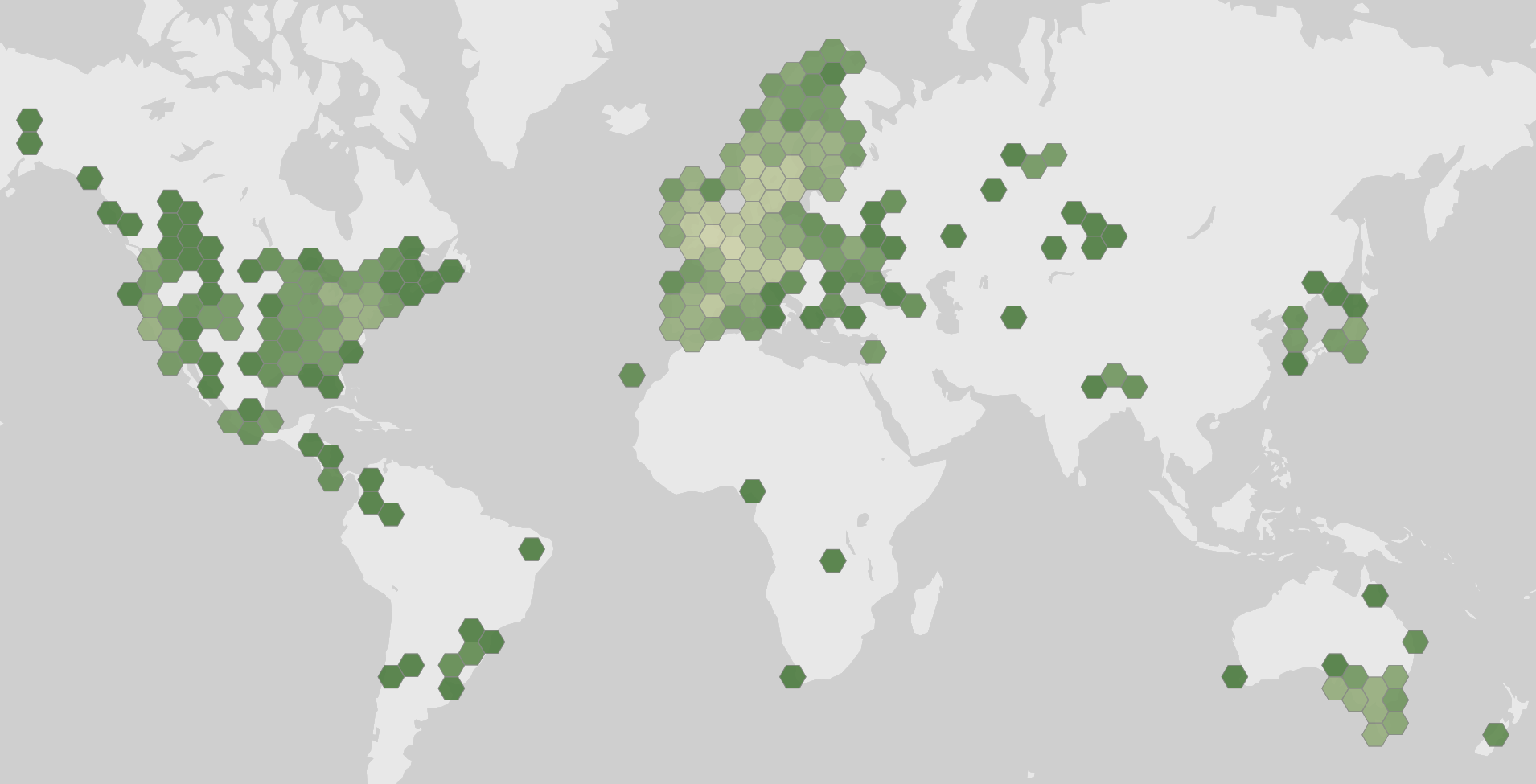
The wood blewit occurs across Europe and North America and appears to be spreading in Australia and New Zealand, where it seems to have been introduced. In Australia it has formed relationships with certain eucalyptus species and gorse, producing a growth pattern and appearance that differs somewhat from its European counterparts.
As a saprotrophic species, it grows on decaying leaf litter rather than living plant tissue. In the United Kingdom it fruits from September through December, and monthly observation data echo that pattern closely: counts climb sharply in September, peak in October, and stay elevated through November before tapering off by December. These figures reflect presence observations rather than true abundance or a complete map of the species' range, but the seasonal spike lines up with the documented autumn fruiting window.
A separate form, glaucocana, is found in mountainous environments, suggesting the species tolerates a range of elevations wherever suitable leaf litter accumulates.
Ecology and Relationships
The wood blewit feeds as a saprotroph, breaking down decaying leaf litter rather than forming the classic mycorrhizal partnerships seen in many forest fungi. In southeast Sweden, soil taken from beneath a wood blewit fairy ring growing under Norway spruce and Scots pine yielded fourteen halogenated low molecular weight organic compounds, three of them brominated and the rest chlorinated. Brominated compounds are otherwise unknown as metabolites of terrestrial fungi, and it remains unclear whether these particular compounds were produced by the mushroom itself or absorbed as pollutants.
In Australia, the species has developed an association with eucalyptus trees and gorse, and grows in a pattern distinct from its European relatives, hinting at a shift in ecological behavior after introduction to a new environment.
The wood blewit's striking color has drawn attention from an unexpected quarter: a young male satin bowerbird near Braidwood in southern New South Wales was reported collecting wood blewits to decorate his bower, part of the species' well-known habit of gathering blue objects for display.
Uses and Cultural History
The wood blewit's habit of growing in fairy rings has long fed European folklore, with some traditions holding that these circles marked places where fairies, pixies, or elves danced in the woods.
While it lacks the deep mythological weight of mushrooms like fly agaric, the wood blewit has featured moderately in the ethnomycological traditions of Europe and Asia, valued primarily as a modest wild edible rather than as a subject of ritual or legend.
It continues to hold practical value today as a sustainable wild food source in northern and eastern Europe, kept relevant season after season by foragers, chefs, and recreational mycologists who seek it out each autumn.
Fun Facts
- A young male satin bowerbird near Braidwood, New South Wales, was reported collecting wood blewits to decorate his bower, drawn by their blue-purple color.
- The mushroom's fairy-ring growth pattern inspired European folklore holding that the circles marked spots where fairies or elves once danced.
- Soil beneath a wood blewit fairy ring in southeast Sweden contained brominated organic compounds, a chemical signature otherwise unknown among terrestrial fungi.
- First described by Pierre Bulliard in 1790, the species was given its exact scientific name by Mordecai Cubitt Cooke in 1871.
- In 2023, taxonomists reassigned the wood blewit, along with its relative the field blewit, to the genus Collybia.
- Despite lacking deep mythological status, it remains valued as a sustainable wild food source across northern and eastern Europe.
Ecology
Habitat
- Forest
- Woodland
- Mountain