Mucor mucedo was first described from Italy in 1729 by P.A. Micheli, who called it Mucor vulgaris. Carl Linnaeus included it in the Species Plantarum in 1753, and it later took the name Mucor mucedo.
Known as the common pinmould, it is a saprotrophic fungus in the phylum Mucoromycota and the genus Mucor. Its 85 known strains are found worldwide on soil, dung, water, plants and moist foods. It is also described as a fungal plant pathogen.
Its fast-growing, fluffy colonies often resemble Rhizopus rots on fruit, which is why it is frequently mistaken for them.
Distribution and Habitat
Mucor mucedo has a worldwide distribution. It occurs in the Canary Islands, Egypt, Great Britain, Ireland, Kenya, the Netherlands, Australia, Sri Lanka, Ukraine, China and Canada.
The fungus lives in soil, dung, water, composted leaf litter and stored grains. It is also common on many plants and fruits, such as grapes and tomatoes. Horse dung is a particularly easy place to find it around March and April.
It grows well on cheese, where it causes the 'cat hair' defect: white mould with long, grey hyphae that look like cat fur. Its presence observations are highest from August through October.
The fungus interacts with animals including horses, rabbits, mice and rats, but it is rarely a cause of disease in them. In soil, it can degrade polycyclic aromatic hydrocarbons, and it cuts residual levels significantly within 12 days of introduction.

Life Cycle
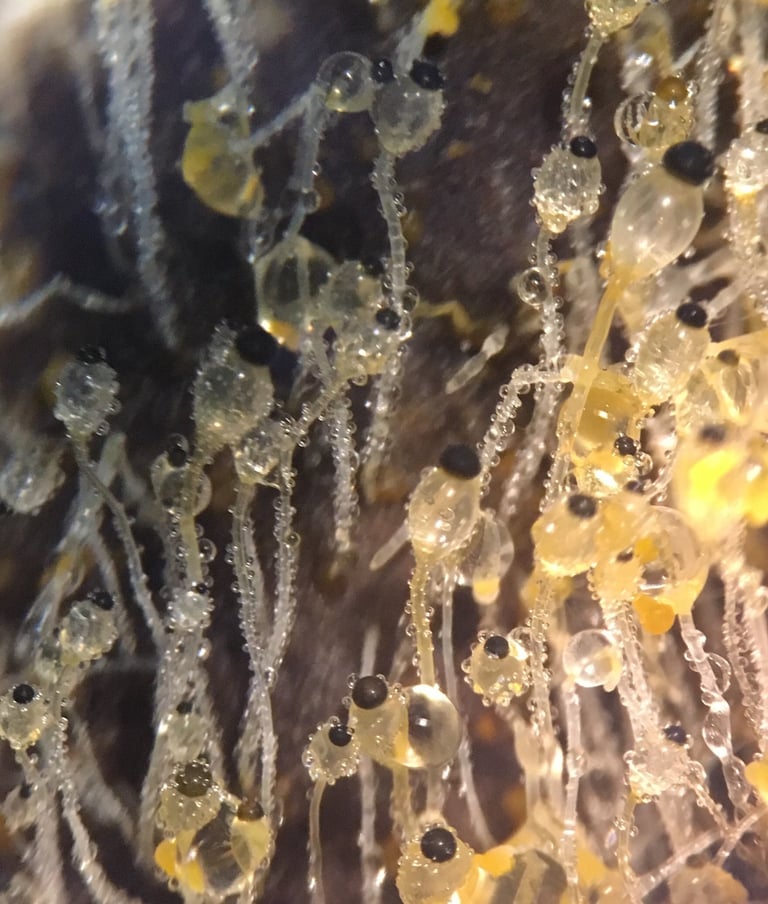
Colonies of Mucor mucedo grow quickly and can reach several centimeters in height. Their tall, simple, unbranched sporangiophores bear swollen tips filled with spores. The spores are white or yellow when immature and turn brownish grey or dark grey as they mature. The fungus reproduces both asexually and sexually.
The species is heterothallic. The (+) and (-) mating strains look alike, although (-) isolates may grow less vigorously in culture. Its zygophores are clearly distinct from its sporangiophores and rarely bear sporangia.
Temperature shapes its growth. It does not grow at 30 °C, but it grows and sporulates between 5 and 25 °C. At 15 °C and below, its sporangiophores become short and recurved, and its spores are larger. Light matters too: cultures grown in daylight at 20 °C mostly produce tall sporangiophores, while cultures kept in the dark form a dense layer of short ones. Pumpkin, sweet potato and potato dextrose agar support good growth and sporulation.
Photos
Photographs from by Brian C. Hunt via iNaturalist, licensed under CC BY 4.0., by Mark Richman via iNaturalist, licensed under CC BY 4.0., by Sarah Culliton via iNaturalist, licensed under CC BY 4.0., by Markus Krieger via iNaturalist, licensed under CC BY 4.0., and by Carolina et Arnold Dodel-Port via Wikimedia Commons, licensed under Public Domain., credited on each photo.
Ecology and classification
Classification
- Phylum
- Mucoromycota
- Class
- Mucoromycetes
- Order
- Mucorales
- Family
- Mucoraceae
- Genus
- Mucor
- Species
- Mucor mucedo
Sources
- GBIF Species names and classification
- iNaturalist Photos
- Wikidata Common names and conservation status
- Wikipedia Summary extract
- Wikimedia Commons Photos