Few fungi grow as theatrically as Phallus indusiatus. Within a single morning, a fruiting body can burst from its egg-like base and unfurl a lacy, net-patterned skirt beneath its cap, a transformation so dramatic that it has earned the mushroom names like veiled lady, bridal veil, and crinoline stinkhorn.
A member of the stinkhorn family Phallaceae, this fungus belongs to the Basidiomycota and has at times been placed in its own genus, Dictyophora, alongside other skirted Phallus species. First described in 1798 by the French botanist Étienne Pierre Ventenat, it is found across tropical regions of Africa, Asia, the Americas, and Australia. Beyond its striking looks, the species carries a long history as a prized food and medicinal ingredient in East Asia, giving it a cultural weight unusual for a stinkhorn.
Fruiting Body and Identification
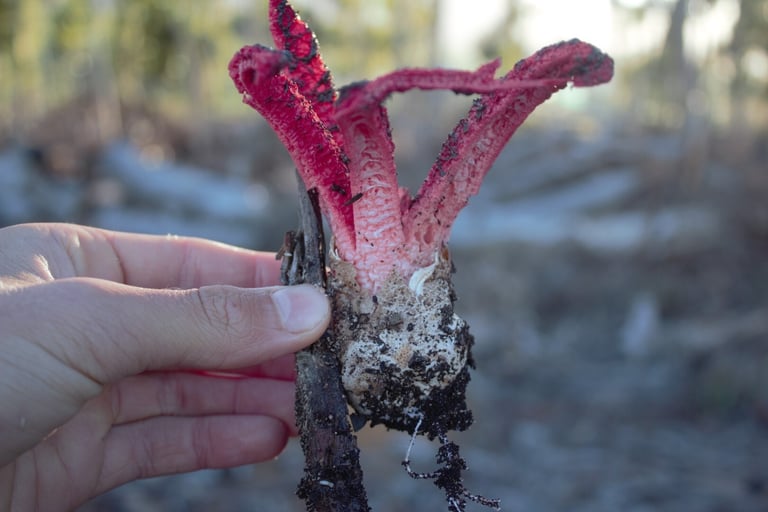
The most reliable way to recognize Phallus indusiatus is its indusium, a net-like white skirt that hangs from the cap and, in well-developed specimens, flares out before collapsing against the stalk. The mesh openings can be polygonal or rounded, and this feature distinguishes the species from close relatives with shorter, less developed skirts.
Fruiting begins underground in an egg-shaped structure up to 6 centimeters across, whitish to buff or reddish-brown, anchored by a thick mycelial cord. Internal pressure eventually splits this peridium, and the mushroom rises rapidly: observers have recorded growth to 12.5 centimeters in a single hour in the early morning, reaching 21 centimeters by 9 a.m., with full development taking 10 to 15 hours. The mature fruiting body stands up to 25 centimeters tall, with a conical to bell-shaped cap 1.5 to 4 centimeters wide, its ridged surface at first coated in a greenish-brown, foul-smelling slime called the gleba. A small hole sits at the very top of the cap.
The hollow stalk is white, spongy, roughly the same width along its length, and measures 7 to 25 centimeters long by 1.5 to 3 centimeters thick. Once insects strip away the gleba, the pale, bare cap surface is revealed underneath, and the ruptured peridium remains as a loose cup, or volva, at the stalk's base. Spores are smooth, elliptical, translucent, and tiny, at 2 to 3 by 1 to 1.5 micrometers. The whole structure is short-lived, typically collapsing within a few days.
Several related Phallus species look similar and can cause confusion. P. multicolor has brighter coloring and is usually smaller; P. merulinus has a smoother cap under the gleba and a more delicate, shorter indusium; P. duplicatus has a smaller skirt hanging only 3 to 6 centimeters from the cap; and P. cinnabarinus is more pungent and draws different fly species. P. indusiatus is best told apart by its conspicuous cap reticulation, which stays visible even under the gleba, and its longer, more robust indusium.
Distribution and Habitat
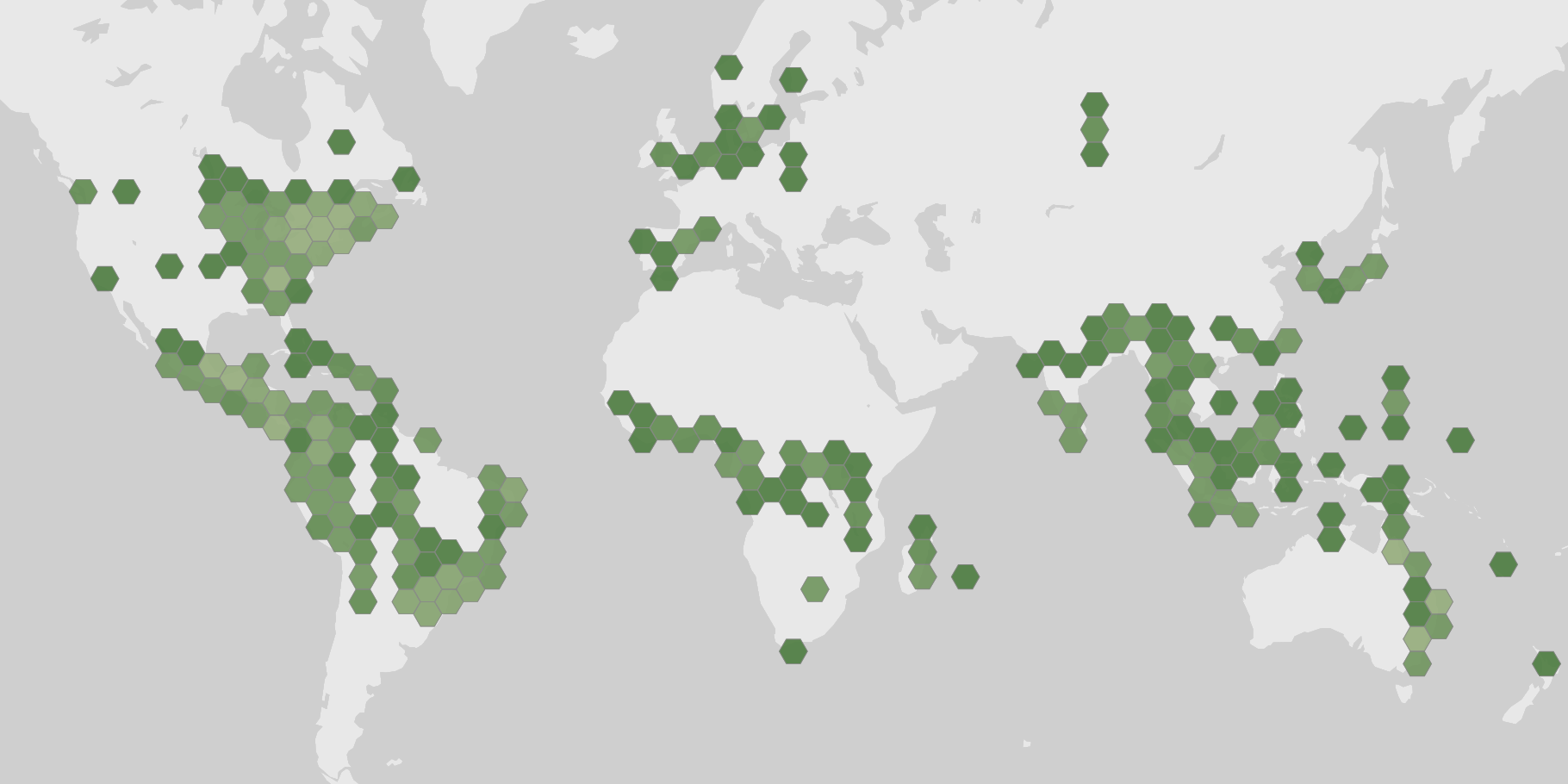
Phallus indusiatus has a broadly tropical distribution. It occurs across parts of Africa, including the Congo, Nigeria, Uganda, and Zaire; in South America in Brazil, Guyana, and Venezuela; in Central America in Costa Rica; and on Tobago. Its North American range is limited to Mexico. In Asia it has been recorded in Indonesia, Nepal, Malaysia, India, southern China, Japan, and Taiwan, and it has also been collected in Australia.
Within this range the fungus favors disturbed ground and areas with woody debris, including wood chips, and in Asia it is particularly associated with bamboo forests, where it tends to fruit after heavy rain.
Monthly presence observations show a clear rise through the year, climbing from the 150–250 range in the early months to a peak of 597 records in one month, preceded by 449 in the month before, before dropping back toward 150–250 by year's end. This pattern likely reflects the timing of fruiting after seasonal rains rather than a complete picture of abundance or range, since the records are presence observations rather than population counts.
Ecology and Relationships
Phallus indusiatus is a saprobe, breaking down wood and other plant organic matter for nutrients rather than forming partnerships with living trees. Fruiting bodies appear singly or in groups on disturbed ground, among wood chips, or, in Asia, scattered through bamboo forests after heavy rain.
Unlike most agaric mushrooms, which forcibly eject their spores, stinkhorns rely on insects. The gleba produces a sticky spore mass with a sharp, sickly-sweet carrion-like odor detectable from a distance, which draws stingless bees of the genus Trigona along with flies from the families Drosophilidae and Muscidae. These insects feed on the gleba and later excrete intact spores elsewhere, effectively dispersing the fungus to new sites.
The function of the indusium itself is not fully understood, but it may serve a dual purpose: visually attracting insects that are not drawn in by scent alone, and acting as a ladder that lets crawling insects reach the gleba at the top of the fruiting body.
Uses and Cultural History
In East Asia, Phallus indusiatus has long been regarded as both a delicacy and an aphrodisiac. Because wild specimens were scarce and difficult to procure, the mushroom was historically reserved for special occasions; during the Qing dynasty it was gathered in Yunnan Province and sent to the Imperial Palace for Empress Dowager Cixi, appearing as one of eight ingredients in the "Bird's Nest Eight Immortals Soup" served at her 60th birthday banquet. It later featured in a state banquet held for American diplomat Henry Kissinger during his visit to China in the early 1970s. Dried mushrooms sold in Asian markets are rehydrated and used in stir-fries, rich chicken soups, or stuffed preparations.
Commercial cultivation began in China in 1979 and transformed the mushroom's availability. Grown on substrates such as bamboo-trash sawdust, bamboo leaves, soybean pods or stems, corn stems, or willow leaves, under conditions of about 24°C and 90–95% humidity, production reached roughly 1,100 metric tons in China by 1998. Prices fell dramatically as a result, from around US $770 per kilogram of dried mushroom in Hong Kong in 1982 to US $100–200 by 1988, and to just US $10–20 by 2000.
The species also has a documented history in traditional Chinese medicine dating to a Tang dynasty pharmacopoeia, where it was used for inflammatory, stomach, and neural complaints; Southern China's Miao people continue to use it for various afflictions, and it has been prescribed for laryngitis, leucorrhea, fever, oliguria, diarrhea, hypertension, cough, and hyperlipidemia. Research has identified bioactive polysaccharides in the fruit body, including a β-D-glucan with anti-inflammatory effects in rats and tumor-suppressing activity against sarcoma 180 in mice, along with hydroxymethylfurfural, a compound of interest to the cosmetics and food industries as a tyrosinase inhibitor.
Fun Facts
- The species has often been classified in a separate genus, Dictyophora, grouped with other skirted Phallus species.
- A fruiting body can grow from egg to full height with astonishing speed, rising 12.5 centimeters in a single hour during early morning growth spurts.
- It was served at a state banquet for American diplomat Henry Kissinger during his 1970s visit to China.
- Dried mushroom prices in Hong Kong dropped from about US $770 per kilogram in 1982 to just US $10–20 by 2000 as commercial cultivation expanded.
- A compound in the fruit body, hydroxymethylfurfural, has drawn interest from the cosmetics industry as a tyrosinase inhibitor relevant to skin pigmentation and food browning.
- Its use in Chinese medicine has been traced back to a Tang dynasty pharmacopoeia, giving it a documented medicinal history spanning more than a thousand years.
Photos
Photographs from via iNaturalist, licensed under CC0 1.0., by Hellena de Mello Dull Ritter via iNaturalist, licensed under CC BY 4.0., by Diego Puc Estrada via iNaturalist, licensed under CC BY 4.0., by Felipe Bryant via iNaturalist, licensed under CC BY 4.0., by Jonathan Curley via iNaturalist, licensed under CC BY 4.0., by Daniel Nicholson via iNaturalist, licensed under CC BY 4.0., by reagan peschke via iNaturalist, licensed under CC BY 4.0., by BarrantesK-OSA via iNaturalist, licensed under CC BY 4.0., by Raquel Mondino via iNaturalist, licensed under CC BY 4.0., and by Luis Recalde via iNaturalist, licensed under CC BY 4.0., credited on each photo.
Ecology and classification
Behavior
- Nocturnal
Habitat
Classification
- Phylum
- Basidiomycota
- Class
- Agaricomycetes
- Order
- Phallales
- Family
- Phallaceae
- Genus
- Phallus
- Species
- Phallus indusiatus
Sources
- GBIF Species names and classification
- iNaturalist Photos
- Wikidata Common names and conservation status
- Wikipedia Summary extract