Few fungi depend so directly on fire as Rhizina undulata. Known as the doughnut fungus or pine firefungus, its spores lie dormant in the soil until heat breaks their dormancy, letting them germinate on burned or heavily disturbed ground.
This species belongs to the family Rhizinaceae within the Ascomycota, and it has a cosmopolitan distribution across central and northern Europe, North America, northern Asia, and southern Africa. It is parasitic on conifer seedlings, and it has caused considerable damage to tree plantations worldwide, making it as much a forestry concern as a curiosity for fungus enthusiasts.
Fruiting Body and Identification
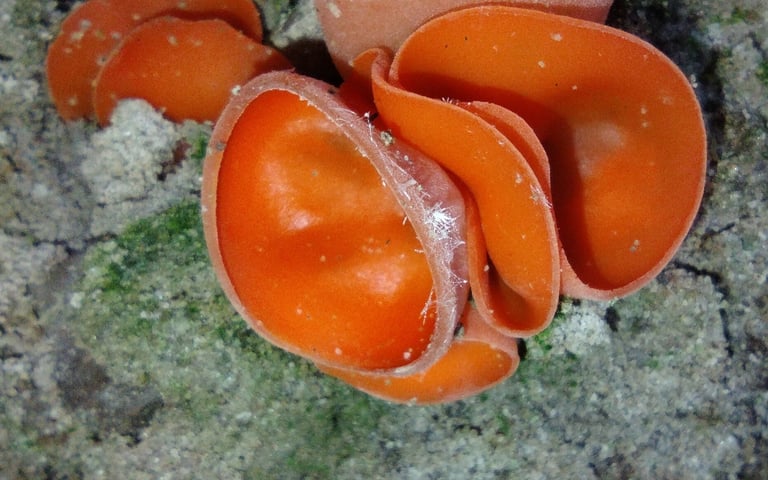
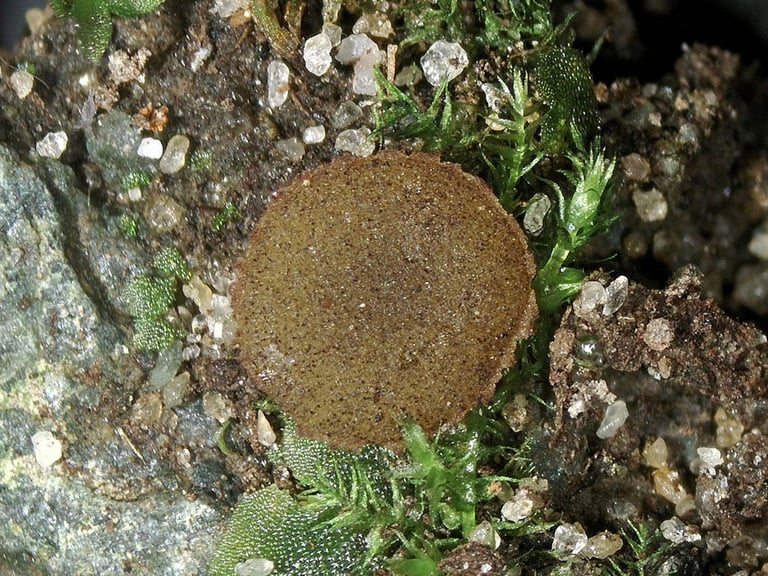
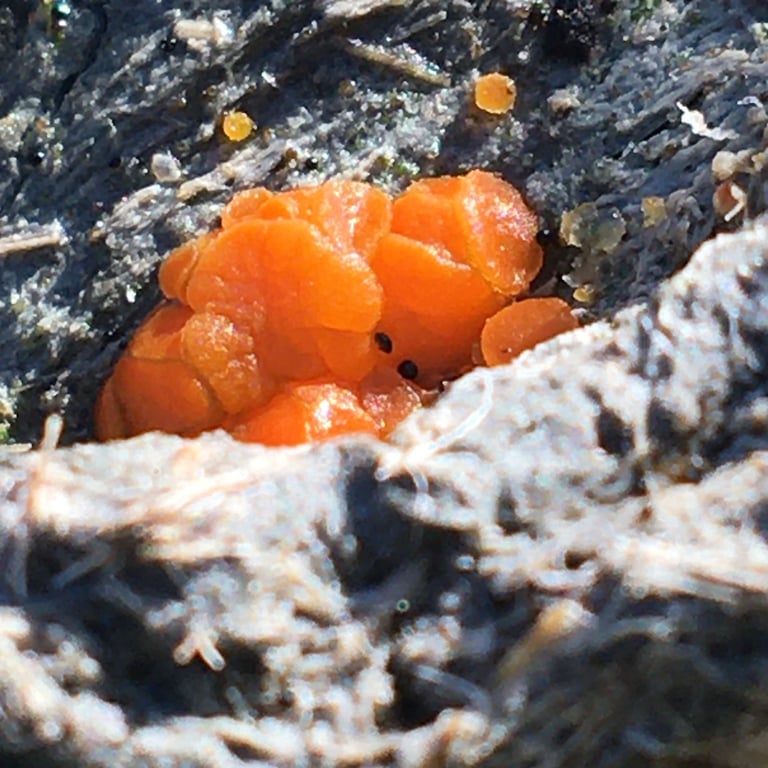
The most reliable identifying features of Rhizina undulata are its crust-like, flat fruiting body with irregular lobes and the numerous whitish to yellowish rhizomorphs that anchor its entire underside to the ground. These fruit bodies, up to 6 cm wide, have a hymenium that is dark purple-brown to blackish, bordered by a wavy, cream-colored margin. The surface turns sticky when moist and leathery with age.
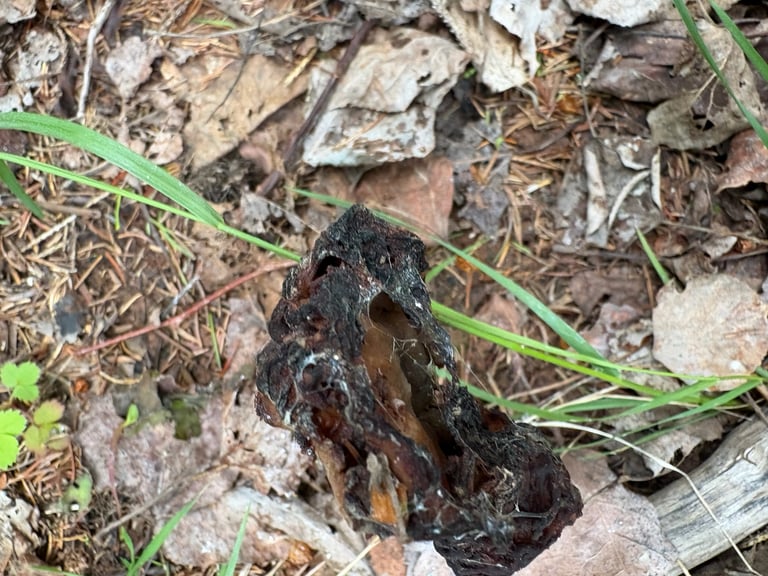
Young fruit bodies start out entirely white, with brown color first appearing at the center and spreading outward. Later in the season, several apothecia may fuse into irregular clumps up to 25 cm wide, losing the cream margin and turning black as they form resting structures capable of surviving until the next fire triggers spore germination.
Microscopically, the spores are fusiform, apiculate, minutely verrucose at maturity, carry one or two oil drops, and measure 30–40 by 8–11 μm. The asci are roughly cylindrical, 250–280 by 14–18 μm, and open through an apical operculum, while the paraphyses are club-shaped, thin-walled, brown, and 7–11 μm wide.
Distribution and Habitat
Rhizina undulata grows on burned soil or conifer debris, favoring acidic soil conditions. It has been recorded across northern Asia, Europe, and North America, and has been introduced into southern Africa. Though generally considered saprobic, it can also behave parasitically, attacking conifers of varying ages.
Fire plays a central role in where and when the fungus appears. Spore dormancy is broken by heat, and the optimum germination temperature of 35–45°C means spores can persist in soil for up to two years awaiting the right conditions. The same effect has been observed where hot asphalt, at 110–130°C, has been laid near conifers, triggering fungal attack on nearby trees.
The fungus is especially associated with recently established conifer plantations where slash burning follows clearcutting. Fruit bodies can occur prolifically in favorable sites, with one recorded case producing over 300 fruit bodies within a 6–7 m radius of a single pine stump. Some observations suggest the fungus spreads radially outward from an initial point over successive years, though this pattern has not been noted consistently.
Monthly observation records show a strong seasonal pattern, with counts rising sharply through summer and peaking around August, suggesting that fruiting and observation activity are concentrated in the warmer months, though these figures reflect recorded sightings rather than actual abundance.

Fun Facts
- Its common name, the doughnut fungus, comes from its flattened, ring-like shape with a wavy margin.
- The fungus is homothallic, meaning it can produce fruit bodies without mating with another individual.
- German forestry scientist Robert Hartig studied the species in the late 1800s and early 1900s, describing how its mycelium invades and kills seedling root tissue cell by cell.
- The fungus's parasitic spread around an infected root system typically stops four to seven years after the initial infection begins.
Photos
Photographs from via iNaturalist, licensed under CC0 1.0., credited on each photo.
Ecology and classification
Habitat
Classification
- Phylum
- Ascomycota
- Class
- Pezizomycetes
- Order
- Pezizales
- Family
- Rhizinaceae
- Genus
- Rhizina
- Species
- Rhizina undulata
Sources
- GBIF Species names and classification
- iNaturalist Photos
- Wikidata Common names and conservation status
- Wikipedia Summary extract