Wood stitchwort (Stellaria nemorum) is a stoloniferous herbaceous perennial flowering plant in the family Caryophyllaceae. It grows across much of Europe, where it thrives in wet places of deciduous forests such as beech forests.
The plant spreads partly by stolons, which lets it form patches over time. Its white flowers and sprawling growth make it a familiar member of the woodland herb layer.
Identification and Appearance
The most useful field mark is the flower: each white bloom has five deeply bifid petals, so the petals look like ten, and it has 10 stamens and 3 styles.
The plant can reach a height of 60 cm (24 in). Its leaves are arranged in opposite pairs. The upper leaves are sessile, meaning they have no stalk, while the lower leaves have petioles.
The flowers open from May to August, which is the period when the plant is easiest to recognize.
Distribution and Habitat
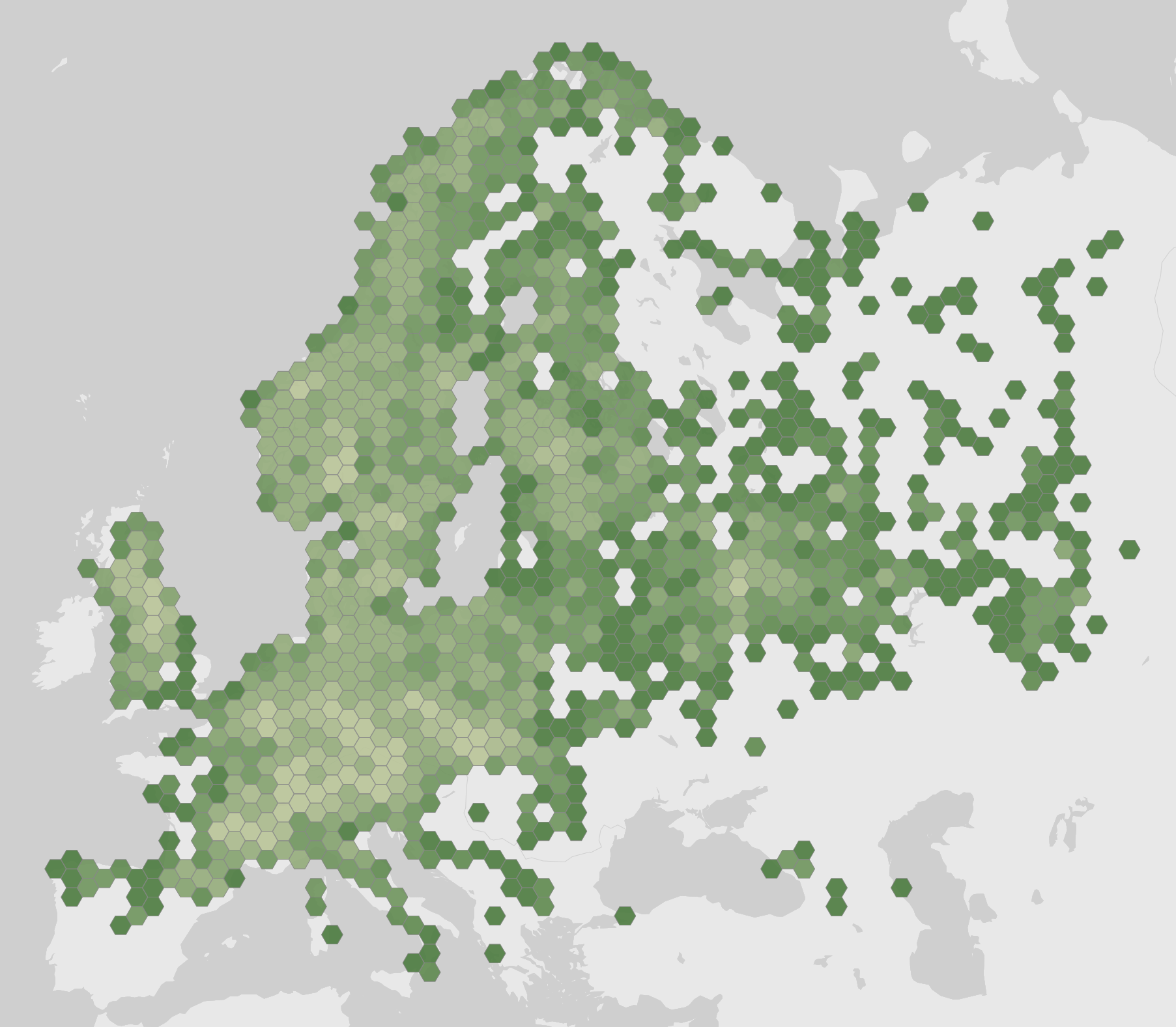
Wood stitchwort is native to Europe and extends east through European Russia to northern Iran, Mongolia, and north-central China. Its native range includes most of central, northern, and southern Europe, including Great Britain, France, Germany, Italy, Spain, Sweden, and Norway.
In the wild it grows in wet places of deciduous forests, such as beech forests. It also occurs on grassland slopes at elevations of 2100 to 2700 m.
It has been introduced to Bolivia, Honduras, southeastern Mexico, and Peru.
Observations peak from late spring into summer, with the highest counts in June and July.
Growth and Form
Wood stitchwort is a perennial, so it persists across years rather than completing its life in a single season. It reaches a height of 60 cm (24 in).
Its stolons allow the plant to spread vegetatively along the ground, extending its patch beyond the original stems.
Ecology and Relationships
The flowers attract a range of visitors, with flies being the most common, including hoverflies such as Episyrphus balteatus and Platycheirus manicatus. Bumblebees such as Bombus lapidarius and Bombus pascuorum and mining bees of the genus Andrena also visit the blooms.
The foliage and seeds are eaten by grasshoppers and crickets of the order Orthoptera and by moth caterpillars of the order Lepidoptera. Passerine birds, which include finches and larks, are among its main bird consumers, and game birds and waterfowl also feed on it.
The plant grows in wet, shaded deciduous woodland and on grassy slopes, which are the conditions it needs.
Photos
Photographs from via iNaturalist, licensed under CC0 1.0., by Полина Полежанкина via iNaturalist, licensed under CC BY 4.0., by Stanislav Murashkin via iNaturalist, licensed under CC BY 4.0., by Gianmaria Bonari via iNaturalist, licensed under CC BY 4.0., by Thomas Dreux via iNaturalist, licensed under CC BY 4.0., by Maxim Votyakov (maximaximax) via iNaturalist, licensed under CC BY 4.0., by Ljaž via iNaturalist, licensed under CC BY 4.0., by Maryna Burlaka via iNaturalist, licensed under CC BY 4.0., by Ingvild Riska via iNaturalist, licensed under CC BY 4.0., by Clément Maouche via iNaturalist, licensed under CC BY 4.0., by Михаил Языков via iNaturalist, licensed under CC BY 4.0., by Марина Давлетшина via iNaturalist, licensed under CC BY 4.0., and by Maria Kohanovskaya via iNaturalist, licensed under CC BY 4.0., credited on each photo.
Ecology and classification
Classification
- Phylum
- Tracheophyta
- Class
- Magnoliopsida
- Order
- Caryophyllales
- Family
- Caryophyllaceae
- Genus
- Stellaria
- Species
- Stellaria nemorum
Sources
- GBIF Species names and classification
- iNaturalist Photos
- Wikidata Common names and conservation status
- Wikipedia Summary extract
- Encyclopedia of Life Habitat, diet and behavior traits
- Plants of the World Online Native range, life form and climate (WCVP)
- GloBI What it eats, what eats it, parasites and pollinators
- trophiCH
- DoPI
- Schwarz et al. 2021
- EuPPollNet