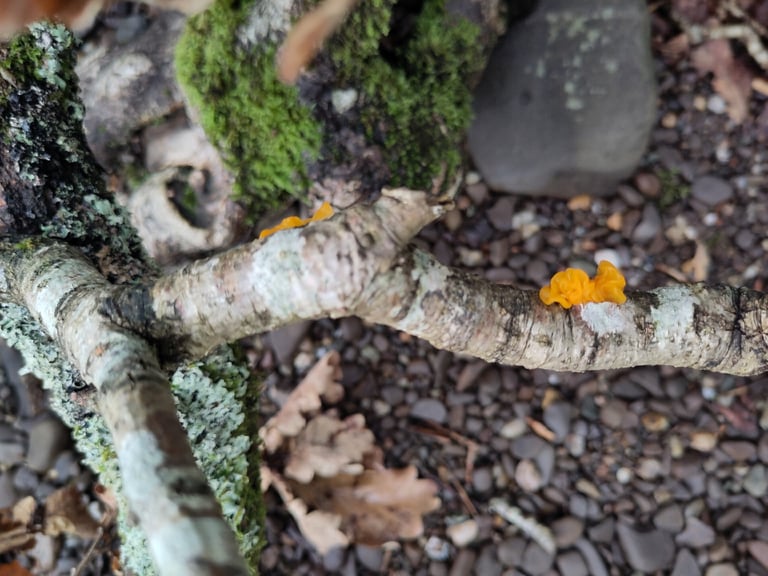
A fungus that feeds on another fungus, sometimes swallowing its host whole in a coat of golden jelly, Tremella aurantia is one of the more unusual sights on a winter woodland walk. Known in North America as golden ear, it produces bright yellow, gelatinous, frond-like fruiting bodies that erupt from dead branches of broadleaf trees.
The species belongs to the class Tremellomycetes within the phylum Basidiomycota, and it has a wide, north temperate distribution across North and South America, Europe, and northern Asia. No conservation status has been assessed for it, but its bright color and strange, seaweed-like form make it one of the more memorable jelly fungi encountered on fallen wood.
Fruiting Body and Identification
The most reliable identifying feature of Tremella aurantia is its color: a bright, uniform yellow across the whole gelatinous fruiting body. The fungus grows as lobed to frondose masses, folded and branched somewhat like a small clump of seaweed, reaching up to 15 cm (6 in) across at maturity. Its texture is soft and jelly-like throughout, without a differentiated cap, gills, pores, or stem, since the entire structure is a single convoluted mass of gelatinous tissue.
Microscopically, the fungus consists of clamped hyphae embedded in a dense gelatinous matrix. Specialized haustorial cells arise from these hyphae and produce filaments that attach to and penetrate the unclamped hyphae of its host fungus, Stereum hirsutum, drawing nutrients from it. The basidia are tremelloid in form, spherical to ellipsoid with oblique to vertical septa, measuring 13–14 by 9–13 μm, and are sometimes stalked.
Spores are subglobose to ellipsoid, smooth-walled, and measure 5.5–9.5 by 4.5–7.5 μm. They germinate either by producing a hyphal tube or by budding off yeast cells, an unusual dual strategy among basidiomycetes.
Distribution and Habitat
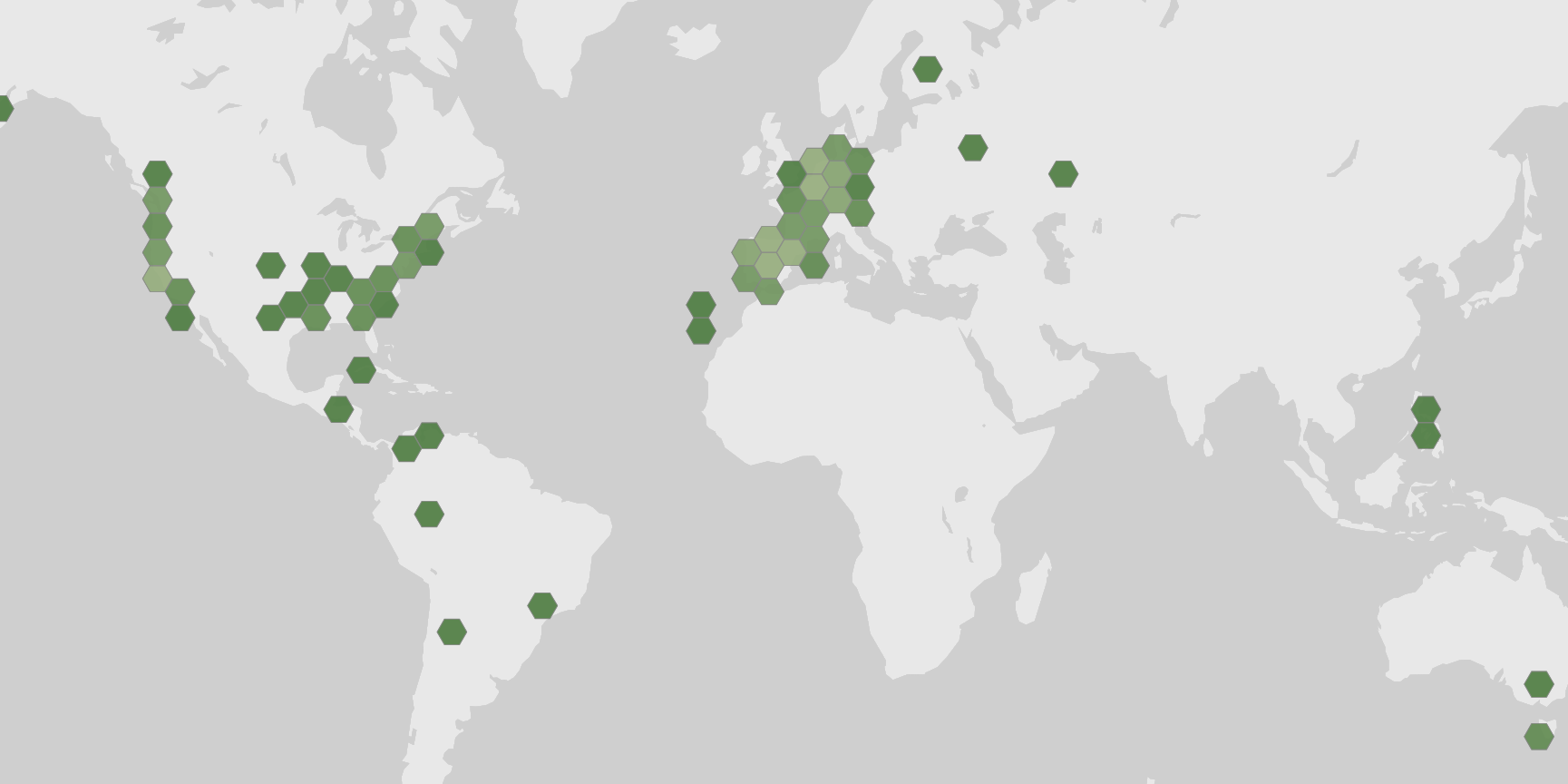
Tremella aurantia has a mainly north temperate distribution, recorded throughout North and South America, Europe, and northern Asia. It follows the distribution of its host fungus, Stereum hirsutum, appearing on dead, attached, or recently fallen branches of broadleaf trees where that host grows.
Monthly observation data show a clear seasonal pattern, with the highest counts recorded in November (230) and December (217), staying elevated into January (183), and dropping sharply through the summer months, with lows in July (16) and August (18). This pattern suggests the fungus fruits and is most often noticed in late autumn and winter, becoming far less conspicuous during the warmer months. These figures are presence observations only and do not indicate abundance or a complete picture of the species' range.
Uses and Cultural History
No confirmed cultural tradition or practical use of Tremella aurantia has been documented. Its bright yellow, gelatinous form closely resembles that of Tremella mesenterica, commonly called "witch's butter," and this resemblance has sometimes led to T. aurantia being erroneously drawn into folklore involving witches and magical transformations.
These associations likely arose from broader cultural myths surrounding brightly colored, oddly shaped fungi in general, rather than from any specific, confirmed tradition tied to T. aurantia itself.
Fun Facts
- Fruiting bodies can grow up to 15 cm (6 in) across, forming lobed, frondose masses that resemble small clumps of seaweed.
- Tremella aurantia is parasitic on another fungus, Stereum hirsutum, and can grow large enough to completely envelop its host's fruiting body.
- Its spores can germinate in two different ways: by growing a hyphal tube or by producing yeast cells.
- Because of its resemblance to Tremella mesenterica, or "witch's butter," T. aurantia has occasionally been swept into folklore about witches and magical transformation, despite no confirmed tradition specific to the species itself.
- Observation records peak sharply in late autumn and winter, particularly November and December, suggesting this is when the fungus is most often fruiting and noticed.
Ecology
Habitat
- Forest
- Woodland