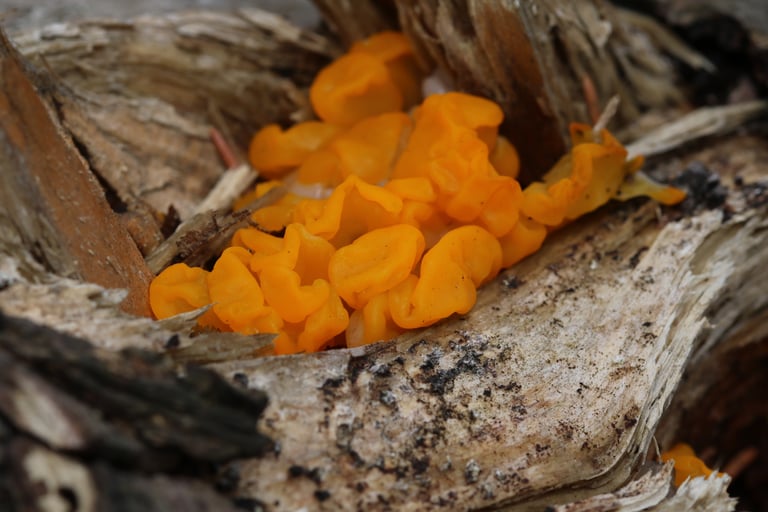
Tremella mesenterica is not simply a wood-dweller—it is a parasite in disguise, feeding on the mycelium of other wood-rotting fungi rather than the wood itself. Its gelatinous, orange-yellow lobes erupt through cracks in bark, looking every bit like a splash of butter left on a dead branch, which is exactly how it earned the common name Witch's Butter.
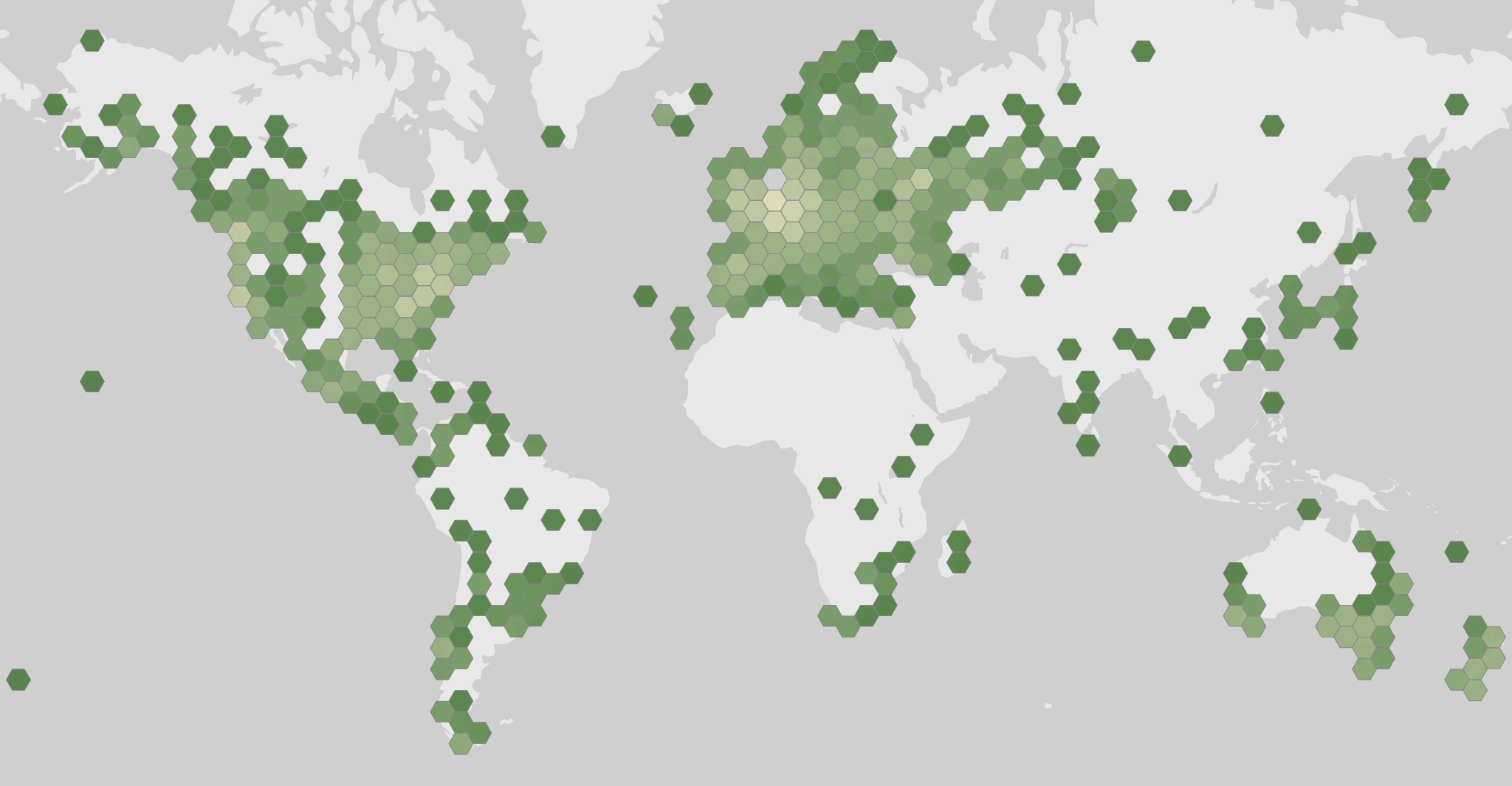
Classified in the family Tremellaceae within the class Tremellomycetes, this jelly fungus has a cosmopolitan distribution, turning up on dead branches across North, Central, and South America, Africa, Europe, Asia, and Australia. Its unusual life cycle, host relationship, and long history in folklore and Chinese cuisine make it far more interesting than its slippery, unassuming appearance suggests.
Fruiting Body and Identification
The most reliable field mark is the fruit body's texture and color: a gelatinous, greasy-to-slimy surface when damp, ranging from deep yellow to bright yellow-orange and fading to pale yellow with age, occasionally appearing colorless or white. The fruiting body is irregular in shape—rounded, lobed, or convoluted like a brain—and can reach up to 7.5 cm (3 in) across and 2.5 to 5 cm (1 to 2 in) high. It typically breaks through the bark of dead branches as it develops. Fresh specimens are tough but pliable when wet, becoming hard when dry, and drying down to a dark reddish or orange husk.
Microscopically, the basidia are ellipsoid to nearly spherical, usually 15–21 μm wide, and divided internally by two to four septa arranged diagonally or vertically. The fungus also reproduces asexually through conidia produced on densely branched conidiophores in the hymenium; young fruit bodies can be so covered in these spherical-to-ellipsoid conidia (2–3 by 2–2.5 μm) that they appear coated in a bright yellow slime. Sexual spores are broadly ellipsoid to oblong, 10–16 by 6–9.5 μm, whitish to pale yellow in mass, and germinate either by a germ tube or by producing yeast-like conidia identical to those of the conidiophores.
Tremella mesenterica is frequently confused with Tremella aurantia, which parasitizes the fungus Stereum hirsutum rather than Peniophora. The two can be told apart by texture and behavior when dried: T. aurantia has a matte, not greasy, surface with thicker lobes, and because it contains unclamped, thick-walled host hyphae, it holds its shape when dried rather than shriveling into a thin film as T. mesenterica does. Under the microscope, T. aurantia has smaller basidia and smaller spores (8.5–10 by 7–8.5 μm). T. brasiliensis and the North American T. mesenterella are also similar, as is Naematelia aurantia, distinguished mainly by its host and reduced translucency.
Members of the family Dacrymycetaceae, such as Dacrymyces chrysospermus, can look superficially similar but are structurally distinct: their basidia are Y-shaped and bear only two spores, compared to the longitudinally split basidia of Tremella. Dacrymyces chrysospermus is also smaller, has a whitish point of attachment, and grows specifically on conifer wood rather than the hardwoods favored by T. mesenterica.
Distribution and Habitat
Tremella mesenterica has a cosmopolitan distribution, recorded across North, Central, and South America, Africa, Europe, Asia, and Australia. It favors mesic to wet habitats and fruits during wet periods of the year rather than on a single fixed schedule. In British Columbia, Canada, it has been found on maple, poplar, and pine, but is most abundant on red alder, reflecting its dependence on the specific wood-decaying fungi it parasitizes rather than on any single tree species.
Because the fungus grows parasitically on the mycelium of corticioid fungi in the genus Peniophora, its distribution is tied to wherever suitable host fungi are decomposing dead wood. Occasionally, T. mesenterica and its host can be found fruiting side by side on the same branch.
Monthly observation records show a clear seasonal pattern, with counts highest in the cooler months—peaking around November through February—and dropping sharply through the summer, reaching their lowest point around June and July. This pattern likely reflects the fungus's need for consistently wet conditions to fruit rather than any fixed calendar season, and as presence records rather than abundance data, the counts should be read only as an indication of when the fungus is being noticed and reported, not how much of it exists.
Life Cycle
Tremella mesenterica has a life cycle that alternates between a yeast-like budding phase and a sexual, fruit-body-forming phase. Basidiospores bud to produce haploid yeast cells, and sexual reproduction begins when yeast cells of two compatible mating types encounter one another. Each mating type secretes its own pheromone—one identified as tremerogen A-10, a S-polyisoprenyl peptide—that triggers the opposite mating type to arrest its cell division cycle in the G1 phase and grow an elongated mating tube, a process resembling bud emergence in ordinary budding yeasts.
Once mating is complete, the fungus develops fruit bodies from a primordium that forms beneath the bark of dead wood. Sometimes more than one fruit body arises separately from the same primordium, which can produce the clustered, multi-lobed masses often seen on a single branch. From there, the visible gelatinous fruiting structure emerges through cracks in the bark to release spores and continue the cycle.
Uses and Cultural History
Accounts of the edibility of Tremella mesenterica vary: some sources classify it as inedible or simply non-poisonous, while others describe it as edible but flavorless. Where it is used as food, its gelatinous, rubbery texture is valued for the body it lends to soups rather than for any distinct flavor. In China, it is used by vegetarians to prepare an immunomodulating cooling soup combined with ingredients such as lotus seed, lily bulb, and jujube.
Beyond the kitchen, the species has drawn scientific interest for the polysaccharides it produces. An acidic polysaccharide isolated from haploid cells of T. mesenterica, first reported by Slodki in 1966, closely resembled compounds made by Cryptococcus laurentii, suggesting a phylogenetic link between the two organisms. This compound, glucuronoxylomannan, has since been chemically characterized as a mannan backbone glycosylated with regularly repeating xylan chains, and it can be produced both by fruit bodies and in pure laboratory culture. Laboratory tests have associated this polysaccharide with immunostimulatory, antidiabetic, anti-inflammatory, hypocholesterolemic, hepatoprotective, and antiallergic effects, and several patents have been filed in China around its potential use in cancer prevention and immune enhancement.
Culturally, foragers and nature writers have come to treat Witch's Butter as a symbol of forest health and biodiversity, viewing it as a visible link between decaying wood and the wider community of decomposer fungi that depend on it.
Fun Facts
- The common name "Witch's Butter" reportedly comes from old folklore claiming the fungus was used by witches to place hexes on people.
- Modern foragers and nature writers often treat Witch's Butter as a symbol of forest health and biodiversity, since its presence points to an active web of decomposer fungi at work in decaying wood.
Ecology
Habitat
- Forest
- Woodland