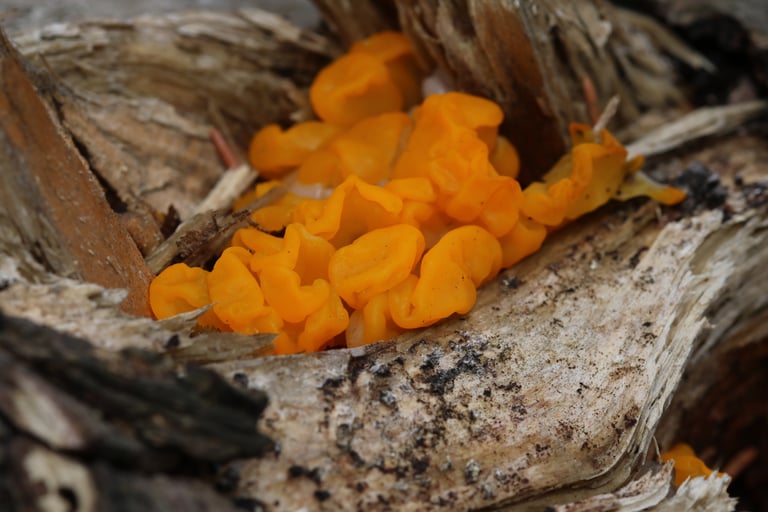
Beneath its many names — snow fungus, snow ear, silver ear, white cloud ears — Tremella fuciformis hides a single, unmistakable form: a cluster of translucent white, frond-like lobes that look more like sea coral or crumpled tissue paper than a typical mushroom.
It belongs to the Tremellaceae, a family of jelly fungi in the phylum Basidiomycota, class Tremellomycetes, order Tremellales. Its fruiting bodies are entirely gelatinous, with none of the cap-and-stem structure most people associate with mushrooms.
This unusual shape and texture, combined with its long history in Chinese cuisine and medicine, make it one of the more recognizable jelly fungi grown and eaten anywhere in the world.
Fruiting Body and Identification
The clearest way to recognize Tremella fuciformis is its overall shape: a dense mass of thin, erect, branching fronds that resemble seaweed, colored watery white and often crisped along their edges. Wild fruiting bodies reach up to 7 centimeters (about 3 inches) across, though cultivated specimens can grow noticeably larger.
The entire structure is gelatinous rather than fleshy. Under the microscope, its hyphae carry clamp connections and sit packed within a dense gelatinous matrix. Specialized haustorial cells grow from these hyphae, sending out filaments that attach to and penetrate the hyphae of the fungus's host — a feature tied directly to its parasitic lifestyle rather than to independent decay.
Reproductive structures are equally distinctive under magnification. The basidia are tremelloid: ellipsoid in shape, with septa that run obliquely to vertically, measuring 10–13 by 6.5–10 micrometers, and sometimes borne on short stalks. Spores are smooth and ellipsoid, 5–8 by 4–6 micrometers, and can germinate either by producing a hyphal tube or by budding off yeast-like cells.
Two other jelly fungi can resemble it at a glance. Ductifera pululahuana is more opaque than T. fuciformis, and Sebacina sparassoidea looks similar but grows directly on the ground rather than on wood.
Distribution and Habitat
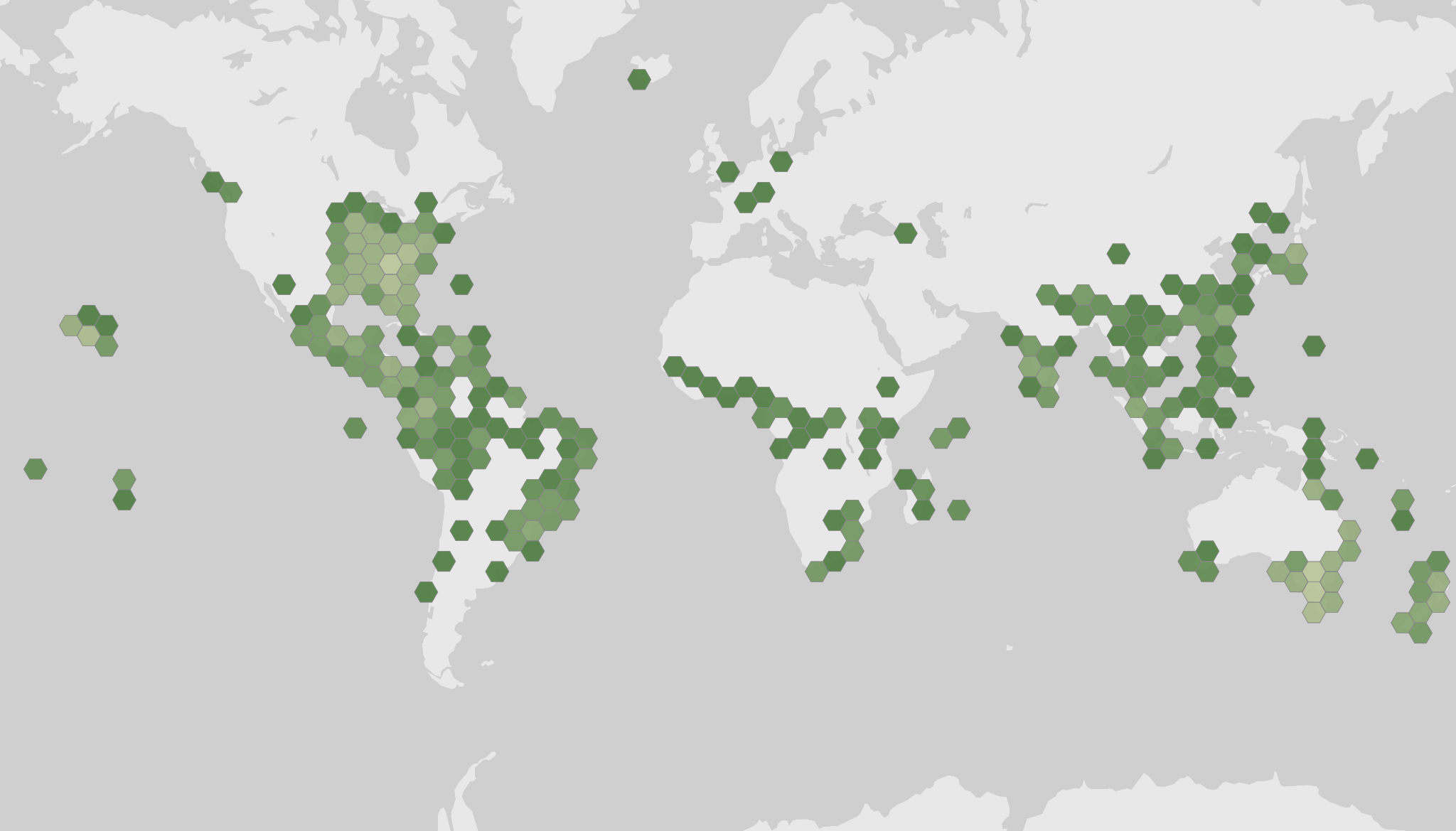
Tremella fuciformis is mainly a fungus of tropical and subtropical regions, though its range extends into temperate parts of Asia and North America. It has been recorded across southern and eastern Asia, sub-Saharan Africa, North and Central America, South America, the Caribbean, the Pacific Islands, Australia, and New Zealand, where a related form may belong to a separate species complex.
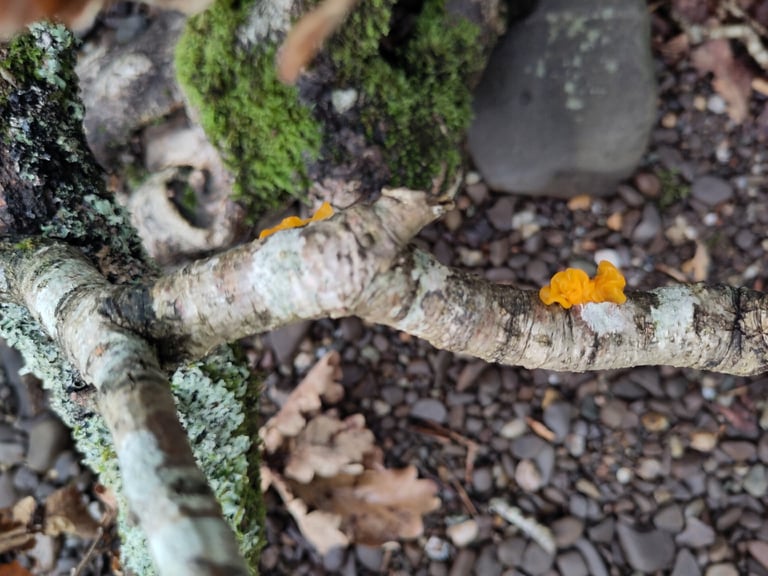
Its distribution follows that of its host. T. fuciformis is a parasite of fungi in the genus Annulohypoxylon — until a 2005 reclassification these were grouped with Hypoxylon, a genus of wood-rotting "cramp ball" fungi. Because of this relationship, fruiting bodies typically appear on dead, still-attached or recently fallen branches of broadleaf trees, following wherever its preferred host, Annulohypoxylon archeri, is present.
Monthly observation records show a clear seasonal pattern, with counts climbing sharply from spring and peaking in June and July before tapering off through autumn and winter. These figures reflect presence observations rather than true abundance or a complete map of the species' range, but the pattern suggests fruiting is concentrated in the warmer months in the regions where records were gathered.
Uses and Cultural History
Tremella fuciformis has one of the longest documented histories of any cultivated fungus, with medicinal use in China traced back to around 200 CE, when it appeared in the Shen Nong Ben Cao Jing, one of the earliest classics of Chinese materia medica. Tradition holds that the Tang dynasty beauty Yang Guifei used it during the eighth century to maintain her complexion, a story still repeated today in descriptions of the fungus as a longevity tonic.
Cultivation in China dates back at least to the nineteenth century, when wooden poles were left exposed in hopes of natural colonization. Growers later improved results by inoculating poles directly with spores or mycelium, but reliable production only became possible once cultivators realized that both T. fuciformis and its fungal host needed to be introduced together. This "dual culture" method, now standard commercially, inoculates a sawdust substrate with both the fungus and its preferred host, Annulohypoxylon archeri, under controlled conditions. Chinese production was estimated at around 130,000 tonnes in 1997, with additional cultivation across East Asia and smaller-scale growing elsewhere.
In the kitchen, the fungus contributes little flavor of its own but is valued for its gelatinous texture, most often appearing in Cantonese dessert soups such as luk mei, alongside jujubes and dried longans, as well as in drinks and ice cream; cheaper cultivated supplies have also brought it into savory dishes. Vietnamese cooks use it in chè, a category of sweet soups, puddings, and beverages. Beyond food, extracts are used in skincare products across China, Korea, and Japan, where they are said to improve skin moisture retention and reduce the appearance of fine lines, and in traditional Chinese medicine it is associated with nourishing the lungs and supporting the body's yin energy.
Fun Facts
- Its host fungus was reclassified in 2005: the wood-rotting "cramp ball" species it depends on moved from the genus Hypoxylon into the new genus Annulohypoxylon.
- The species carries an unusually large number of common names in English alone, including snow fungus, snow ear, silver ear fungus, white ear fungus, and white cloud ears.
- Commercial growers only achieved reliable cultivation after discovering that the fungus and its fungal host must be inoculated into the growing substrate together, a technique known as dual culture.
- Legend credits the Tang dynasty beauty Yang Guifei with using the fungus to preserve her complexion more than 1,200 years ago.
Photos
Photographs from via iNaturalist, licensed under CC0 1.0., by Toadkeeper via iNaturalist, licensed under CC BY 4.0., by Atsushi Nakajima via iNaturalist, licensed under CC BY 4.0., by Brian C. Hunt via iNaturalist, licensed under CC BY 4.0., by Addie via iNaturalist, licensed under CC BY 4.0., by Ben Machado via iNaturalist, licensed under CC BY 4.0., by Teodoro Chivatá Bedoya via iNaturalist, licensed under CC BY 4.0., by Celeste Ray via iNaturalist, licensed under CC BY 4.0., by Nat Gorka via iNaturalist, licensed under CC BY 4.0., by Mark Richman via iNaturalist, licensed under CC BY 4.0., by willingarden via iNaturalist, licensed under CC BY 4.0., by Brynn Fricke via iNaturalist, licensed under CC BY 4.0., and by Cristina Sininho Sa via iNaturalist, licensed under CC BY 4.0., credited on each photo.
Ecology and classification
Habitat
Classification
- Phylum
- Basidiomycota
- Class
- Tremellomycetes
- Order
- Tremellales
- Family
- Tremellaceae
- Genus
- Tremella
- Species
- Tremella fuciformis
Sources
- GBIF Species names and classification
- iNaturalist Photos
- Wikidata Common names and conservation status
- Wikipedia Summary extract
- Encyclopedia of Life Habitat, diet and behavior traits