Tuber magnatum, the white truffle, grows almost nowhere outside a narrow band of Southern Europe—yet the very same species has been found as far away as Thailand, thousands of kilometers from its Piedmontese heartland.
The species belongs to the fungal kingdom, in the order Pezizales and family Tuberaceae. Unlike mushrooms with visible caps and stems, it grows entirely underground as an ascocarp, forming a close partnership with the roots of specific host trees.
Its range centers on Italy but extends into other parts of Southern Europe. Few fungi command the same mix of scientific curiosity and gastronomic obsession, a combination that makes the white truffle one of the most sought-after organisms on the market.
Fruiting Body and Identification
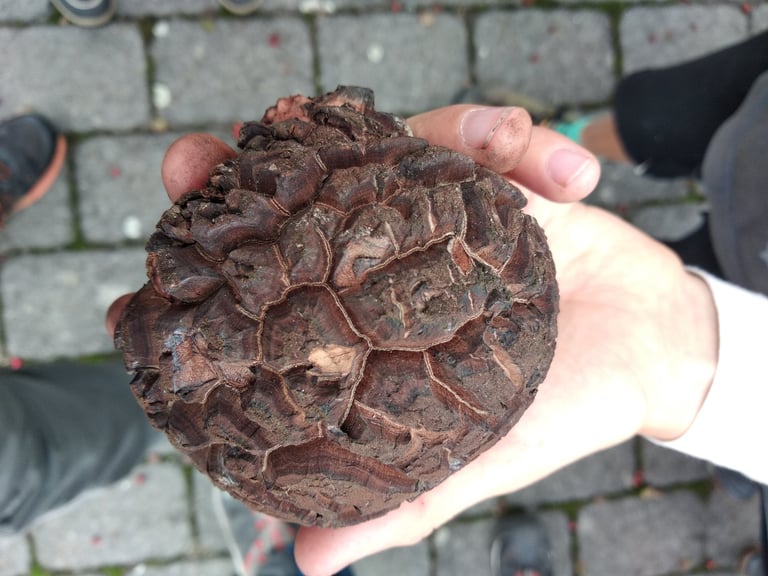
The most reliable way to recognize Tuber magnatum is its pale, smooth exterior, since unlike black truffles it lacks the coarse, wart-like peridium typical of many other Tuber species. Fruiting bodies form entirely underground and are irregularly rounded, taking on the shape of whatever soil pocket they grow within.
Mature specimens can reach 12 centimeters (4.5 inches) across and weigh up to 500 grams (18 ounces), though most collected truffles are considerably smaller. Fruiting takes place in autumn, when the ascocarps reach the size at which they are typically harvested.
Inside, the flesh is pale cream to brown, marked with fine white marbling that runs through the tissue in irregular veins. This internal pattern, combined with the smooth outer surface, distinguishes it from many darker, wrinkled truffle relatives.
Distribution and Habitat
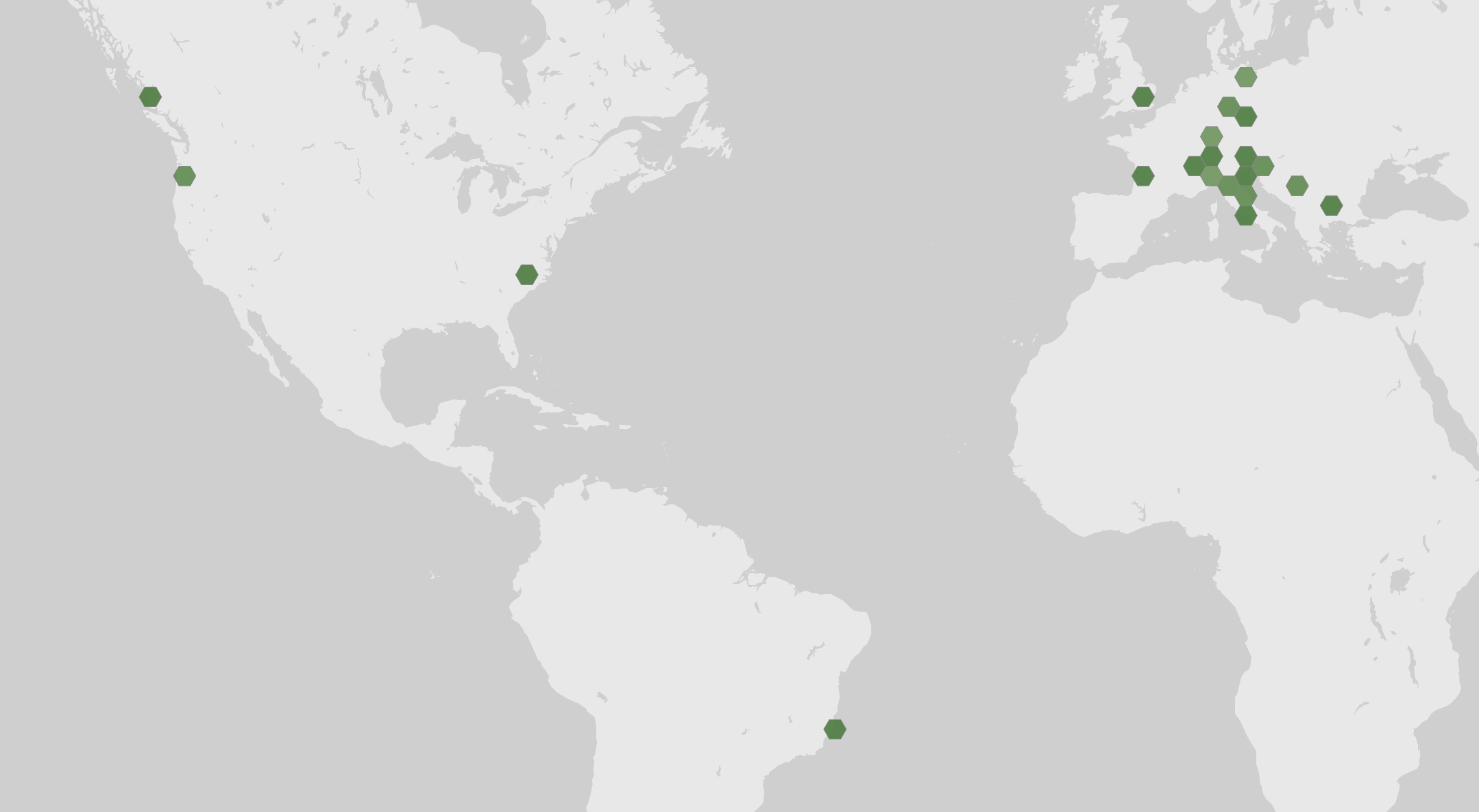
Tuber magnatum is centered on northern Italy, above all the Langhe and Montferrat districts of Piedmont around Alba and Asti, long the most celebrated source of the fungus. It also occurs in Acqualagna in the Marche, in Molise, Abruzzo, the hills near San Miniato in Tuscany, and in Sicily.
Beyond Italy, populations are documented in Croatia's Istria region along the Mirna river, the Ticino and Geneva cantons of Switzerland, southeastern France, Hungary, Serbia, Slovenia's Dragonja and Rižana valleys, Greece, Bosnia and Herzegovina (notably Vlašić, Lisina, and Kozara), and even Thailand.
The fungus forms symbiotic partnerships with a range of trees, most often oaks such as Quercus pubescens, Q. cerris, Q. ilex, Q. robur, and Q. petraea, as well as poplars, hazels, beech, and several willow species. It favors neutral to alkaline soils with an average pH near 7.7, and fruiting bodies require at least 0.4°C during their winter formation, which roughly limits its range to areas north of the 0°C mean winter isotherm.
Observation records peak sharply in October and November, consistent with the traditional autumn harvest season, with a smaller rise in July. These figures reflect when people report finding the fungus rather than a measure of its true abundance or population size.
Uses and Cultural History
Few fungi carry the cultural weight of the white truffle, prized in the culinary world for its delicate flavor and intense aroma. In Piedmontese cuisine it is often paired with robust red wines such as Barolo, while French cooks shave it over foie gras to build layers of rich, buttery flavor.
The Alba region has celebrated the fungus since 1929 through the International Alba White Truffle Fair, held each October and November when the market is busiest. Prices have climbed dramatically over the decades: truffles sold for $2,200–$4,800 per kilogram in 2001, and by December 2009 that figure had risen to roughly $14,200 per kilogram. Individual specimens have fetched extraordinary sums at auction, including $330,000 paid twice by Macau casino owner Stanley Ho, once in 2007 for a 1.5-kilogram truffle and again in 2010 for a pair including one weighing nearly a kilogram.
Such value has made fraud common. Cheaper look-alike species such as Tuber borchii and Tuber oligospermum are sometimes sold as T. magnatum, and in 2012 tests found that 15% of high-priced truffles marketed as French were actually a cheaper Chinese species. Some fraudulent products even have their scent enhanced with a petroleum-based compound harmful to human health. In 2017, Italy's financial police uncovered a €66 million tax fraud scheme among truffle producers, prompting a law requiring hunters earning over €7,000 annually to document the origin of their truffles.
Fun Facts
- A white truffle weighing 1.31 kilograms (2 lb 14 oz) was found near Buje, Croatia, in November 1999 and was, at the time, entered into the Guinness Book of Records as the largest in the world.
- In December 2014, a 1.89-kilogram (4 lb 2.5 oz) specimen unearthed in Umbria, Italy, sold for $61,000 at a Sotheby's auction, despite expectations it might fetch $1 million.
- In 2021, an 830-gram white truffle from Piedmont sold for €103,000 at auction.
- Chemical analysis shows Tuber magnatum accumulates roughly twice as much zinc as other truffle species, along with elevated copper, potassium, sodium, and phosphorus.
- European folk medicine once regarded truffles, including this species, as general aphrodisiacs and digestive aids, a reputation likely tied more to their rarity and scent than to any proven effect.
- On the Asti market in 2012, more than 90% of the truffles sold did not actually come from Alba, and about three-quarters of those labeled as Piedmontese originated elsewhere in Italy.
Photos
Photographs from by Brian C. Hunt via iNaturalist, licensed under CC BY 4.0., credited on each photo.
Ecology and classification
Habitat
Classification
- Phylum
- Ascomycota
- Class
- Pezizomycetes
- Order
- Pezizales
- Family
- Tuberaceae
- Genus
- Tuber
- Species
- Tuber magnatum
Sources
- GBIF Species names and classification
- iNaturalist Photos
- Wikidata Common names and conservation status
- Wikipedia Summary extract