European mycologists often skip the name Verpa bohemica altogether, preferring the synonym Ptychoverpa bohemica—a naming split that reflects just how distinctive this little fungus is within its family. It belongs to the Ascomycota, in the order Pezizales and the family Morchellaceae, placing it alongside the true morels even though it forms its own genus.
Commonly called the early morel or the wrinkled thimble-cap, it is worth a closer look precisely because both names hint at what sets it apart: an unusual, thimble-like cap and a habit of appearing before its morel relatives.
Fruiting Body and Identification
The single most reliable way to identify Verpa bohemica is not its cap shape but its enormous spores, which measure 60–80 by 15–18 μm—far larger than those of any similar species. Each ascus holds just two spores (rarely three), a trait unique among the morel-like fungi and one that separates it microscopically from every lookalike.
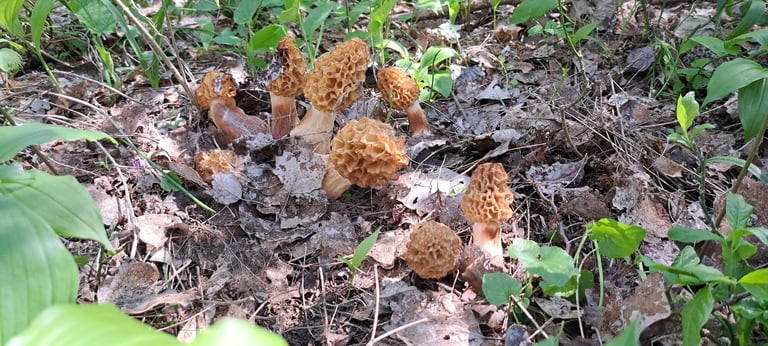
The cap, technically an apothecium, is 2 to 4 cm across and 2 to 5 cm long, conical to bell-shaped, and folded into longitudinal ridges that often fuse into a vein-like network. It ranges from yellowish brown to reddish brown with a paler underside, and—critically for identification—it is attached to the stem only at its very top, with the lobed edge hanging free. The stem beneath is cream-white, 6 to 12 cm long and 1 to 2.5 cm thick, tapering upward and initially stuffed with cottony hyphae before becoming hollow with age; the whole fruiting body is fragile. The flesh is white and the spore print is yellow.
Under the microscope the asci are smooth and elliptical, 275–350 μm long, and remarkably heliotropic—they bend toward light so that their tips face open sky, a mechanism that helps aim spore discharge into airflow for better dispersal. The club-shaped paraphyses, 7–8 μm wide at their tips, round out the microscopic picture.
Distribution and Habitat
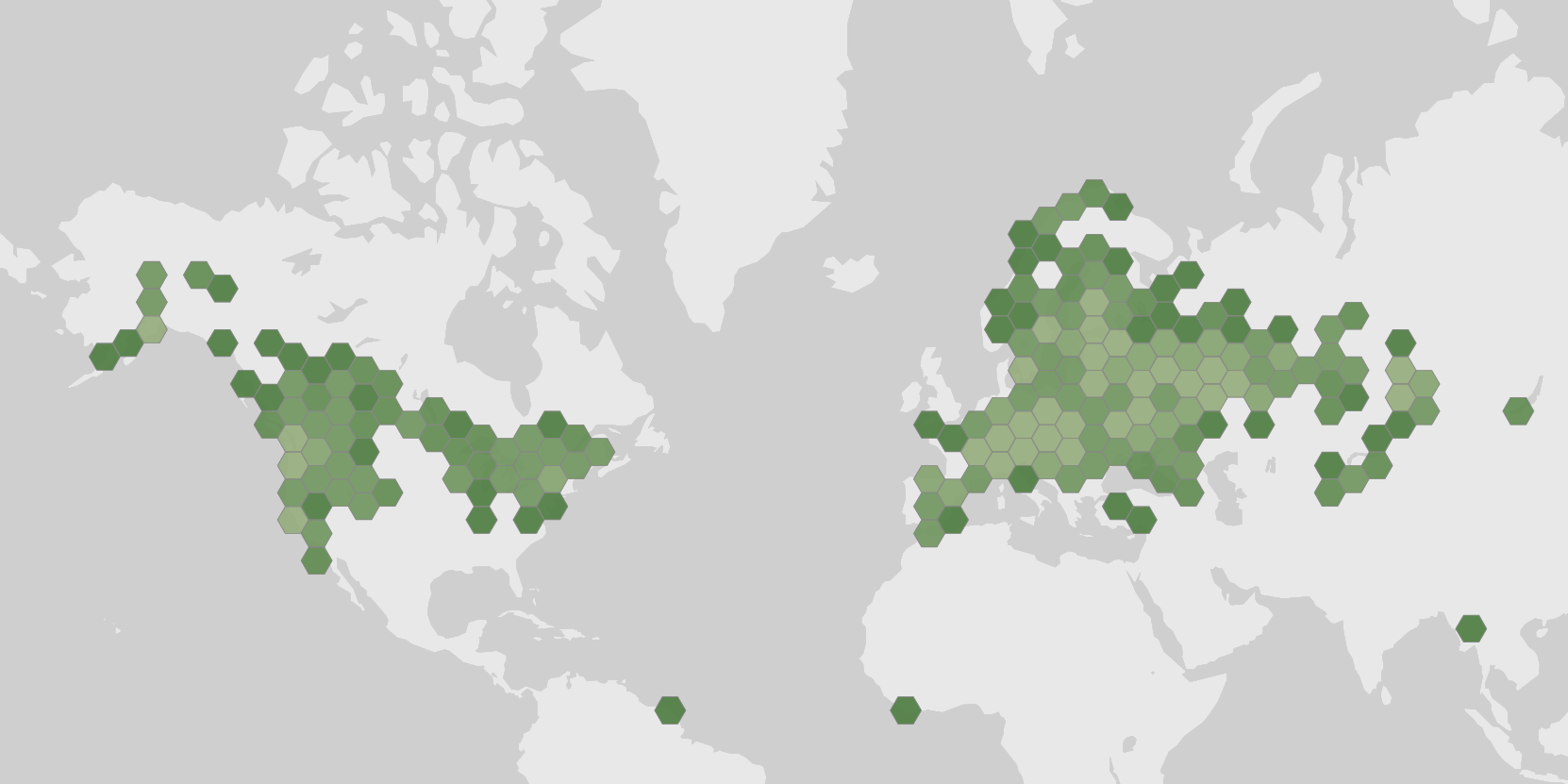
Verpa bohemica has a wide range across northern North America, extending south to the Great Lakes region in the Midwest and to northern California on the West Coast. In Europe it has been recorded from Austria, the Czech Republic, Denmark, Finland, Germany, Norway, Poland, Russia, Romania, Slovenia, Spain, Sweden, and Ukraine, and in Asia it is known from India and Turkey.
Fruiting bodies grow singly or scattered directly on the ground in woods, favoring moist sites with ample sunlight along riverbanks and near cottonwoods, willows, and aspens, often buried in plant litter. Growth occurs across a fairly wide temperature range—from a minimum of 3 °C to an optimum near 22 °C and a maximum around 30 °C. Isotope studies point to a saprobic lifestyle drawing nutrients from decomposing organic matter, though some evidence suggests it may also be mycorrhizal for part of its life cycle.
Monthly observation data show a sharp concentration of records in April and May, consistent with its reputation as one of the earliest morel-season fungi to fruit—appearing before the narrow-head, yellow, and thick-footed morels in a documented Iowa study. These figures reflect presence observations only, not true abundance or a complete picture of its range. The fruiting bodies also double as breeding habitat for several fly species, including Porricondyla media, Pegomya geniculata, and Trichocera annulata.
Uses and Cultural History
In forest-dwelling communities, the early morel has carried a modest but meaningful cultural role, often regarded as a symbol of the earth reawakening after winter. Its early spring appearance, ahead of the true morels, made it a recognizable seasonal marker for foragers even though it never achieved the culinary prestige of Morchella species.
Despite that secondary status, Verpa bohemica holds a place in certain culinary traditions, having been incorporated into traditional recipes tied specifically to the early spring foraging season. Its cultural presence is tied closely to timing—arriving when little else is available to gather from the woods.
Fun Facts
- The species was first described in 1828 by Czech physician and mycologist Julius Vincenz von Krombholz, who classified it as Morchella bohemica; German naturalist Joseph Schröter moved it into the genus Verpa in 1893.
- It is sometimes called a "thimble morel," a nod to its cap shape and its placement in the family Morchellaceae alongside true morels, even though it sits in a different genus.
- Because it was originally described under the genus Morchella, it is often mistaken for a "true" morel, but true morels are strictly limited to the genus Morchella—Verpa species are a separate lineage.
- Beyond its culinary uses, the fungus has held modest cultural weight in forest communities as an early sign of spring's return.
Ecology
Habitat
- Forest
- Woodland