
Pinopsida · Pinales
Monkey Puzzle
Araucaria araucana
EndangeredAlso known as: Chilean-pine, Monkey-Puzzle, Monkey-puzzle
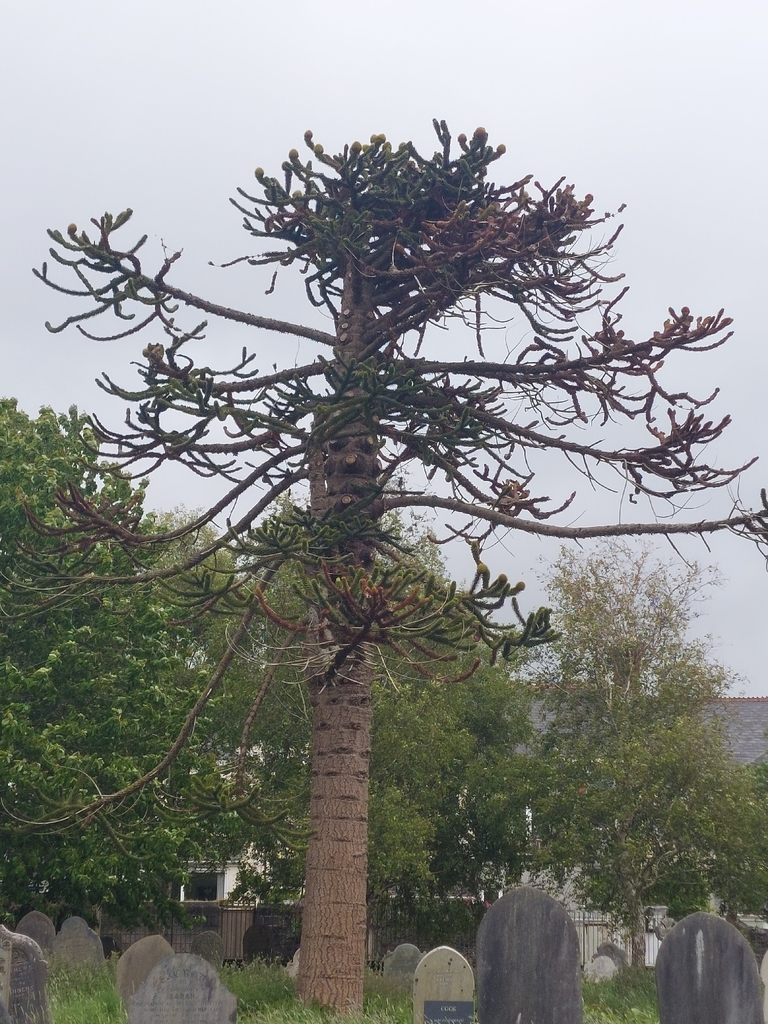
© Barney M · iNaturalist · CC BY 4.0
Scientific Classification & Quick Facts
Classification
Known For
Detailed measurements for this species are still being verified.
The Monkey Puzzle is an ancient conifer that defies the expectations of modern evergreens. With its rigid, triangular leaves pressed tightly against stout branches and its distinctly reptilian appearance, Araucaria araucana looks more like a creature from a prehistoric landscape than a tree native to South America. This towering species, which can live for centuries, once dominated vast stretches of temperate forest across the Andes Mountains but now survives in fragmented pockets across its native range and cultivation sites in twelve countries worldwide.
Today the species is listed as Endangered, its wild populations shrunk by logging, agricultural conversion, and fire. Yet the Monkey Puzzle remains culturally and ecologically significant to the Indigenous peoples of southern Chile and Argentina, who have harvested its protein-rich seeds for millennia. Understanding this tree’s ecology, reproduction, and the threats it faces is essential to reversing its decline and ensuring that this living link to the Mesozoic survives for future generations.
Identification and Appearance
Araucaria araucana, the Monkey Puzzle, is a distinctive evergreen conifer instantly recognisable by its dense covering of thick, scale-like leaves. The leaves are triangular, measuring 3–4 centimetres long and 1–3 centimetres broad at the base, with sharp edges and pointed tips that give the tree its characteristic texture. These leaves are tough and leathery, remaining attached to the tree for up to 24 years, which means older branches become progressively bare while younger growth remains thickly covered in foliage.
The tree’s overall appearance is striking and geometric. Its branching pattern is notably regular and tiered, creating a pyramidal or columnar silhouette that becomes more distinctive with age. The trunk is typically straight and robust, supporting heavy lateral branches arranged in whorls. The bark is thick and deeply furrowed, developing a dark grey-brown colour with age. Young growth often displays a lighter hue, providing visible contrast between new and mature wood.
Sexual dimorphism
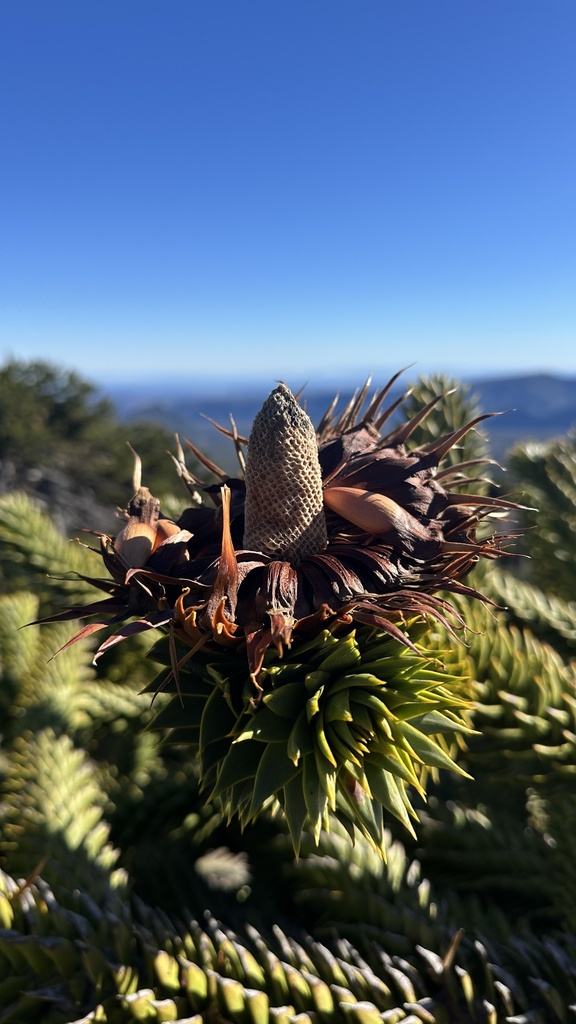
The species is typically dioecious, meaning individual trees are either male or female. Male and female cones appear on separate trees, with the female cones being substantially larger and more prominent than the male cones. This distinction becomes apparent once trees reach reproductive maturity, making sex determination impossible in younger specimens without observing reproductive structures.
Distribution and Habitat
Araucaria araucana, the Monkey Puzzle, is native to the temperate rainforests of southern South America. The species is primarily concentrated in Chile, where the vast majority of records originate (170 observations), with a smaller but significant population in Argentina (53 observations). Beyond its native range, the tree has been widely cultivated as an ornamental in cooler climates across the Northern Hemisphere and Oceania, with notable populations recorded in the United Kingdom (33), Belgium (14), the Netherlands (7), Germany (5), and Norway (5), as well as in New Zealand (6) in the Southern Hemisphere. In total, the species has been documented in 12 countries.
Elevation data reveals a preference for lowland to mid-elevation zones, with records spanning from 96 metres to 576 metres above sea level, averaging 229 metres. This range reflects the species’ natural habitat in the Andes foothills and lower montane regions of its native range. Observations show a pronounced seasonal pattern, with peak activity recorded in January (104 observations) during the Southern Hemisphere summer, followed by a sharp decline through autumn and winter months. By September through December, recorded observations drop to zero, likely reflecting reduced survey effort rather than actual absence, as cultivated populations in the Northern Hemisphere remain present year-round.
The distribution data underscores the tree’s dual significance: a rare and declining native element in Chilean and Argentine forests, and a popular garden specimen in temperate regions worldwide. Its establishment outside its native range demonstrates remarkable cold tolerance, allowing successful cultivation in regions with winter temperatures well below freezing. The concentration of observations in Chile and Argentina continues to reflect the species’ stronghold in Patagonian temperate forests, where ancient populations persist in increasingly fragmented reserves.
Growth and Cultivation
Growth
Araucaria araucana, the Monkey Puzzle, is a distinctive evergreen conifer native to the Andes Mountains of Chile and Argentina. It develops a dense, columnar to pyramidal form with whorled branches that extend to the ground in young trees, creating an instantly recognizable silhouette. The tree grows slowly but reaches impressive mature heights of 30–40 metres in its native habitat, though cultivated specimens are often smaller. Its dark green, scale-like leaves are sharp and overlapping, densely packed along the branches in a spiral arrangement that gives the tree its characteristic appearance.
The trunk thickens substantially with age, becoming thick and robust with reddish-brown, fibrous bark. Young trees may take 10–15 years to reach substantial size, making this a long-term investment for gardeners and landscapers. The species retains its lower branches well, maintaining its striking form throughout its life rather than becoming bare and columnar like many other conifers.
Flowering and Fruiting
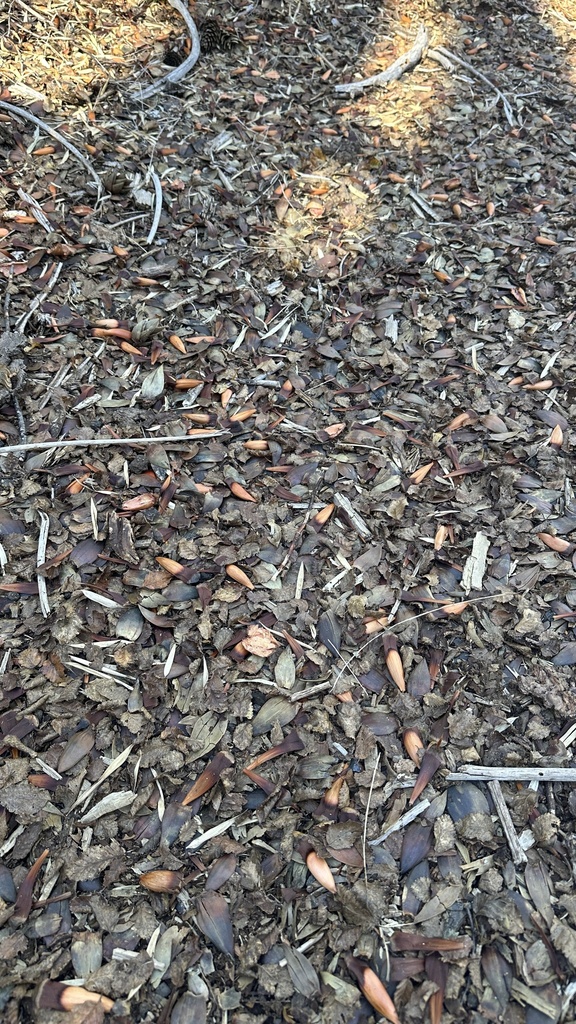
Araucaria araucana is dioecious, with separate male and female trees. Male trees produce elongated, cylindrical cones that release pollen, while female trees develop large, globular cones that can reach 15 centimetres in diameter. These female cones mature over 2–3 years and eventually disintegrate to release large, edible seeds. The seeds are triangular and contain a single embryo; they have been harvested and eaten by indigenous peoples of the Andes for centuries. Flowering occurs in spring, though the exact timing varies with local climate and the tree’s age.
Cultivation
The Monkey Puzzle thrives in cool, temperate climates and requires protection from harsh winds, particularly when young. It prefers well-drained soil and is moderately tolerant of poor soil quality, though it performs best in fertile, slightly acidic to neutral conditions. The tree appreciates full sun but can tolerate partial shade. During establishment, regular watering is important; once mature, it shows reasonable hardiness to drought and extreme cold in temperate zones, though it dislikes hot, dry summers and humid subtropical climates.
Propagation is possible from seed (which must be fresh for best results) or from cuttings, though cuttings are slower and more difficult to establish. In cooler temperate regions, this tree makes an outstanding specimen plant for parks and large gardens, where its unusual form and slow growth become valued landscape features. Regular pruning is rarely necessary, as the tree naturally develops a balanced shape.
Conservation and Threats
Araucaria araucana, the Monkey Puzzle, is listed as Endangered on the IUCN Red List. This classification reflects the species’ restricted range in the Andes Mountains of southern Chile and Argentina, combined with ongoing habitat loss and regeneration challenges. However, the population trend is increasing, indicating that conservation efforts and legal protections are having a measurable positive effect.
Threats
The primary threats to Monkey Puzzle regeneration are complex and often interconnected. Overgrazing by livestock and introduced herbivores damages seedlings and prevents natural reproduction. Invasive tree species compete with young Monkey Puzzle for light, water, and nutrients, though their precise impact remains unclear. Native seed predators—particularly native mammals—have been found to destroy seeds at rates comparable to or exceeding those caused by invasive species. The relatively recent establishment of some invasive mammal populations means their populations remain smaller than some native predators, potentially masking their long-term threat potential.
Habitat conversion for agriculture and timber production has historically reduced the species’ range significantly. In its native Andean forests, Monkey Puzzle competes for space and resources with both native and non-native vegetation. Climate change may also pose an emerging threat, though specific impacts on this high-altitude species remain poorly studied.
Conservation Efforts
Both Chile and Argentina have enacted legal protections for Monkey Puzzle, limiting logging and establishing protected areas within its range. The species is included in CITES Appendix I, restricting international trade. Several protected areas in the Andes—including national parks and nature reserves—now safeguard populations and provide opportunities for regeneration studies. These legal frameworks, combined with habitat restoration initiatives and seed banking programmes, have contributed to the increasing population trend observed in recent decades.
Cultural Significance
The monkey puzzle tree holds profound significance for the Mapuche Pewenche people of the Andes in southern Chile, where it is known as pewen. The relationship between the Pewenche and this ancient conifer spans centuries, shaping both the tree’s ecology and the survival of the indigenous community. The Pewenche have actively managed pewen forests through seed dispersal, tree planting, and protection from threats, embedding the species into their cultural and ecological identity. Some indigenous peoples consider the tree sacred, reflecting its central importance beyond mere subsistence.
The nutritious seeds of Araucaria araucana form a traditional food staple for the Pewenche, making the tree economically and nutritionally vital to their way of life. This ethnobotanical importance is intertwined with indigenous ecological knowledge systems that demonstrate sophisticated understanding of forest management and biodiversity conservation. Research examining the indigenous community of Ralco Lepoy, located in the Andes with approximately 800 inhabitants, illustrates how traditional use and conservation of the pewen are inseparable—the tree’s survival depends on continued Pewenche stewardship, while the people’s cultural and physical survival depends on the tree’s persistence.
Fun Facts
Araucaria araucana, the monkey puzzle, is one of the most unusual conifers on Earth—a living fossil with branches so densely armoured in sharp leaves that early European explorers found it nearly impossible to climb. Native to the Andes of Chile and Argentina, this evergreen giant has survived ice ages and volcanic upheavals to become a botanical treasure of South America.
- It is the hardiest species in its entire genus. Among all Araucaria species worldwide, the monkey puzzle tolerates the coldest climates and has become a popular ornamental tree in temperate gardens from Scotland to New Zealand, far from its Andean homeland.
- Its trunk can reach nearly 1.5 metres in diameter and heights of 40 metres. These massive columns can live for over 1,300 years, making individual trees older than most European cathedrals.
- Every leaf is a weapon. The foliage consists of rigid, overlapping leaves with sharp points that cover branches so completely that the trunk becomes invisible—a defence strategy that has protected it from herbivores since the age of dinosaurs.
- The nuts have fed civilizations for thousands of years. Indigenous Mapuche and Pehuenche peoples of the Andes have depended on Araucaria seeds (called piñones) as a staple protein source; the tree was so central to their survival that its name in the Mapudungun language, pewen, became part of their cultural identity.
- Male and female cones grow on separate trees. The massive female cones can weigh up to 4 kilograms and take two years to mature, releasing dozens of large, nutritious seeds that are dispersed by animals rather than wind—an unusually generous seed strategy for a conifer.
- It belongs to an ancient family with a Jurassic pedigree. The Araucariaceae family dominated conifer forests 160 million years ago; today, only three living genera remain, making Araucaria araucana a direct evolutionary link to the age of sauropods.
- Its resin has antimicrobial properties prized in traditional medicine. Mapuche healers have long used preparations from the bark and resin to treat wounds and respiratory ailments—a use now being investigated by modern pharmacologists.
Conservation Status
LC · NT · VU · EN (Endangered) · CR · EW · EX
Photo Gallery
Barney M · CC BY 4.0
Related Species
Was this profile helpful?