One dominant male Antarctic fur seal may mate with as many as 20 females in a single breeding season, defending a patch of rocky shoreline no bigger than a small room against rivals twice as motivated to take it from him.
This mid-sized pinniped belongs to the family Otariidae, one of eight species in the genus Arctocephalus. It ranges across the Southern Ocean's island chains and is currently assessed as Least Concern. Its dramatic recovery from near-extinction, its complex breeding colonies, and its role as a major krill predator make it one of the better-studied seals of the Southern Ocean.
Identification and Appearance
The most useful field mark is the combination of a long neck, pointed muzzle, and long, naked-tipped external ears, features that set fur seals apart from true seals at a glance. The nose barely extends past the mouth, and adult males in particular carry very long whiskers, 35 to 50 centimeters, among the longest of any pinniped.
Males grow up to 2 meters long and average 133 kg, dwarfing females, which reach only 1.4 meters and about 34 kg. This strong size difference reflects the species' polygynous breeding system, where larger males compete directly for territory.
Color varies by age and sex. Adult males are dark brown; females and juveniles are paler, almost gray with lighter undersides. Pups are born nearly black. Color patterns are highly variable, and some hybridization with Subantarctic fur seals has been recorded, along with rare partially leucistic individuals.
Fore flippers make up about one-third of total body length, and hind flippers slightly more than one-fourth, adaptations for both swimming and the unusually agile movement on land that sets this species apart from most other pinnipeds.
Distribution and Habitat
Antarctic fur seals have a circumpolar distribution, breeding on islands south of the Antarctic Convergence between 61° S and the Subantarctic. Major breeding colonies occur at South Georgia and the South Sandwich Islands, South Orkney and South Shetland Islands, and Bouvet Island in the South Atlantic; Marion Island, the Crozet Islands, Kerguelen, and Heard Island in the Southern Indian Ocean; and Macquarie Island in the Southern Pacific.
South Georgia holds the overwhelming majority of the global population, while Bouvet Island holds the second largest. Population trends differ by site: colonies at Kerguelen and the McDonald Islands are growing, Macquarie and Heard Islands appear stable, while Bouvet Island is declining.
On land the seals favor rocky habitats but will also use beaches and vegetated zones. At sea they range across pelagic and coastal waters, with males diving to a maximum of 350 meters and females to 210 meters. During winter, seals disperse widely from the Antarctic continent as far as the Falkland Islands, southern Argentina, and Gough Island.
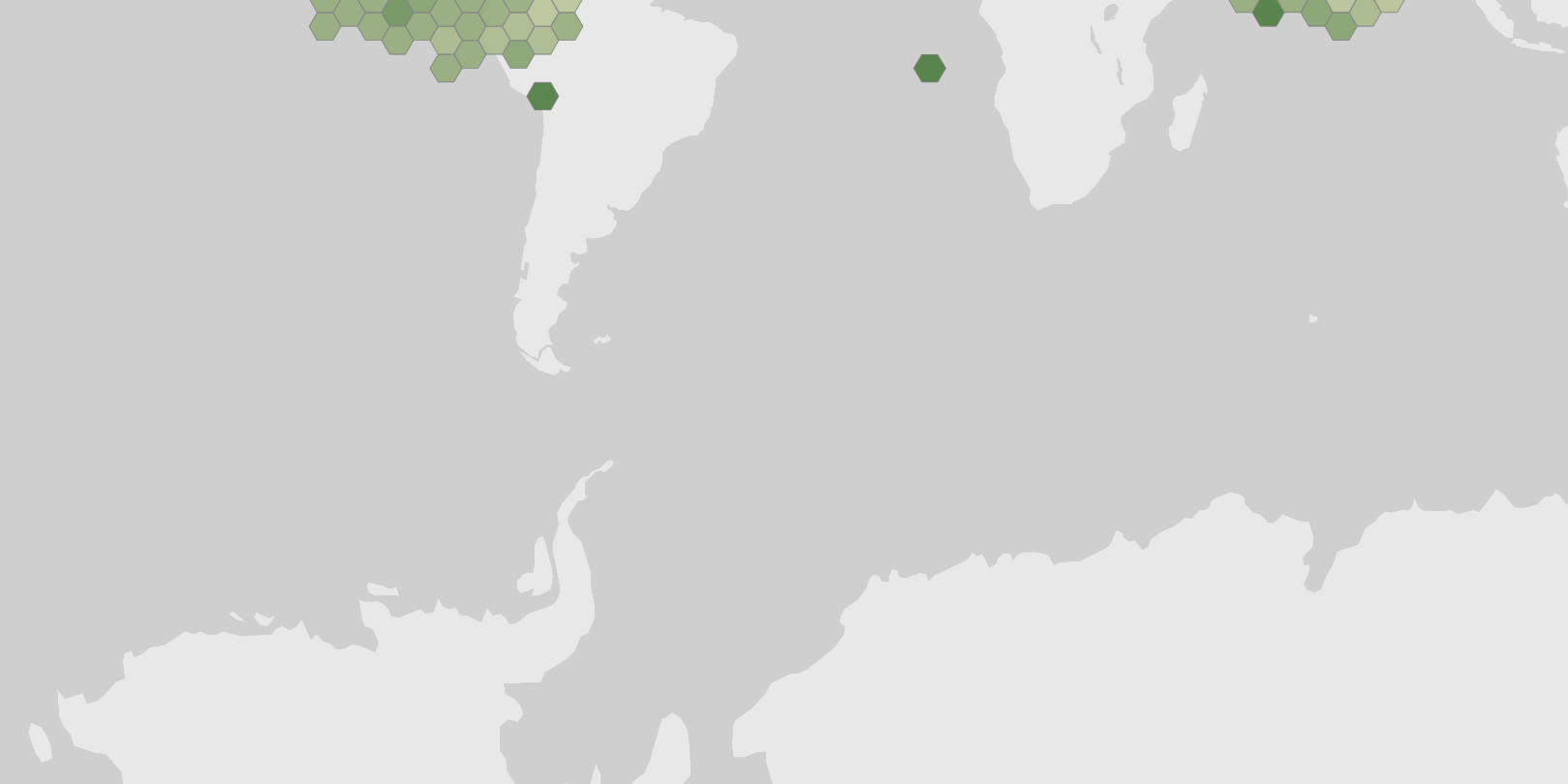
Observation records peak toward the start and middle of the year, consistent with the species' strong seasonal presence at breeding sites before dispersing more widely afterward.
Behavior and Lifestyle
Antarctic fur seals are unusually agile on land, considered one of the most terrestrial pinnipeds alongside the leopard seal, capable of crossing slippery rocks and dense grass faster than a person and reaching 20 km/h on smooth ground, a speed they can exceed while swimming.
Breeding is polygynous and tightly organized around territory. Males arrive in October or early November to establish breeding grounds, competing fiercely; territory size shrinks from about 60 square meters in mid-November to just 22 square meters by December as competition intensifies. A dominance hierarchy maintains order among territorial males.
Outside the breeding season, social structure loosens. Adult and subadult males may gather in groups while molting along the Antarctic Peninsula, while females remain largely asocial apart from their bond with their pup. Seals appear solitary when foraging or migrating at sea, with typical dives averaging about 30 meters and lasting roughly two minutes. After pups are weaned, seals disperse to sea from May through November, though some adult males and juveniles remain ashore year-round.
Communication
Males rely on two main vocal signals: a threatening roar directed at rival males or in response to threats such as predators, and a softer "huff-chuff" call used while moving through breeding territories, interacting with females, and signaling status.
Females can also roar and huff-chuff, but their communication centers on their pups. They use a high-pitched call, reinforced soon after birth, so a pup can recognize its mother when she returns from hunting trips. At close range, mother and pup confirm each other's identity by scent, combining acoustic and chemical signals for a reliable bond in crowded, noisy colonies.
Hunting and Diet
Antarctic fur seals hunt across a varied menu dominated by fish, krill, and cephalopods, with fish making up nearly 75% of the diet outside winter. At South Georgia, mackerel icefish is a key fish prey alongside heavy krill consumption. Lactating females rely mainly on krill, switching to fish when it is scarce, while adult and subadult males shift to a roughly even split of krill and fish during winter.
The species also preys on smaller penguins weighing 4 to 8 kg, such as rockhopper and macaroni penguins. Adult males have been observed chasing and successfully catching or injuring king penguins both on land and at sea, though only males succeed in killing them; females that give chase do not. Recorded prey groups include fish, various crustaceans such as Euphausia krill, and squid.
Diet composition shifts with season, colony, and year, likely tracking local oceanographic conditions that determine krill and fish availability.
Reproduction and Raising Young
Breeding is polygynous, with dominant males mating with an average of 15 females, and sometimes as many as 27, over a season. Males establish and defend territories starting in October, arriving about a month before females come ashore in December.
Females give birth to a single pup, conceived the previous year, within days of arriving, then mate again just six to seven days after giving birth. Gestation lasts about 11.75 months (257 to 260 days) with likely delayed implantation. Breeding is highly synchronized, with 90% of pups born within a 10-day window each December; newborns weigh about 6 kg.
Mothers alternate short suckling bouts with foraging trips at sea lasting 1 to 13 days, averaging around 5 days, returning to nurse for about two days each time. Pups begin entering the water by early January but cannot swim well until March. Weaning occurs at about 117 days, after which pups have to fend for themselves; reproductive maturity comes at three to four years of age for both sexes, though males rarely hold breeding territory before age eight due to the physical toll of competition.
Population and Ecological Role
Antarctic fur seals are key predators of krill, fish, and squid across the Southern Ocean, and colony size has been linked to local prey availability, with short-term environmental shifts affecting female reproductive success. The species also hosts lungworm parasites of the genus Parafilaroides, which infect the lungs of their hosts.
South Georgia alone hosts a population estimated between 4.5 and 6.2 million animals, accounting for about 95% of the global total, making this species one of the most abundant fur seals despite its history of near-extinction from hunting.
Conservation and Threats
The Antarctic fur seal is currently assessed as Least Concern, reflecting a dramatic recovery from fewer than 3,000 individuals in the 1800s, when sealing for fur drove the species to the brink of extinction. It gained special protection in 1964 and today is listed under CITES Appendix II, meaning trade must be controlled to prevent it from becoming threatened again.
Despite this recovery, the South Georgia population, which holds about 95% of the global total, has shown worrying declines: adult female abundance fell around 30% between 2003 and 2012 and 24% since 1984, to roughly 550,000. This decline has been linked to climate change reducing krill availability as warming waters push prey to greater depths. Leopard seal predation can also take up to a third of pups born at some South Shetland Islands sites, adding further pressure at a local scale.
Other threats include entanglement in fishing debris such as discarded line, netting, and packing bands, a problem that has halved in recent years following compliance campaigns with MARPOL waste disposal provisions, though it persists. Growing tourism and scientific visitation have increased human-seal encounters, occasionally resulting in serious bites, while a reduced genetic diversity from the historical population bottleneck may leave the species more vulnerable to disease and future climate stress.
Cultural Significance
Antarctic fur seals were hunted intensively through the 1800s and 1900s for their fur, a trade that nearly wiped out the species before it collapsed. Since then, the species has held little economic importance to humans.
However, the growth of commercial krill harvesting raises the possibility of renewed human impact on the species in the future, as fur seals and krill fisheries compete for the same resource.
Fun Facts
- Male Antarctic fur seals lose about 1.5 kg of body weight per day while defending their breeding territories, and often suffer facial injuries from fights with rivals.
- The species was named after the German survey vessel SMS Gazelle, which collected the first specimens from the Kerguelen Islands.
- Some individuals show partial leucism, a rare condition producing unusually pale patches in an otherwise dark-coated species.
- Territorial males typically do not hold breeding ground until they are at least eight years old, since defending territory is so physically costly.
Photos
Photographs from via iNaturalist, licensed under CC0 1.0., by Helen Bovill via iNaturalist, licensed under CC BY 4.0., by bungelina via iNaturalist, licensed under CC BY 4.0., by Ingvild Riska via iNaturalist, licensed under CC BY 4.0., by patrickc via iNaturalist, licensed under CC BY 4.0., by Lucas Kaminski via iNaturalist, licensed under CC BY 4.0., and by Emily Turteltaub Nelson via iNaturalist, licensed under CC BY 4.0., credited on each photo.
Ecology and classification
Classification
- Phylum
- Chordata
- Class
- Mammalia
- Order
- Carnivora
- Family
- Otariidae
- Genus
- Arctocephalus
- Species
- Arctocephalus gazella
Sources
- GBIF Species names and classification
- iNaturalist Photos
- Wikidata Common names and conservation status
- Wikipedia Summary extract
- Encyclopedia of Life Habitat, diet and behavior traits
- Animal Diversity Web Animal habitat, behavior and diet
- AnAge Longevity
- COMBINE Mammal size, lifespan, breeding, diet and activity
- GloBI What it eats, what eats it, parasites and pollinators
- MammalBase