The Eurasian otter (Lutra lutra) can vanish beneath the surface of a river and stay submerged for up to two minutes while chasing fish, propelled by a body built almost entirely for life in water.
A member of the weasel family, Mustelidae, within the otter subfamily Lutrinae, the Eurasian otter is the most widely distributed otter species on Earth. It ranges across the rivers, lakes and coastlines of Europe, much of Asia and parts of North Africa, and is currently classified as Near Threatened by the IUCN.
After collapsing across much of its range during the twentieth century, the species has staged a slow recovery in several countries, making it a rare example of a European carnivore clawing its way back from the edge.
Identification and Appearance
The clearest way to recognize a Eurasian otter is by its build rather than by comparison with other species, since in much of its range it is the only otter present. Where ranges overlap with the North American river otter, the Eurasian otter can be told apart by its shorter neck, broader face, wider spacing between the ears and a longer tail.
Adults measure 57 to 95 cm (22.5 to 37.5 in) in body length, with a separate tail of 35 to 45 cm (14 to 17.5 in). Females run shorter than males. Average body weight sits around 10 kg, though old males occasionally reach 17 kg, and one unverified record specimen was reported at over 24 kg (53 lb).
Its fur is brown across the back and cream-colored on the belly, a two-toned pattern typical of the species. The body is long and slender, an adaptation reinforced by dense, osteosclerotic bones that reduce buoyancy and make swimming and diving more efficient.
Distribution and Habitat
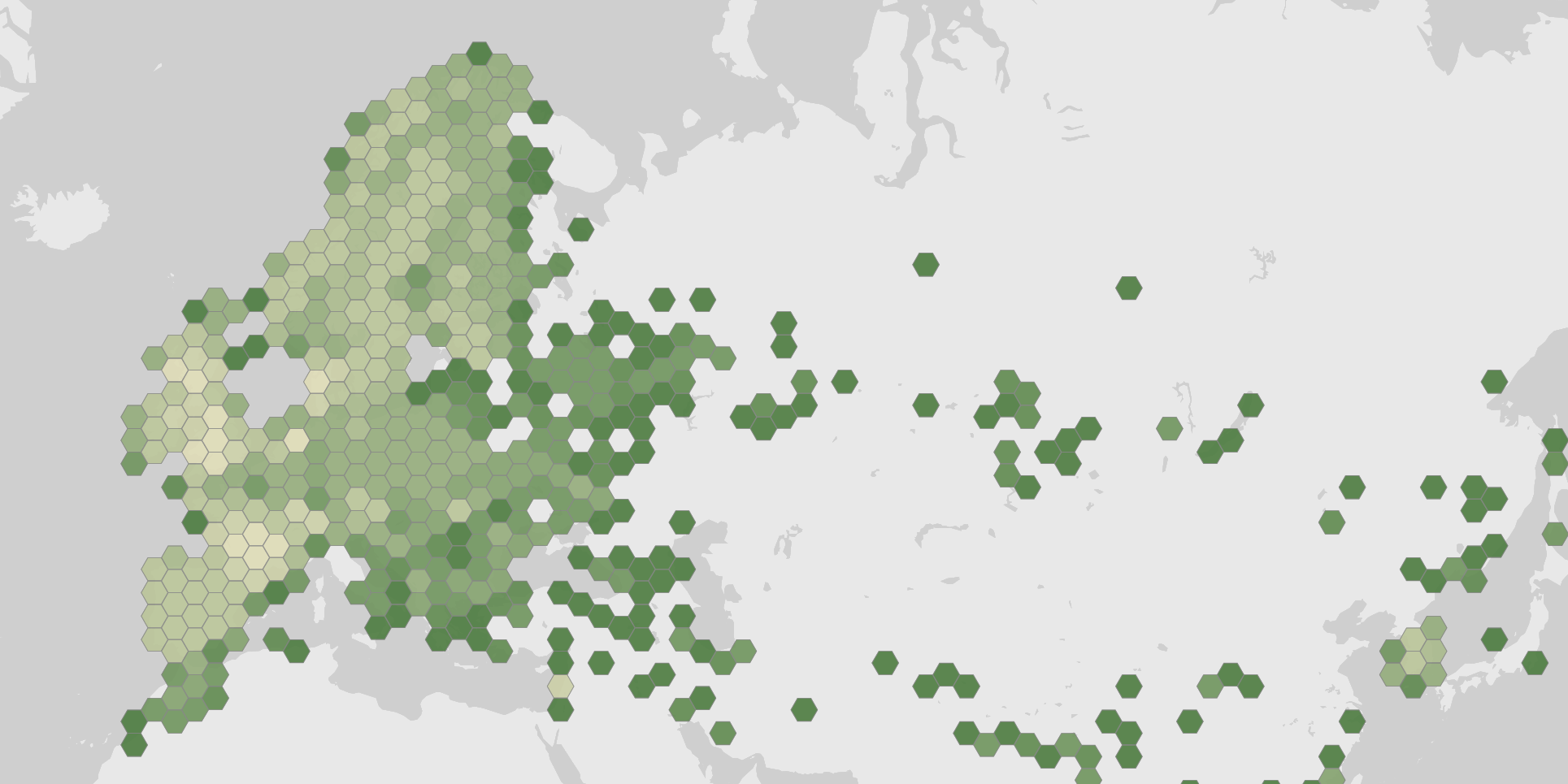
The Eurasian otter holds the broadest range of any otter species, stretching across Europe, North Africa and parts of Asia as far as the Palestine region. It is thought to be extinct in Liechtenstein and Switzerland, yet it remains common in Latvia, along the Norwegian coast, in western Spain and Portugal, and across Great Britain and Ireland; in Italy it survives in the southern part of the peninsula.
It depends on unpolluted fresh water, living in lakes, streams, rivers, canals and ponds wherever prey is plentiful, and in Andalusia it has adapted to artificial lakes on golf courses. Coastal populations forage in salt water but still need regular access to fresh water to rinse salt and debris from their fur.
Records extend the species into mountainous and arid landscapes: montane creeks near Latakia and Raqqa in Syria and the lower Euphrates valley near Deir ez-Zor, and elevations above 1,600 m in western Nepal's Jajarkot and Eastern Rukum districts. In India it occupies the Himalayan foothills, the southern Western Ghats and central Indian landscapes. In Kyrgyzstan the species was long presumed to have vanished, until a single otter was sighted on the Turuk River in Khan-Tengiri Nature Park in 2025, leaving open whether it was a wandering migrant or the sign of a surviving population.
Monthly observation counts peak in January at over 30,000 records and dip to around 15,000 in June, a pattern that likely reflects seasonal differences in observer activity and otter visibility rather than true changes in population size.
Behavior and Lifestyle
Eurasian otters are most active at dusk and after dark, spending daylight hours resting in dens dug into banks, tree roots or piles of boulders. Most individuals live alone, coming together only briefly to mate or when a mother is raising cubs, though loosely knit groups of up to six otters are occasionally seen.
Play is a constant feature of their behavior at every age. Otters slide down muddy banks or snowdrifts on their bellies, trot, gallop and chase one another through the water, and this rough-and-tumble activity is thought to sharpen the hunting skills young otters will need as adults.
Communication
Eurasian otters rely heavily on scent and touch to communicate, using paired glands at the base of the tail to produce a strong, musky secretion. They mark vegetation, logs and even their own fur with this scent, signaling territorial boundaries, individual identity and reproductive state to other otters passing through.
They are also vocal animals, with distinct calls for alarm, greeting and mating among as many as a dozen recognized sounds. Their vocal repertoire includes short, shrill whistles, yelps, whimpers and high-pitched screams of distress, used at close range between mates, mothers and cubs, or rivals defending territory.
Hunting and Diet
Hunting relies less on sight than on touch: the Eurasian otter sweeps its whiskers, or vibrissae, through the water to detect the movement of fish and other prey even in murky conditions. It hunts and feeds several times throughout the day, consuming roughly 1 kg of food daily.
Fish make up the bulk of its diet, supplemented by crustaceans, clams, small mammals, amphibians, birds, eggs, insects and worms, along with a small amount of plant matter. This broad prey base lets the otter exploit whatever is locally abundant, from slow rivers rich in fish to wetlands where amphibians and invertebrates are easier to catch.
Reproduction and Raising Young
Eurasian otters breed year-round, with mating most concentrated between February and March and again in July, and can occur in water or on land. Females have a continuous estrus cycle, and sexual maturity is reached at around 18 to 24 months of age, with most females breeding for the first time around two and a half years old.
Gestation lasts roughly 60 to 70 days. A litter usually numbers two to three cubs, occasionally up to four, each weighing around 10 percent of the mother's body weight, or roughly 99 to 122 g at birth.
Cubs open their eyes after about a month and begin venturing from the den around two months of age, with weaning complete by three months. They remain dependent on their mother for up to 13 to 14 months before dispersing. Males play no direct role in raising the young, though a female's territory typically lies entirely within that of a resident male.
Conservation and Threats
The IUCN lists the Eurasian otter as Near Threatened, a status reflecting a species that has come close to serious decline but is showing signs of recovery across much of its European range. The main historical driver of decline was chemical pollution, particularly polychlorinated biphenyls and organochlorine pesticides that accumulated in waterways during the second half of the twentieth century, compounded by habitat loss and both legal and illegal hunting.
Recovery has followed a Europe-wide ban on the most harmful pesticides in 1979, improvements in water quality that rebuilt fish populations, and legal protection under the European Union Habitats Directive and national laws. In the United Kingdom, sites with confirmed otter presence rose by 55 percent between 1994 and 2002, and by August 2011 the Environment Agency confirmed otters had returned to every county in England, after decades of near-total absence outside the West Country and parts of northern England.
The picture is uneven elsewhere. In Germany the species is nearly extinct in the wild and listed as critically endangered, prompting the 1979 founding of Aktion Fischotterschutz and the establishment of the Hankensbüttel Otter Centre. It is listed as endangered in Pakistan, India, Bangladesh, Myanmar and Thailand, and critically endangered in Mongolia, while South Korea designates it a Natural Monument and first-class endangered species. In Iberia, the ongoing decline of native freshwater fish and the spread of exotic species such as centrarchids threaten to reverse recent gains.
Conservation status
- LC
- NT
- VU
- EN
- CR
Near Threatened
Cultural Significance
The otter's scientific name traces back to the Proto-Indo-European root udr-, meaning roughly "water animal," the same root that gave rise to the English word "otter" itself.
Across several cultures, otters are regarded as symbols of playfulness and curiosity, reflecting the animal's readily observed habit of sliding and chasing in the water. Their pelts have also long been valued by humans, historically prized in the fur trade.
Fun Facts
- The genus name Lutra derives from the Proto-Indo-European root *udr-, meaning roughly "water animal," the same root behind the English word "otter."
- A 2001 genetic study of otter skulls from Denmark found no recent loss of genetic diversity despite population declines, but did reveal evidence of a population bottleneck around 2000 years ago, possibly linked to ancient human pressure.
- In August 2011, the Environment Agency confirmed that otters had returned to every county in England for the first time in decades.
- A single otter sighted on Kyrgyzstan's Turuk River in 2025 raised hope that the country's otters, long presumed gone, might still survive.
- South Korea designates the Eurasian otter a Natural Monument as well as a first-class endangered species.
Ecology
Habitat
- Wetland
- Coastal
- Mountain
- Freshwater
Behavior
- Nocturnal
- Predator
- Solitary
- Territorial
Diet
- Piscivore
Photos
SourcesGBIFiNaturalistWikidataWikipediaAnimal Diversity WebAnAge