In Britain the Eurasian badger is simply called the badger, because it is the only badger species still living there. It belongs to the weasel family Mustelidae and ranges across most of Europe, West Asia and parts of Central Asia.
The species is classed as Least Concern on the IUCN Red List. Its range is wide, and its population is large and in some regions still growing. Several subspecies are recognised, and the nominate subspecies predominates across most of Europe.
Adults are powerful, low-slung diggers that live in complex underground setts. They often live in groups that share territories and burrows, which sets them apart from most other mustelids. An individual can live up to .
Identification and Appearance
The most useful field mark is the badger's build. Its small head sits on a thick, short neck, and its stocky, wedge-shaped body rests on short, massive limbs. The ears are short and tipped with white, and the tail is short.
Adults measure about in length and weigh about on average. Weight follows the seasons: adults gain mass from spring to autumn and peak just before winter. Adults commonly weigh 7 to 13 kg in summer and 15 to 17 kg in autumn.
Sexes differ in subtle ways. Boars have broader heads, thicker necks and narrower tails than sows, while sows have sleeker bodies, narrower heads and fluffier tails. Males exceed females only slightly in body measurements but can be considerably heavier.
The feet are short and strong, with five toes on each foot. The claws are long, blunt and unretractable, and the hind claws wear down with age. The muzzle is muscular and flexible for digging and probing, and it carries whiskers.
Distribution and Habitat
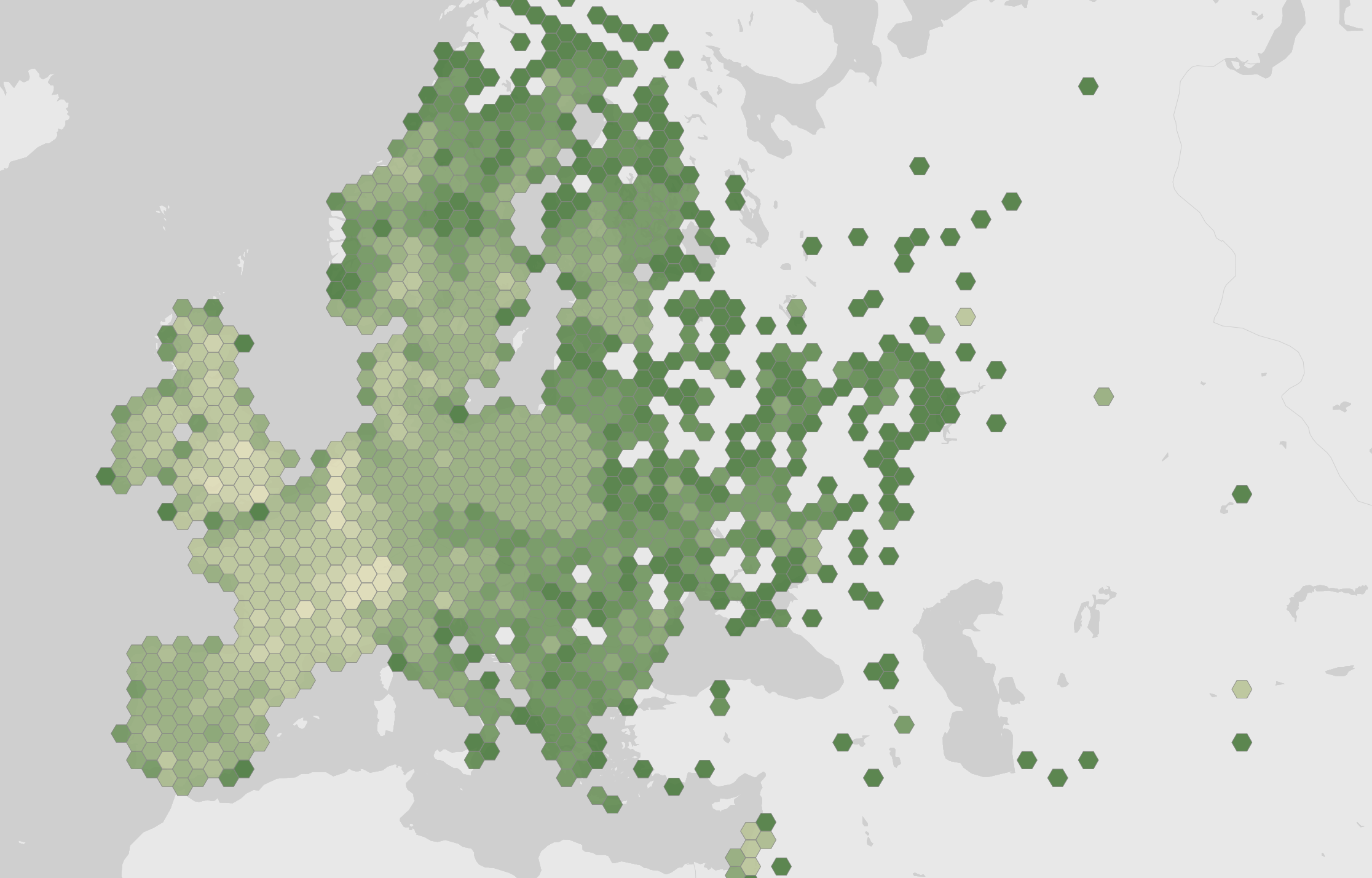
The Eurasian badger is native to most of Europe, and its range extends into Armenia, Georgia and Russia. Its eastern boundary with the Asian badger follows the Volga River, with the European species living on the western bank. In the North Caucasus, the range of the Caucasian badger meets it, and the two species overlap in places, potentially forming a hybrid zone.
The species favors woods and pasturelands in lowland areas. It also lives in deciduous and mixed woodlands, clearings, hedges, scrub, riverbanks and Mediterranean maquis shrubland. Grassland, steppe and semi-desert are also used.
Setts are dug on free-draining banks, embankments and slopes, often among trees, shrubs or rocks that cover the entrance. Well-drained soils that are easy to excavate and relatively free of disturbance are preferred. Badgers have adapted to suburban areas and urban parks, although not to the same extent as red foxes. In mountainous regions they can be found at altitudes of up to 2,000 m.
Behavior and Lifestyle
Eurasian badgers are nocturnal, with peak activity at dusk and dawn. They spend the day in the sett and move out after dark to forage. Compared with most mustelids, they are quite gregarious. Social groups may have between 2 and 23 individuals, and the average group holds one to six adults and their offspring.
Group size depends on food. Badgers in low-density populations tend to be more solitary, while those in dense populations live in groups. When food is scarce, clan members may revert to a more solitary life. Each group typically has a single dominant breeding pair, and male territories often overlap.
Each group occupies a territory of about 30 to 150 ha in good or marginal habitat, and the home range averages . Groups defend their territories with communal latrines and well-worn paths. Within a group they groom one another with their claws and teeth, and this grooming may serve a social purpose.
Each group uses several setts. The main sett, usually central in the territory, holds many adults, and younger animals live in peripheral setts. Setts contain multiple exits, and passages can run 35 to 81 m. Badgers carry bedding of dried grass, bracken, straw, leaves and moss into the chambers, sometimes up to 30 bundles in a single night.
Communication
Badgers use posture as well as sound. Tail flicking and scraping the hind legs signal aggression when an animal feels threatened. Raising the tail and erecting the fur signal sexual excitement, and the same raised-tail display can appear when attacked by dogs.
Their vocal repertoire is varied. Deep growls from males and females signal aggression and defense, and low kekkering noises accompany fights. Higher-pitched wailing signals an attack, while cubs whicker when playing or in distress.
Scent is the most important channel. Communal latrines, along with secretions from subcaudal and anal glands, mark group territories. Urine can also signal the estrus condition of females, and badgers apply sub-caudal secretions to group members, which may create a shared group odor.
Diet and Nutrition
Earthworms are the primary food of Eurasian badgers, and much of their daily behavior is organized around finding them. They eat several earthworm species. Badgers forage alone, even when they live in groups, and they work a patch of roughly one hectare. They grip a worm with their incisors and find any pieces that break off.
The diet is mixed. Plant foods make up about 40% of it, and vertebrates make up about 40%, with invertebrates the remaining 20%. Badgers eat more than 30 kinds of fruit, including pears, plums, cherries, blackberries and acorns, as well as cereals such as maize, oats and wheat. They also dig up tubers and occasionally eat fungi.
Large insects are an important part of the menu. Beetles, leatherjackets, caterpillars and wasps are common prey, and badgers raid wasp nests, especially in seasons when wasps are most abundant. Small mammals such as rabbits, voles, shrews, moles, mice and hedgehogs are also taken. Badgers also eat carrion and, occasionally, birds, frogs, fish, lizards, slugs and snails.
Reproduction and Raising Young
Eurasian badgers are polygynous where they live in groups, and only the dominant male and female usually mate. Matings outside the group are frequent. Females may advertise estrus to males from other groups through scent marking, and males often enlarge their territories during the breeding season to include more females.
Breeding can happen throughout the year, but most matings occur from February to May and again from August to October. Females can conceive while pregnant, and fertilized eggs may wait two to nine months before implanting in the uterus. After implantation, gestation lasts about . Cubs are usually born from mid-January to mid-March in underground chambers lined with bedding.
A litter is usually one per year and has one to six cubs, with three on average. Newborn cubs are pink with greyish, silvery fur and fused eyelids, and they weigh 75 to 132 g. Their eyes open at four to five weeks. They emerge from the sett at about eight weeks and are weaned by about , although they may still suckle for another month or two.
Females reach sexual maturity at about . Usually only the dominant sow breeds, and she may kill the cubs of subordinate sows. Subordinate females help guard, feed and groom the cubs. Males give no care at all, and in social groups young often stay close to their mother after they are independent.
Population and Ecological Role
Eurasian badger populations are large and widespread. Russia alone held about 30,000 individuals in 1990, and the population in Great Britain was estimated at 300,000 in 2012. In the UK the population grew by 77% during the 1980s and 1990s. Across much of its range the population has increased in recent decades, partly because rabies declined in Central Europe.
Badgers help keep invertebrate populations in check, and their feeding on insects may control some pest species. They also disperse seeds, because they eat large amounts of fruit, and only a small share of the seeds they swallow are damaged beyond germination.
Few animals prey on adult badgers. Grey wolves, Eurasian lynxes and large dogs can threaten them, and golden jackals and red foxes prey on cubs. Badgers can fight fiercely when cornered, which deters many predators. Badgers host many parasites, including tapeworms, roundworms, fleas, ticks and lice.
Conservation and Threats
The IUCN Red List classes the Eurasian badger as Least Concern. This reflects its wide distribution, its relatively common status and populations that are generally stable. Densities have risen in Europe over the last decade, and the species fares well in parts of Western Europe, including Great Britain.
Bovine tuberculosis, caused by Mycobacterium bovis, is a major cause of badger deaths, although infected badgers can survive for years before dying. The disease was first seen in Swiss badgers in 1951 and was detected in the UK in 1971. Evidence points to badgers as the main reservoir of infection for cattle in southwest England, Wales and Ireland, and culling badgers to control it remains contested.
Intensive agriculture has removed habitat in some areas, and badgers are hunted as pests in others. Changing climate patterns may also hurt survival. Warmer springs can end torpor early and send badgers out to search for food when little is available.
Cultural Significance
Badgers feature in European folklore and literature. In Irish mythology they are shape-shifters and kin to Tadg, the king of Tara. In German folklore the badger is a cautious, peace-loving character who loves his home and family, and in Kenneth Grahame's The Wind in the Willows, Mr. Badger is a gruff but wise friend.
The badger is also the emblem of Hufflepuff in the Harry Potter books, and the Badger Lords of Redwall are renowned warriors. In Zagreb the satirical theatre Jazavac takes its name from the badger's reputation for cunning. Finland's Luhanka municipality shows a badger on its coat of arms, reflecting the former fur trade.
People use badger hair in brushes and badger skins for rugs. Badgers are of little importance to hunting, although they are hunted locally by jaw trap, by digging them out with dogs, and by shooting them at their setts.
Photos
Photographs from via iNaturalist, licensed under CC0 1.0., by Justin Philbois via iNaturalist, licensed under CC BY 4.0., by Sandra Stewart via iNaturalist, licensed under CC BY 4.0., by Robin Fokker via iNaturalist, licensed under CC BY 4.0., by Salem via iNaturalist, licensed under CC BY 4.0., by euqirneto via iNaturalist, licensed under CC BY 4.0., by Ondřej Křivan via iNaturalist, licensed under CC BY 4.0., by Robyn via iNaturalist, licensed under CC BY 4.0., by Thomas Gyselinck via iNaturalist, licensed under CC BY 4.0., by Viktor Strenada via iNaturalist, licensed under CC BY 4.0., by Valentin Moser via iNaturalist, licensed under CC BY 4.0., by franciscodocampo via iNaturalist, licensed under CC BY 4.0., and by Sylvie via iNaturalist, licensed under CC BY 4.0., credited on each photo.
Ecology and classification
Classification
- Phylum
- Chordata
- Class
- Mammalia
- Order
- Carnivora
- Family
- Mustelidae
- Genus
- Meles
- Species
- Meles meles
Sources
- GBIF Species names and classification
- iNaturalist Photos
- Wikidata Common names and conservation status
- Wikipedia Summary extract
- Encyclopedia of Life Habitat, diet and behavior traits
- Animal Diversity Web Animal habitat, behavior and diet
- AnAge Longevity
- COMBINE Mammal size, lifespan, breeding, diet and activity
- GloBI What it eats, what eats it, parasites and pollinators
- trophiCH
- HWML Parasite Collection
- CarniDIET
- TETRA-EU