The beech marten, also called the stone marten, is one of the most adaptable members of its family, thriving in open landscapes and even inside buildings where its forest-dwelling relative the pine marten cannot survive.
A member of the family Mustelidae within the order Carnivora, Martes foina is listed as Least Concern by the IUCN thanks to its wide distribution, large population, and presence in many protected areas. Unlike the forest-specialist pine marten, the beech marten is a generalist that occupies open country, rocky outcrops, and human settlements alike, making it one of the more visible small carnivores across its range.
Identification and Appearance
The single best way to tell a beech marten from a pine marten is its throat patch: always white, large, and split into two projections that reach the forelegs, with the dark belly color jutting forward into the white as a line rather than the reverse pattern seen in the pine marten. Its nose is light peach or grey, never the dark black of the pine marten.
Males measure 430–590 mm in body length with a 250–320 mm tail, while females are smaller at 380–470 mm with a 230–275 mm tail. Weight shifts seasonally: males run 1.7–1.8 kg in winter and 2–2.1 kg in summer, while females weigh 1.1–1.3 kg in winter and 1.4–1.5 kg in summer.
The head is more elongated and angular than the pine marten's, with shorter, more rounded, widely spaced ears. Its coat is coarser and lighter in tone, with whitish rather than greyish underfur, and its tail is sparsely furred and dark brown, standing out against a darker back.
Its feet are less densely furred than the pine marten's, leaving the paw pads visible even in winter, and its shorter limbs give it a creeping, polecat-like gait rather than the bounding movement of the pine marten. This difference in foot loading, roughly double that of the pine marten per unit of supporting surface, forces it to avoid deep snow.
Distribution and Habitat
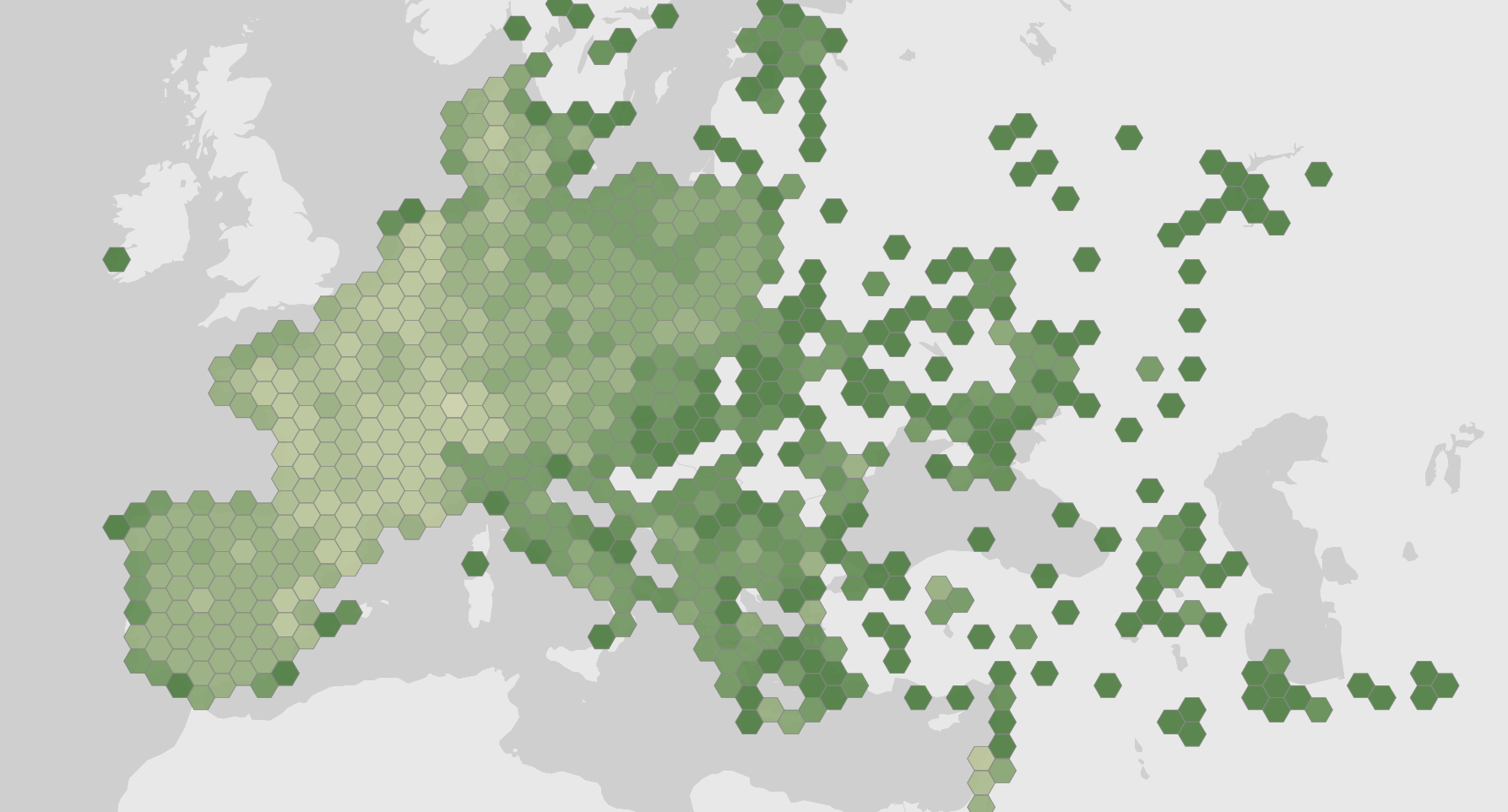
The beech marten ranges across much of Europe and Central Asia, from Spain and Portugal in the west through Central and Southern Europe, the Middle East, and Central Asia, reaching as far east as the Altai and Tien Shan mountains and northwest China. It is notably absent from the British Isles, the Scandinavian Peninsula, Finland, the northern Baltic, and northern European Russia. Farther south and east, it is found in Afghanistan, Pakistan, India, Nepal, and Bhutan, with its presence in northern Burma confirmed only recently.
This marten favors open deciduous forest and rocky outcroppings in mountainous country, and it can be found at elevations up to 4,000 m during summer. Compared to other Martes species, it is less tied to continuous forest cover and often uses more open landscapes. Natural den sites include abandoned burrows, hollow trees, and rocky crevices, but it also dens readily in buildings, making it a frequent visitor to agricultural land and the edges of towns and suburbs.
A notable population exists outside its native range in Wisconsin, concentrated near the urban centers around Milwaukee and in upland wooded areas of the Kettle Moraine State Forest, as well as woodlands in Walworth, Racine, Waukesha, and likely Jefferson Counties. These North American animals are thought to descend from feral individuals that escaped a private fur farm in Burlington during the 1940s, with further releases or escapes recorded in 1972.
Behavior and Lifestyle
The beech marten is mainly crepuscular and nocturnal, most active between 6 PM and midnight, with long periods of daytime inactivity, though it may appear by day in summer when nights are short or during the mating season. It is largely solitary, coming together with others of its kind only to mate or as a mother with her young, and defends a home range that averages 12 to 211 hectares, with males holding larger territories than females and ranges expanding in summer.
More terrestrial than the pine marten, it hunts mainly on the ground, moving with a meandering gait while strolling and a bounding gait while running, and pounces on prey when hunting. It climbs skillfully when needed, raiding bird nests, and swims well. It does not dig its own burrows, instead denning in rock fissures, stone slides, hollow trees up to 9 meters high, or, especially in winter, inside buildings.
During heavy snowfall it conserves energy by traveling along paths already made by hares or skiers, a practical response to its heavier foot loading compared to the pine marten.
Communication
Scent marking is the beech marten's primary means of communication, used to signal territorial boundaries and reproductive readiness to other individuals, which otherwise avoid direct contact with one another. Its excellent senses of sight and smell both function well in darkness, supporting its nocturnal lifestyle.
During the mating season, cries become distinctly audible, especially at night, while males also use subtle cooing vocalizations to signal calm intent to females before copulation.
Recordings
call · France · Tanguy Loïs · CC BY-SA
Hunting and Diet
As an omnivore that takes roughly seventy percent animal matter and thirty percent plant matter, the beech marten pounces on prey it encounters while foraging on the ground, hunting small mammals, birds, and their nestlings and eggs. It opens bird eggs with a small incision, sucking out the yolk and leaving the shell hollow.
Its animal prey includes a wide range of vertebrates and invertebrates: birds, rodents such as wood mice and bank voles, hares, shrews, and large arthropods, along with frogs. Among recorded prey, birds and rodents such as Apodemus sylvaticus and Myodes glareolus stand out most frequently, alongside brown hares.
In summer, seasonal fruit becomes important, including blackberries, raspberries, and elderberries, and in some regions plant matter makes up a major share of the summer diet. When food is scarce, it turns to carrion, and it is known to raid chicken coops and rabbit hutches, caching surplus food for later use like other mustelids.
Reproduction and Raising Young
Mating is polygynandrous, with male territories overlapping those of several females, and copulation occurring from June through August, mainly at night or in early morning, sometimes even on the ground or on rooftops. Encounters begin with the female responding aggressively to an approaching male, who calmly vocalizes his intent with soft cooing; copulation itself can last up to an hour, aided by a fat pad on the female's neck that the male grips during mating.
After mating, the fertilized egg does not implant immediately: development pauses until around February of the following year, a delayed implantation that stretches total pregnancy to 230–275 days, even though true embryonic development after implantation takes only about a month. Birth takes place in late March to early April, producing an average of about 3 to 4 blind, hairless kits that open their eyes around 30 to 36 days of age.
Mothers nurse and protect their young alone in the den, with weaning complete by around two months, timed to finish just before the next mating season begins. Young learn hunting techniques from their mother after weaning and become indistinguishable from adults by early July, reaching independence by the end of summer. Sexual maturity follows at 15 to 27 months of age.
Population and Ecological Role
Beech martens help control rodent populations, including rats and mice, across central Europe, and in turn provide prey for red foxes, lynxes, golden jackals, snow leopards, wolves, Eurasian eagle-owls, and golden eagles. Juveniles also face predation from birds of prey and wildcats.
Where it shares range with the pine marten, the two species largely avoid competing by favoring different foods: the pine marten leans more on birds and rodents, while the beech marten takes more fruit and insects, though interactions are not always peaceful, with rare cases of pine martens killing beech martens and beech martens killing European polecats.
The species also acts as a seed disperser for fleshy-fruited plants in Central European forests, carrying seeds in its scat across the landscape, making it an important dispersal vector for forest plant communities. Most adult beech martens studied carry helminths, including the cestode Taenia martis and several nematode species.
Conservation and Threats
The beech marten is listed as Least Concern by the IUCN, reflecting that most of its populations are not considered threatened. One exception was an unidentified form once found on the island of Ibiza in the Balearic Islands, which was hunted to extinction in the 1960s. It holds no special status under the US Federal List or CITES.
Cultural Significance
People generally regard the beech marten as beneficial, since it helps control rodent populations on and around farms. Its pelt has some commercial value, though less than that of its relative the pine marten.
The species is also traded as a pet, and individuals live fairly long in captivity, a fact consistent with its recorded maximum lifespan.
Fun Facts
- The name Martes comes from the Latin word for marten, while foina derives from the Middle High German vūne, also meaning marten.
- There is a documented case from Germany of a beech marten killing a domestic cat, and a separate report of a domestic cat killing a beech marten after a struggle lasting more than half an hour.
- Beech martens have been known to kill European polecats on rare occasions, despite being similar in size.
Photos
Photographs from by timboucher via iNaturalist, licensed under CC BY 4.0., via iNaturalist, licensed under CC0 1.0., by Adrien Cozannet via iNaturalist, licensed under CC BY 4.0., by olrett via iNaturalist, licensed under CC BY 4.0., by Emad Tahaei via iNaturalist, licensed under CC BY 4.0., by Bartosz Czołczyński via iNaturalist, licensed under CC BY 4.0., by Meister Bichler via iNaturalist, licensed under CC BY 4.0., by Guillaume Petit via iNaturalist, licensed under CC BY 4.0., by Loz Emerson via iNaturalist, licensed under CC BY 4.0., by Sandra Cellina via iNaturalist, licensed under CC BY 4.0., by Héléna Pinto-Barraud via iNaturalist, licensed under CC BY 4.0., by Bobo-X via iNaturalist, licensed under CC BY 4.0., by Ondřej Křivan via iNaturalist, licensed under CC BY 4.0., by Horatiu Stefanie via iNaturalist, licensed under CC BY 4.0., by Sander Vollmer via iNaturalist, licensed under CC BY 4.0., by CaracalShan via iNaturalist, licensed under CC BY 4.0., and by Daniel Benák via iNaturalist, licensed under CC BY 4.0., credited on each photo.
Ecology and classification
Classification
- Phylum
- Chordata
- Class
- Mammalia
- Order
- Carnivora
- Family
- Mustelidae
- Genus
- Martes
- Species
- Martes foina
Sources
- GBIF Species names and classification
- iNaturalist Photos
- Wikidata Common names and conservation status
- Wikipedia Summary extract
- Xeno-canto Audio recordings
- Animal Diversity Web Animal habitat, behavior and diet
- AnAge Longevity
- COMBINE Mammal size, lifespan, breeding, diet and activity
- GloBI What it eats, what eats it, parasites and pollinators
- trophiCH
- Wardeh et al. 2015 (EID2)
- MammalBase
- CarniDIET
- TETRA-EU