Arabidopsis thaliana, known as thale cress or mouse-ear cress, is easy to walk past without noticing. It grows as a modest, low rosette along roadsides and in patches of disturbed ground, the kind of plant most people would call a weed and never look at twice.
It belongs to the mustard family, Brassicaceae, within the order Brassicales and the class Magnoliopsida. Native across Eurasia and Africa, it has spread far beyond that range and now turns up wherever soil has been disturbed.
Its unassuming appearance hides a plant whose biology has drawn close attention from botanists, and the sections below explain why such a small, common weed repays a closer look.
Identification and Appearance
The clearest way to recognize Arabidopsis thaliana is its low basal rosette of small, slightly hairy leaves topped by a thin, mostly leafless flowering stalk. Plants usually stand 20 to 25 centimeters tall, though the rosette itself hugs the ground.
The basal leaves are green to slightly purplish, 1.5 to 5 centimeters long and only 2 to 10 millimeters wide, with margins ranging from smooth to coarsely toothed. Leaves higher on the flowering stem are smaller, unstalked, and usually smooth-edged. Both leaf types are covered in small, single-celled hairs called trichomes, giving the foliage a faintly fuzzy texture.
The flowers are tiny, only about 3 millimeters across, clustered in a flat-topped cluster called a corymb and built on the classic four-petaled Brassicaceae plan. After flowering, each fruit develops into a narrow pod, or silique, 5 to 20 millimeters long, containing 20 to 30 seeds.
Below ground, the plant has a simple root system: a single primary root grows straight down before producing finer lateral roots. These roots are known to associate with rhizosphere bacteria such as Bacillus megaterium, a detail that sets the species apart from casual observation of similar small weedy mustards.
Distribution and Habitat
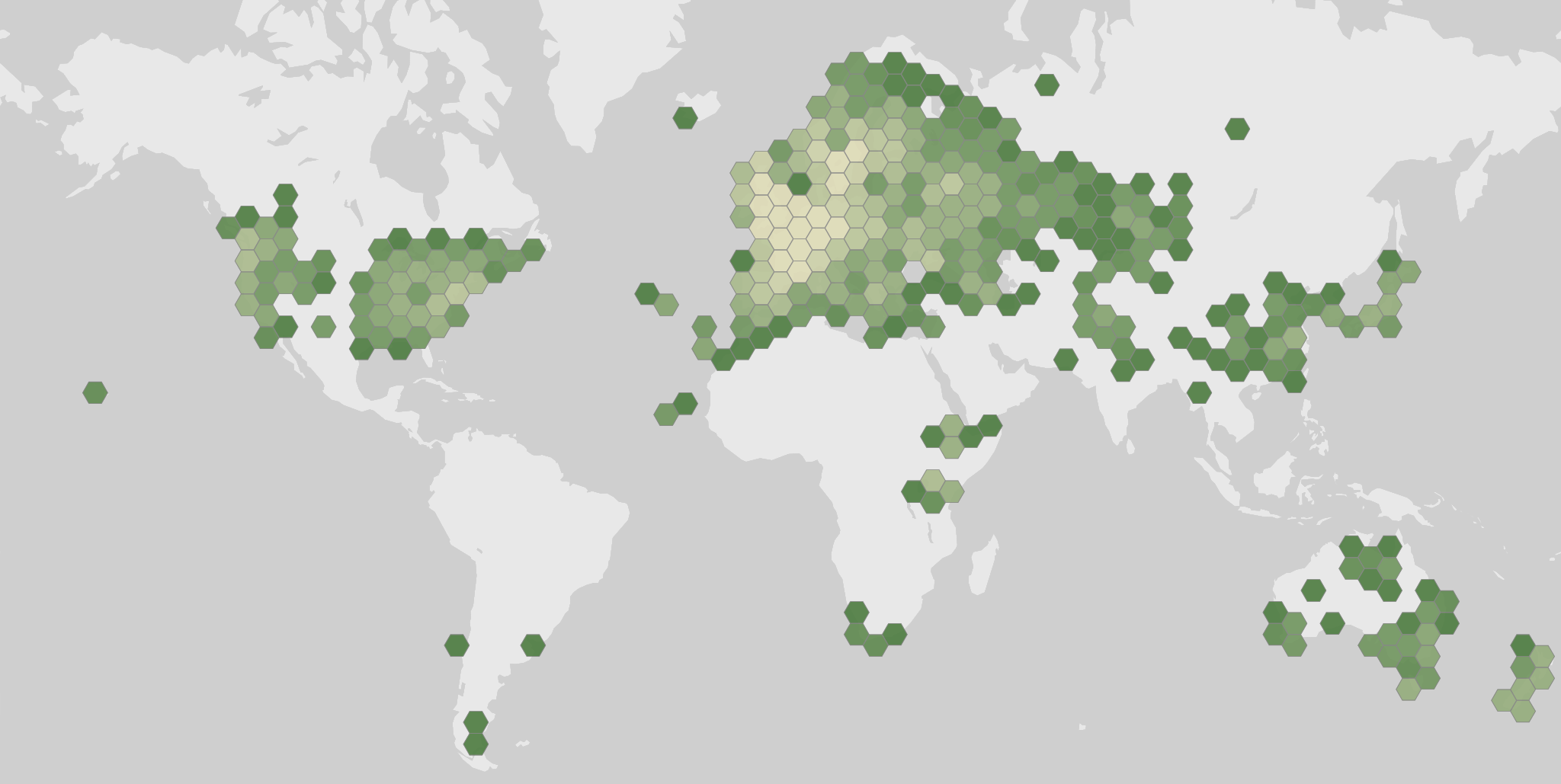
Arabidopsis thaliana occurs across a broad and largely continuous native range stretching from the Mediterranean north to Scandinavia and from Spain east to Greece, with populations native to parts of Europe, Asia, and Africa. It also appears to be native to tropical alpine environments in Africa and possibly South Africa. Since the 17th century it has been introduced and naturalized worldwide, including in North America.
The species uses a wide span of elevations, from near sea level up to 2,000 meters, and turns up on plains, mountain slopes, and river banks as readily as along roadsides. It favors rocky, sandy, and calcareous soils and often acts as a pioneer on bare or disturbed ground.
Its weedy habit shows in its fondness for agricultural fields, railway lines, and waste ground, though its limited competitive ability and small stature keep it from being classified as a noxious weed. Monthly observation counts show a strong peak in spring, climbing sharply from around 4,000 in February to a high near 58,000 in May before tapering off through summer and into a low base by late autumn; this pattern likely reflects when the plant is flowering and most visible rather than a measure of its true abundance.
Growth and Form
Arabidopsis thaliana grows as a fast, compact annual, occasionally biennial, and can pass from germination to mature seed in about six weeks under laboratory conditions. This speed reflects its habit as a spring ephemeral: the central flowering stem typically emerges around three weeks after germination, and each plant can go on to produce several thousand seeds.
Its small size, rapid cycle, and heavy seed output have made it a favored subject for studying how plants build their bodies. Work on its flower development established the now widely applied ABC model, in which three classes of floral organ identity genes govern the arrangement of sepals, petals, stamens, and carpels in the flower's whorls; mutations in these genes can cause one organ to develop as another, producing flowers with repeating patterns of sepals and petals instead of the normal structure.
Similar attention has gone into how its leaves take shape, from the initiation of the leaf primordium through the establishment of a distinct upper and lower leaf surface. The translucency of young seedlings, especially their roots, also makes the plant well suited to live imaging under fluorescence and confocal microscopy, allowing researchers to track development in individual cells over time without needing to fix or section the tissue.
Reproduction and Life Cycle
Arabidopsis thaliana reproduces mainly by self-pollination, with an outcrossing rate estimated at under 0.3 percent. Fertilization typically happens through pre-anthesis autogamy, meaning pollination is largely complete before the flower even opens.
Genetic analysis of linkage patterns across the genome suggests this shift to self-pollination took hold roughly a million years or more ago. While selfing does little to generate new genetic variation, the process of meiosis that precedes it may still offer a benefit: it allows recombinational repair of DNA damage each time germ cells form, a advantage that may explain why meiosis has persisted in a species that mostly fertilizes itself.
Ecology and Relationships
Arabidopsis thaliana has become a central tool for understanding how plants defend themselves against disease, and this role has revealed a great deal about plant-pathogen relationships more broadly. Most plants resist most pathogens simply because they are not compatible hosts, a phenomenon called nonhost resistance; studies using A. thaliana mutants exposed to the powdery mildew fungus Blumeria graminis helped identify the specific genes, named PEN genes, responsible for blocking infection.
When exposed to a pathogen or harmless microbe, the plant mounts an initial defense called PAMP-triggered immunity, triggered when surface receptors detect conserved microbial molecules. The best studied of these receptors, FLS2, recognizes a fragment of bacterial flagellin, while a second receptor, EFR, detects the bacterial protein EF-Tu; both were first identified and characterized in A. thaliana. A stronger, more targeted defense, effector-triggered immunity, kicks in when the plant's resistance genes detect specific proteins secreted by an invading pathogen.
These discoveries depended on A. thaliana's interactions with a range of bacterial, fungal, oomycete, viral, and nematode organisms, making it a working model for the broader relationships between plants and the microbes that challenge or coexist with them.
Fun Facts
- The species was first illustrated in the 16th century by Johannes Thal, who described it as Pilosella siliquata; Carolus Linnaeus later used that illustration in 1753 to name it Arabis thaliana, and it was moved to the genus Arabidopsis about a century afterward.
- Researchers routinely transform its genome using a technique called "floral dip," which involves simply dipping the plant's flower buds into a solution of Agrobacterium tumefaciens carrying a gene of interest, avoiding the need for tissue culture altogether.
Ecology
Habitat
- Mountain
- Freshwater
- Grassland
- Disturbed Ground
Growth habit
- Herb