The quaking aspen's leaves tremble at the slightest breeze, a trait so constant it gave the species both its common name and its scientific epithet, tremuloides. What looks like a grove of separate trees is often a single organism: aspens spread mainly through root sprouts, so a stand can share one root system and one genetic identity for thousands of years.
Populus tremuloides is a deciduous tree in the willow family, Salicaceae, native to the cooler regions of North America. It is classified as Least Concern by the IUCN. Its combination of shimmering foliage, immense clonal age, and sheer geographic reach makes it one of the continent's most studied trees.
Identification and Appearance
The clearest field mark is the bark: smooth and pale, ranging from whitish to light green when young, and interrupted by thick black horizontal scars and prominent black knots. Combined with leaves that quiver constantly in even a light wind, this makes the species easy to recognize at a distance.
Mature quaking aspens typically stand 15 to 18 meters tall with trunks around 25 centimeters in diameter, though the largest recorded individual reached 36.5 meters in height and 1.37 meters in diameter. Leaves on mature trees are nearly round, 4 to 6 centimeters across, with small rounded teeth and a long, flattened petiole; young trees and root sprouts instead bear much larger, nearly triangular leaves 10 to 20 centimeters long. The leaves are green above and gray beneath, turning gold to yellow in autumn and only rarely red.
A useful distinguishing feature among poplars is the petiole: in aspens it is flattened from side to side along its entire length, unlike the partial flattening seen in some other Populus species. Trees are dioecious, with separate male and female clones producing catkins 4 to 6 centimeters long in early spring before the leaves emerge.
Parallel vertical scratches on the bark, distinct from the natural horizontal scarring, are telltale signs of elk stripping bark with their front teeth. Growth rate and lifespan also vary by region: aspens grow more slowly but live longer in the drier west, typically 80 to 100 years and occasionally 200, while eastern stands often decay within 60 years even though the underlying root system can persist far longer.
Distribution and Habitat
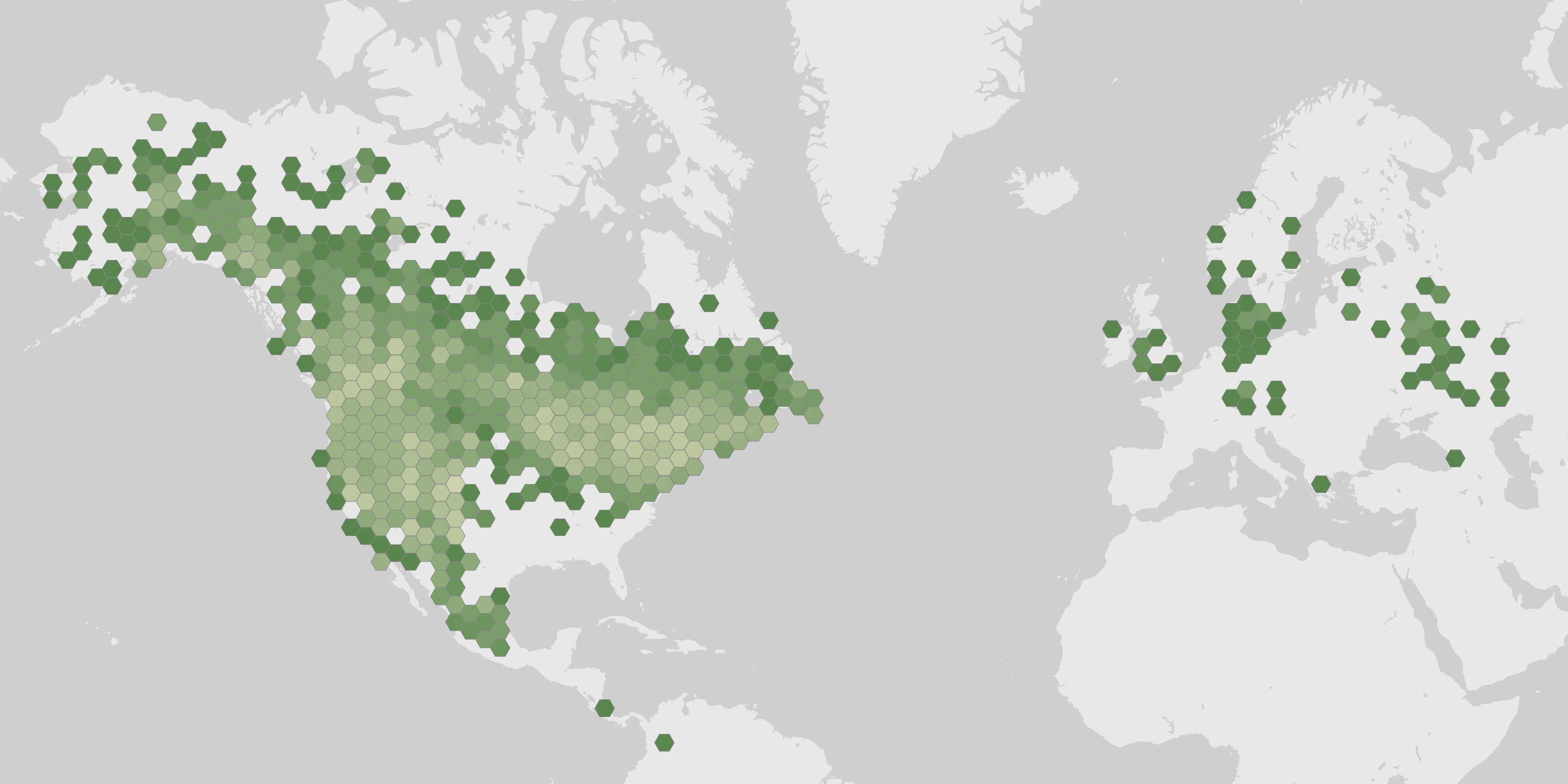
Quaking aspen is one of the most widely distributed trees in North America, occurring across every Canadian province and territory except possibly parts of Nunavut, and reaching as far north as the Brooks Range foothills in Alaska. Its range extends south at low elevation to northern Nebraska and central Indiana, and it grows at high elevation as far south as Guanajuato, Mexico, with isolated populations in Baja California, Jalisco, Michoacán, Sinaloa, Sonora, and Veracruz.
The species tolerates an extreme range of climates. In Montana it has endured January lows of -57°C and summer highs of 41°C, while annual precipitation across its range varies from just 180 millimeters in interior Alaska to over 1,020 millimeters in Newfoundland's Gander region. In the Western United States it rarely survives below 460 meters elevation because of hot summers, generally occurring instead between 1,500 and 3,700 meters, and in Colorado and southern Wyoming it forms a narrow elevational belt from 2,100 to 3,350 meters.
Aspen mixes with chokecherry, serviceberry, and hawthorn in sagebrush steppe, and forms shrub-like dwarf clones in marginal, cold, dry sites such as the upper elevation limits of the White Mountains. Its overall range is shaped first by water surplus and then by growing-season temperature extremes.
Monthly observation records show a strong seasonal pattern, rising sharply from early spring, peaking in June and July, and falling off through autumn and winter. This pattern most likely reflects when the tree is easiest to observe and record rather than any change in its actual population.
Ecology and Relationships
Quaking aspen reproduces mainly by sending up root sprouts from adventitious buds, allowing a single clone to expand into a colony covering many hectares. Because aspens are either male or female and large stands are usually all one sex, pollination is often limited, and the tiny seeds—about three million per pound—lack a stored food source or protective coating, so they remain viable only briefly and rarely establish new trees from seed.
Aspen groves support a wide range of wildlife. Buds and bark feed snowshoe hares, moose, black bears, cottontail rabbits, porcupines, deer, grouse, and mountain beavers, while sheep, goats, cattle, and elk browse the shoots and foliage. Beavers eat the bark and foliage and store aspen logs as winter food, and the leaves host caterpillars of numerous moths and butterflies, though the tree also serves as host to damaging insects such as the large aspen tortrix.
Since the early 1990s, increased mortality has been reported in aspen stands across North America, linked to defoliating insects, wood-boring beetles, and fungal cankers such as Cytospora. In parts of the Western United States, heavy grazing by cattle, deer, and elk can prevent young sprouts from reaching maturity, while decades of wildfire suppression have removed a disturbance that aspens depend on to compete with encroaching conifers. Thaw-freeze events and lighter late-winter snowfall tied to warming temperatures have added further stress in southern and western Canada.
Uses and Human Relationships
The trembling of aspen leaves has long carried symbolic weight. Among Celtic peoples, the rustling sound was thought to be the tree communicating with another world, whispering wisdom from ancestors on another plane, and the name itself, from the Latin populus tremula, literally means "trembling poplar."
Practically, indigenous North Americans and European settlers in the western United States extracted a substance from aspen bark to use as a substitute for quinine. As timber, aspen wood dries slowly, rots quickly, and burns without much heat, making it a poor fuel wood despite being cheap and widely used at campgrounds; pioneers used it for log cabins and dugouts only when better species were unavailable. Today its main commercial use, especially in Canada, is as pulp for books, newsprint, and fine printing paper, and it is well suited to panel products such as oriented strand board and waferboard, as well as furniture, boxes, crates, and plywood core stock.
Quaking aspen is the state tree of Utah. The cultivar 'Prairie Gold' was introduced by the Nebraska Statewide Arboretum with a local nursery, marketed as better adapted to the warmer, drier conditions of lower elevations.
Fun Facts
- Quaking aspen is the most widely distributed tree species in North America, occurring in every Canadian province and territory except possibly parts of Nunavut, and reaching from Alaska to central Mexico.
- Its seeds are extraordinarily small, at about three million seeds per pound, and lack a stored food source or protective coating, which is part of why the species reproduces mainly through root sprouts instead.
- Elk leave distinctive parallel vertical scratches on aspen bark by stripping it off with their front teeth, distinct from the tree's natural horizontal black scarring.
- Some Celtic traditions held that aspen shields could protect a person both physically and psychically, and that the sound of the leaves fluttering in the wind was a message from the otherworld.
Conservation status
- LC
- NT
- VU
- EN
- CR
Least Concern
Ecology
Habitat
- Forest
- Woodland
- Shrubland
- Mountain
Growth habit
- Tree