Cassava feeds hundreds of millions of people across the tropics, yet its roots and leaves are dangerous to eat raw. This paradox, a staple crop that is also a natural source of cyanide, has shaped how farmers grow, harvest and prepare it for thousands of years.
Manihot esculenta, known as cassava, manioc or yuca, is a woody shrub in the spurge family, Euphorbiaceae. It is native to South America, spanning Brazil, Paraguay and parts of the Andes, and is now grown as an annual crop throughout the tropics and subtropics for its starchy tuberous root.
Beyond the boiled root eaten at the table, cassava is processed into tapioca starch, ground into flours such as Brazilian farofa and West African garri, and used in animal feed and industry. Few plants illustrate so clearly how human ingenuity can turn a toxic wild relative into a global food staple.
Identification and Appearance
The clearest field mark is the plant's alternately arranged, palmately lobed leaves, each divided into three to seven lobes, paired with a milky sap that oozes from cut stems or leaves. Cassava is monoecious, bearing separate male and female flowers together in inflorescences that form at the tip of the growing stem.
The plant itself is a woody shrub, but the part people recognize and harvest is the storage root: long, tapered and covered in a rough brown rind that peels away easily. Inside, the flesh is white or yellowish, firm and evenly textured, running around a woody vascular bundle down the center. Commercial roots typically measure 5 to 10 centimeters wide at the top and 15 to 30 centimeters long.
Growers distinguish two growth habits: an erect, non-branching form favored by farmers for ease of harvest, transport and storage, and a branching form that flowers more readily. Because the erect type rarely flowers, plant breeders rely on photoperiod extension, pruning and growth regulators to induce flowering for crop improvement.
Nutritionally, the roots are mostly starch with only small amounts of calcium, phosphorus and vitamin C, and they contain little protein. The leaves, by contrast, are protein-rich, though low in the essential amino acid methionine, an important difference between the two edible parts of the same plant.
Distribution and Habitat
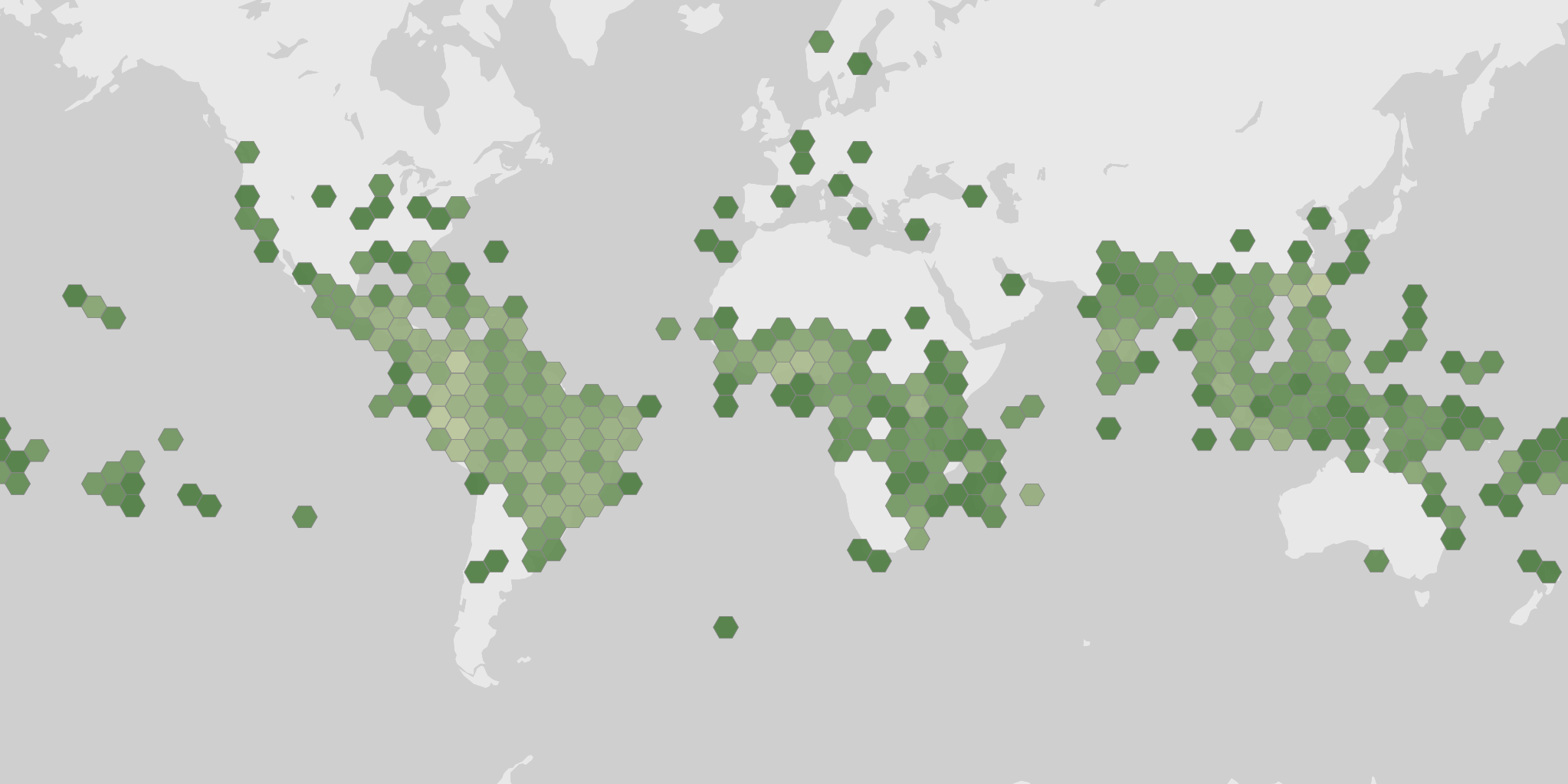
Cassava's native range lies in South America, from Brazil and Paraguay into parts of the Andes, but the crop is now cultivated far beyond it. In China alone it is grown across Fujian, Guangdong, Guangxi, Guizhou, Hainan, Taiwan and Yunnan, part of a pattern repeated throughout the tropics worldwide.
Monthly observation data show counts ranging from around 1,287 in September to a peak of 2,876 in March, with a secondary rise to 2,396 in November. This pattern may reflect seasonal presence or observer activity rather than the plant's true abundance, since these are presence records only, not population counts or a complete map of where cassava grows.
Because cassava is so widely cultivated rather than found growing wild, its modern distribution says as much about agricultural practice and trade as it does about natural habitat preference.
Uses and Human Relationships
Farmers propagate cassava from stem cuttings roughly 15 centimeters long, planted just before the wet season. The crop thrives where mean annual temperatures run between 20 and 29 degrees Celsius, though it tolerates extremes from 12 to 40 degrees Celsius, with annual rainfall of 1,000 to 2,500 millimeters and a growing period of at least 240 days; parts of Mexico's northern Gulf Coastal Plain, with phaeozem, regosol, arenosol, andosol and luvisol soils, meet these conditions well.
Harvest involves stripping the leafy stems, pulling up the stem base and cutting away the tuberous roots. Once cut, the roots begin to deteriorate almost immediately: a healing response produces coumaric acid, which oxidizes and blackens the flesh within days, a process tied to cyanide release during mechanical harvesting. This rapid spoilage has long limited cassava's export potential, prompting preservation methods such as fungicide treatment, wax coating, freezing, and breeding programs that use gene silencing or carotenoid-rich varieties to extend shelf life by weeks.
Viral disease has also shaped cassava's history. African cassava mosaic virus, spread by whiteflies, caused a major famine after an outbreak in the 1920s, and a more damaging mutant strain identified in Uganda in the late 1980s spread at roughly 80 kilometers per year across Uganda, Rwanda, Burundi and the two Congos. Cassava brown streak virus remains a major worldwide threat, and researchers have found that African cultivars carrying genes from Manihot carthaginensis subsp. glaziovii show resistance to mosaic disease, a discovery guiding ongoing breeding and genetic engineering efforts.
Culturally, cassava carries deep symbolic weight among indigenous South American peoples. The Tupi, credited with first domesticating the plant, gave it the name "mani-oca," and across the region manioc features in creation myths and agricultural rituals, including narratives recorded among the Machiguenga of Peru's Urubamba region.
Fun Facts
- The Tupi people, who first domesticated cassava, named it "mani-oca," a term still echoed in its common name manioc today.
- In many South American cultures, manioc appears in creation myths and agricultural rituals, including a narrative recorded among the Machiguenga Indians of Peru's Urubamba region.
- Not all cassava is equally toxic: some varieties naturally contain low levels of cyanogenic acid and can be eaten without the processing that other varieties require.
Photos
Photographs from by Nadine Gaffney via iNaturalist, licensed under CC BY 4.0., via iNaturalist, licensed under CC0 1.0., by Alex Day via iNaturalist, licensed under CC BY 4.0., by Siya ul haque via iNaturalist, licensed under CC BY 4.0., by Hilda Chan via iNaturalist, licensed under CC BY 4.0., by Matteo Bellucci via iNaturalist, licensed under CC BY 4.0., by angryphyco via iNaturalist, licensed under CC BY 4.0., by Corey Farwell via iNaturalist, licensed under CC BY 4.0., by Raúl A. Ruiz M. via iNaturalist, licensed under CC BY 4.0., by Cody Hinchliff via iNaturalist, licensed under CC BY 4.0., by abidanimallover via iNaturalist, licensed under CC BY 4.0., by Maria Janeiro via iNaturalist, licensed under CC BY 4.0., by Aparna via iNaturalist, licensed under CC BY 4.0., by Thomas Gyselinck via iNaturalist, licensed under CC BY 4.0., by Ong Jyh Seng via iNaturalist, licensed under CC BY 4.0., by B. Phalan via iNaturalist, licensed under CC BY 4.0., and by Manuel R Popp via iNaturalist, licensed under CC BY 4.0., credited on each photo.
Ecology and classification
Habitat
Growth habit
- Shrub
Classification
- Phylum
- Tracheophyta
- Class
- Magnoliopsida
- Order
- Malpighiales
- Family
- Euphorbiaceae
- Genus
- Manihot
- Species
- Manihot esculenta
Sources
- GBIF Species names and classification
- iNaturalist Photos
- Wikidata Common names and conservation status
- Wikipedia Summary extract
- Encyclopedia of Life Habitat, diet and behavior traits