Each passion fruit typically holds around 250 seeds, every one wrapped in its own pocket of tart, musky pulp. Passiflora edulis is a perennial climbing vine in the passion flower family, native to a swath of South America running from southern Brazil through Paraguay into northern Argentina, where it has since spread far beyond its origins as both a cultivated crop and an escaped garden plant.
Beyond its fruit, the plant carries centuries of cultural meaning, having been read by early Spanish missionaries as a living symbol of the Passion of Christ, a story that runs alongside its more familiar identity as a popular tropical fruit crop.
Identification and Appearance
The clearest field mark is the flower itself: a solitary bloom 5 to 7.5 centimeters wide at each leaf node, with 5 oblong green sepals and 5 white petals, each 4 to 6 millimeters long, forming a delicate fringe around a rich purple base. Five stamens, an ovary, and a branched style rise from the flower's center, with the styles curving backward and ending in distinctly headed stigmas.
The vine itself is a perennial climber that grabs onto support with tendrils growing from the leaf axils, tendrils that show a red or purple tint while young. Two main varieties exist: Passiflora edulis f. edulis, which produces dark purple fruit flecked with fine white specks, and P. edulis f. flavicarpa, whose fruit ripens light yellow.
The fruit is a spherical to ovoid pepo, 4 to 7.5 centimeters across, encased in a smooth, leathery rind 9 to 13 millimeters thick that includes a substantial layer of pith. Purple fruits run smaller, around 35 grams, while yellow fruits average closer to 80 grams. Inside, roughly 250 brown seeds, each about 2.4 millimeters long, sit within individual juice-filled sacs that give the fruit its slightly acidic, musky flavor, often likened to guava.
Yellow varieties differ from purple ones not just in fruit size and color but in flower biology, discussed further under reproduction; the yellow form's peel and juice have also been found to contain prunasin and other cyanogenic glycosides, a chemical difference not shared equally by the purple form.
Distribution and Habitat
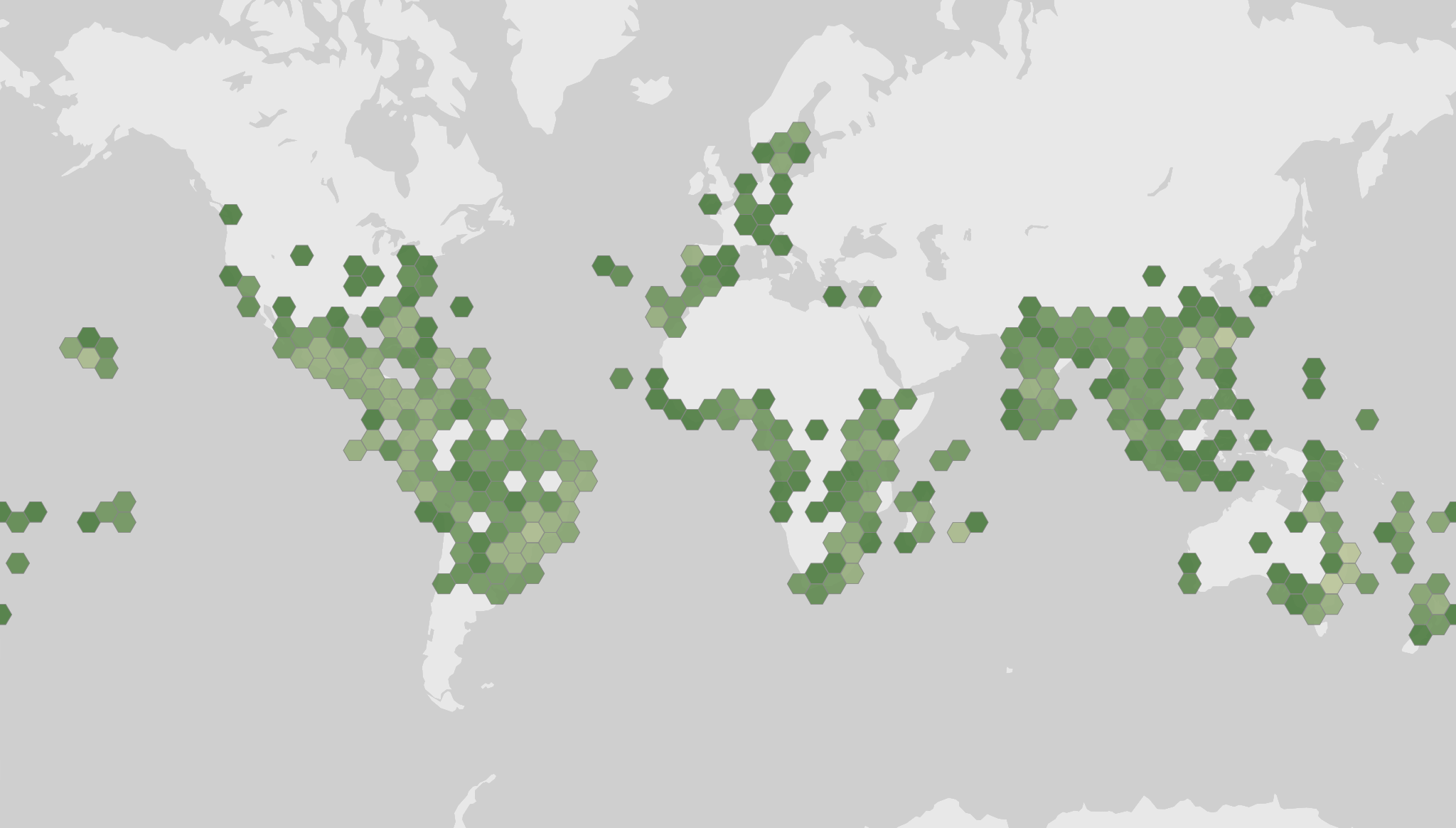
Passiflora edulis is native to southern Brazil, Paraguay, and northern Argentina, but it now grows well beyond that range as both a cultivated crop and an escapee from gardens. Where it has naturalized, it turns up in forests within mountain valleys, at elevations between 100 and 1,900 meters.
Recorded observations of the species show two modest peaks over the year, one around April and a second stretching from October into November, with quieter months in between. These figures come from presence records rather than any measure of abundance or population size, so they point only to when the plant has been noticed and reported, not to how common it actually is at any given time or place.
Taken together, the pattern fits a species that thrives across a broad elevational band in warm, humid forest environments, while also persisting readily in disturbed or cultivated ground far from its original range.
Reproduction and Life Cycle
The two main forms of Passiflora edulis differ sharply in how their flowers reproduce: the yellow-fruited form is self-sterile and needs pollen from another plant to set fruit, while the purple-fruited form is self-compatible and can pollinate itself. Yellow passion fruit flowers come in three types, distinguished by the curvature of their styles, a detail that affects how successfully pollen reaches the stigma.
In California, effective pollination has been linked closely to the carpenter bee. Because these bees favor decaying wood for shelter, some growers place old logs near their vines specifically to attract and keep carpenter bees nearby, improving the odds of fruit set.
The flower's own architecture, with its backward-curving styles and prominently headed stigmas, is built around this insect partnership, making the presence of the right pollinator as important to fruit production as the vine's own compatibility system.
Uses and Human Relationships
Passion fruit has a long history as both a food and a folk remedy. In Caribbean communities, the fruit is traditionally blended into a refreshing drink, and the plant has also been used to treat a range of ailments through both practical and spiritual means.
The plant's cultural weight runs deeper than cuisine. In the 16th century, Spanish missionaries in the Americas looked at the flower's structure and saw it as representing the Passion of Christ, with individual parts of the bloom read as symbols tied to the crucifixion story, a connection that gave the genus its enduring religious association.
Commercially, passion fruit is grown across tropical and semitropical regions, including in the United States in Florida, Hawaii, and California, though the vine generally needs protection from frost, since only certain cultivars tolerate light freezes after heavy pruning. Growers also contend with a range of diseases, including passion fruit woodiness virus, cucumber mosaic virus, phytoplasma-caused "overshooting," bacterial leaf spot, bacterial grease-spot, and collar rot, several of which spread through sap-sucking insects like aphids and have no chemical cure once a plant is infected.
Fun Facts
- The vine's leaves are glossy and three-lobed, growing 3 to 5 inches long with finely serrated edges, and each leaf stalk carries two small glands.
- The genus name Passiflora traces back to Spanish missionaries who interpreted the flower's corona as a crown of thorns and its other parts as emblems of Christ's Passion.
- According to tradition, a friar named Emmanuel de Villegas used the flower's radial corona filaments as a teaching tool during evangelization, reading them as symbolic of the crucifixion.
Ecology
Habitat
- Forest
- Mountain
- Disturbed Ground
Growth habit
- Vine