Sun spurge gets its name from an old belief that its flower clusters turn to follow the sun across the sky, a supposed heliotropic behavior captured in its species name helioscopia, from the Greek for "sun" and "to observe."
This herbaceous annual in the spurge family (Euphorbiaceae) is native to most of Europe, North Africa, and much of Asia, and has since been introduced widely elsewhere. Also known as madwoman's milk, it is a familiar sight on disturbed ground and cultivated land, and its long history in folk medicine and its distinctive appearance make it worth a closer look.
Identification and Appearance
The clearest field mark is the plant's flower arrangement: small yellow-green flowers sit atop two to five basal bracts that resemble the leaves but are yellower, giving the flower head a distinctive glowing look.
Sun spurge grows 10 to 50 cm tall on a single, erect, hairless stem that branches toward the top. Its oval leaves are broadest near the tip, measure 1.5 to 3 cm long, and have a finely toothed margin.
Flowering runs from mid-spring to late summer. The species can be confused with Euphorbia rhabdotosperma, which looks similar but has smaller parts and a different seed surface; that species occurs in Iran, the North Caucasus, Transcaucasus, Turkey, and Turkmenistan.
Distribution and Habitat
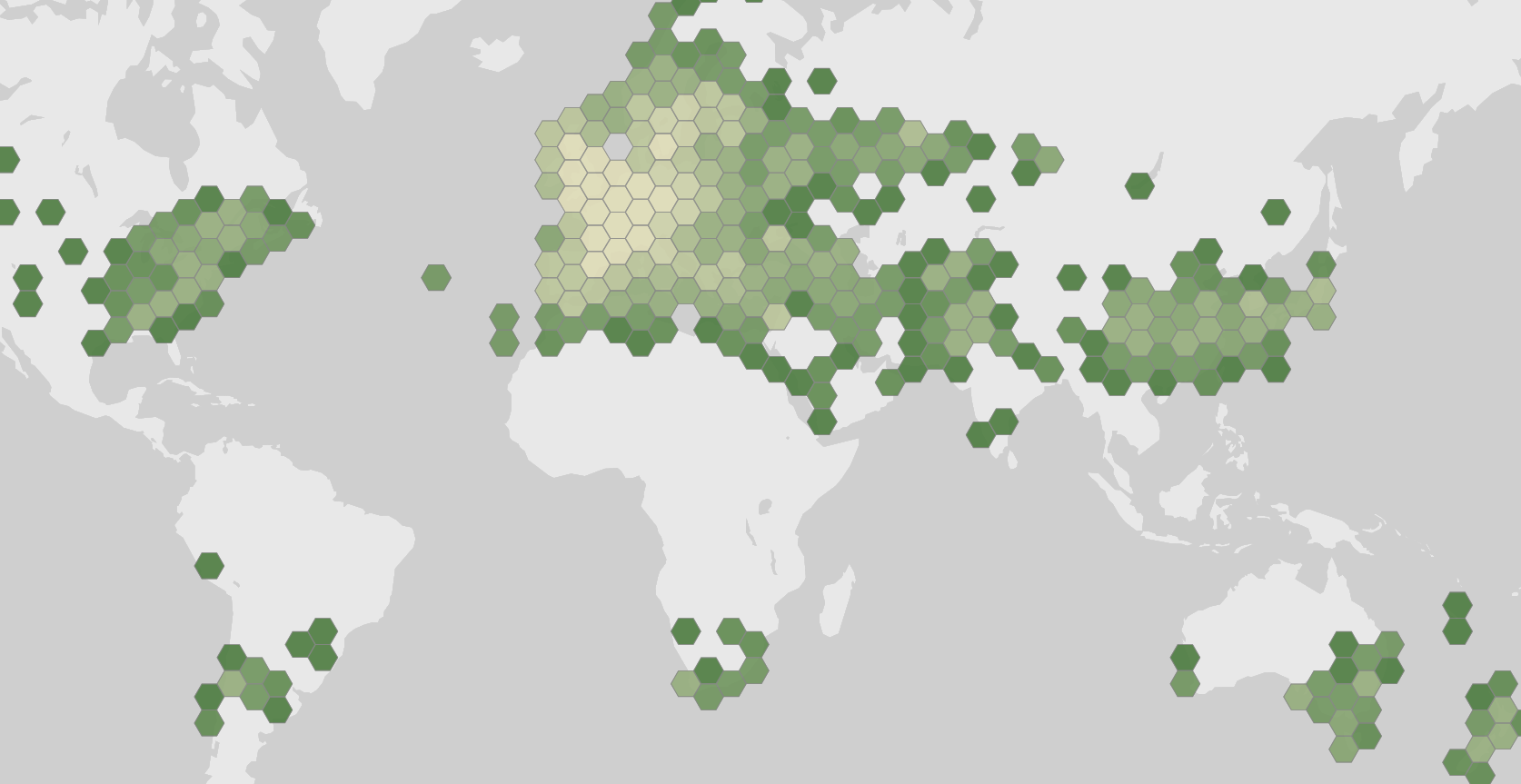
Sun spurge has one of the broadest native ranges among European spurges, spanning Macaronesia, North Africa, and temperate Eurasia through to the Indian subcontinent, with a native presence recorded from Afghanistan and Iran to China, Japan, and Korea, as well as across nearly all of Europe.
It favors disturbed and cultivated ground: it is described as a weed of cultivation, found in fields, roadsides, scrub, and the margins of mixed forests. In China it is recorded across a wide swath of provinces, including Anhui, Fujian, Gansu, Guangdong, Hebei, Shaanxi, Sichuan, and Xinjiang, among many others.
The species has also been introduced well beyond its native range, now established across much of the United States and Canada, in New Zealand, Argentina, and Great Britain and Ireland, among other regions.
Monthly observation counts show clear seasonal peaks, rising from a low in winter to a high in spring and early summer, consistent with the plant's active growing and flowering season, though these figures reflect presence observations rather than actual population size.
Growth and Form
Sun spurge grows as an annual or biennial herb, completing its life cycle within one or two growing seasons rather than persisting as a long-lived perennial.
Ecology and Relationships
Sun spurge attracts a range of flower visitors, most notably hoverflies such as Episyrphus balteatus and Melanostoma mellinum, along with beetles like Attalus lusitanicus; though a visit to the flower is not proof that pollination occurs.
The plant also serves as food for a variety of animals. Birds make up a large share of its recorded consumers, including finches and buntings such as Acanthis flammea, Carduelis citrinella, Carpodacus erythrinus, and Chloris chloris, as well as the skylark (Alauda arvensis) and game birds like Alectoris graeca, ducks (Anas platyrhynchos), and geese (Anser anser). Insects are also recorded feeding on it, including the flea beetle Aphthona pygmaea and the grasshopper Calliptamus italicus.
As a weed of cultivated and disturbed ground, it thrives in fields, roadsides, and forest margins, habitats shaped by human disturbance and soil turnover.
Uses and Human Relationships
The genus name Euphorbia commemorates Euphorbus, a physician to King Juba II of Mauretania in the 1st century BCE, who reportedly used plants of this genus for medicinal purposes; Linnaeus adopted the name in 1753 in his honor.
Euphorbia helioscopia has long been used in folk medicine and remains part of Chinese traditional medicine. Active ingredients extracted from the plant are used in the pharmaceutical industry, and its extract has been found to inhibit hepatocellular carcinoma in mice in laboratory studies.
Fun Facts
- Sun spurge seedlings show epigeal germination, with a smooth, erect hypocotyl about 1 cm tall and smooth, oval, spreading cotyledons.
- The whole seedling exudes white latex the moment it is injured, a trait that persists into the mature plant.
- The species has naturalized far beyond its native Eurasian and North African range, now found across much of North America, New Zealand, and even the Falkland Islands and St. Helena.
Photos
Photographs from via iNaturalist, licensed under CC0 1.0., by guywallbanks via iNaturalist, licensed under CC BY 4.0., by Ondřej Křivan via iNaturalist, licensed under CC BY 4.0., by zebedeugalinha via iNaturalist, licensed under CC BY 4.0., by Марина Садыкова via iNaturalist, licensed under CC BY 4.0., by Константин Селивёрстов via iNaturalist, licensed under CC BY 4.0., by Thomas Mesaglio via iNaturalist, licensed under CC BY 4.0., and by Orzigul Anvarova via iNaturalist, licensed under CC BY 4.0., credited on each photo.
Ecology and classification
Growth habit
- Herb
Classification
- Phylum
- Tracheophyta
- Class
- Magnoliopsida
- Order
- Malpighiales
- Family
- Euphorbiaceae
- Genus
- Euphorbia
- Species
- Euphorbia helioscopia
Sources
- GBIF Species names and classification
- iNaturalist Photos
- Wikidata Common names and conservation status
- Wikipedia Summary extract
- Encyclopedia of Life Habitat, diet and behavior traits
- Plants of the World Online Native range, life form and climate (WCVP)
- GloBI What it eats, what eats it, parasites and pollinators
- trophiCH
- DoPI
- EuPPollNet