The castor bean plant stands alone in more ways than one: it is the sole species in its genus, Ricinus, and the only member of the subtribe Ricininae.
It is a perennial flowering plant belonging to the spurge family, Euphorbiaceae, within the order Malpighiales. Best known by its common names, castor bean and castor oil plant, it has drawn attention from botanists, gardeners, and toxicologists alike for reasons that go far beyond its unusual family tree.
Identification and Appearance
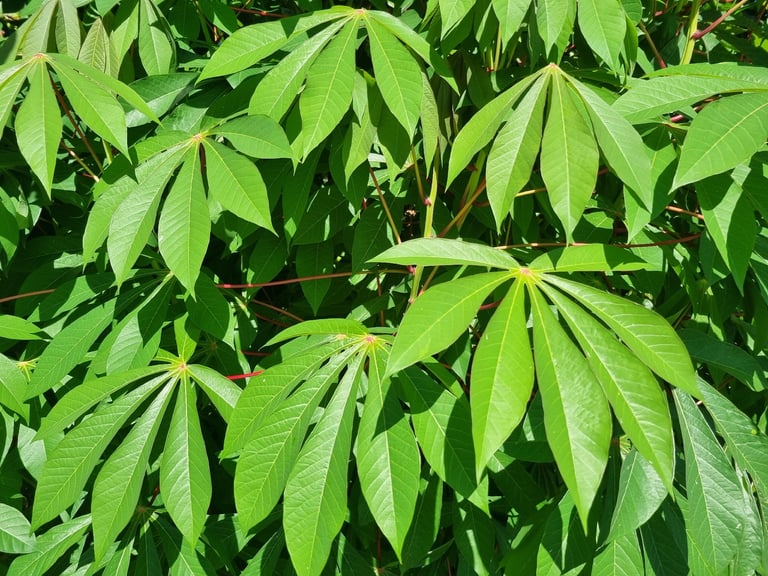
The most useful field mark is the plant's large, glossy, palmate leaf, deeply divided into five to twelve coarsely toothed lobes and measuring 15 to 45 centimeters across on a long stalk. Growth habit varies enormously: castor bean is typically a fast-growing, suckering shrub, but in favorable conditions it can reach the size of a small tree, up to about 12 meters, though it is not cold hardy and often behaves as an annual in frost-prone areas.
Leaf color changes with variety and age. Some cultivars emerge dark reddish-purple or bronze before maturing to green, sometimes retaining a reddish tinge, while others stay green from the start. A number of ornamental varieties carry a pigment that masks chlorophyll entirely, keeping leaves, stems, and young fruit a dramatic purple-to-reddish-brown for the plant's whole life. Stems and seed capsules follow the same pigmentation pattern, and plants of both color forms often grow side by side.
Flowers lack petals and are unisexual, with both sexes borne on the same plant in terminal, panicle-like spikes. Numerous yellowish-green male flowers with prominent creamy stamens sit lower on the spike, while fewer female flowers with striking red stigmas occupy the tips, enclosed within immature spiny capsules that are often more visually showy than the flowers themselves.
The fruit is a spiny, greenish to reddish-purple capsule holding large, oval, shiny, bean-like seeds with variable brownish mottling. Each seed bears a warty, fat-rich appendage called a caruncle at one end, a feature that helps distinguish castor seeds from other bean-like seeds and plays a role in how the plant disperses.
Distribution and Habitat
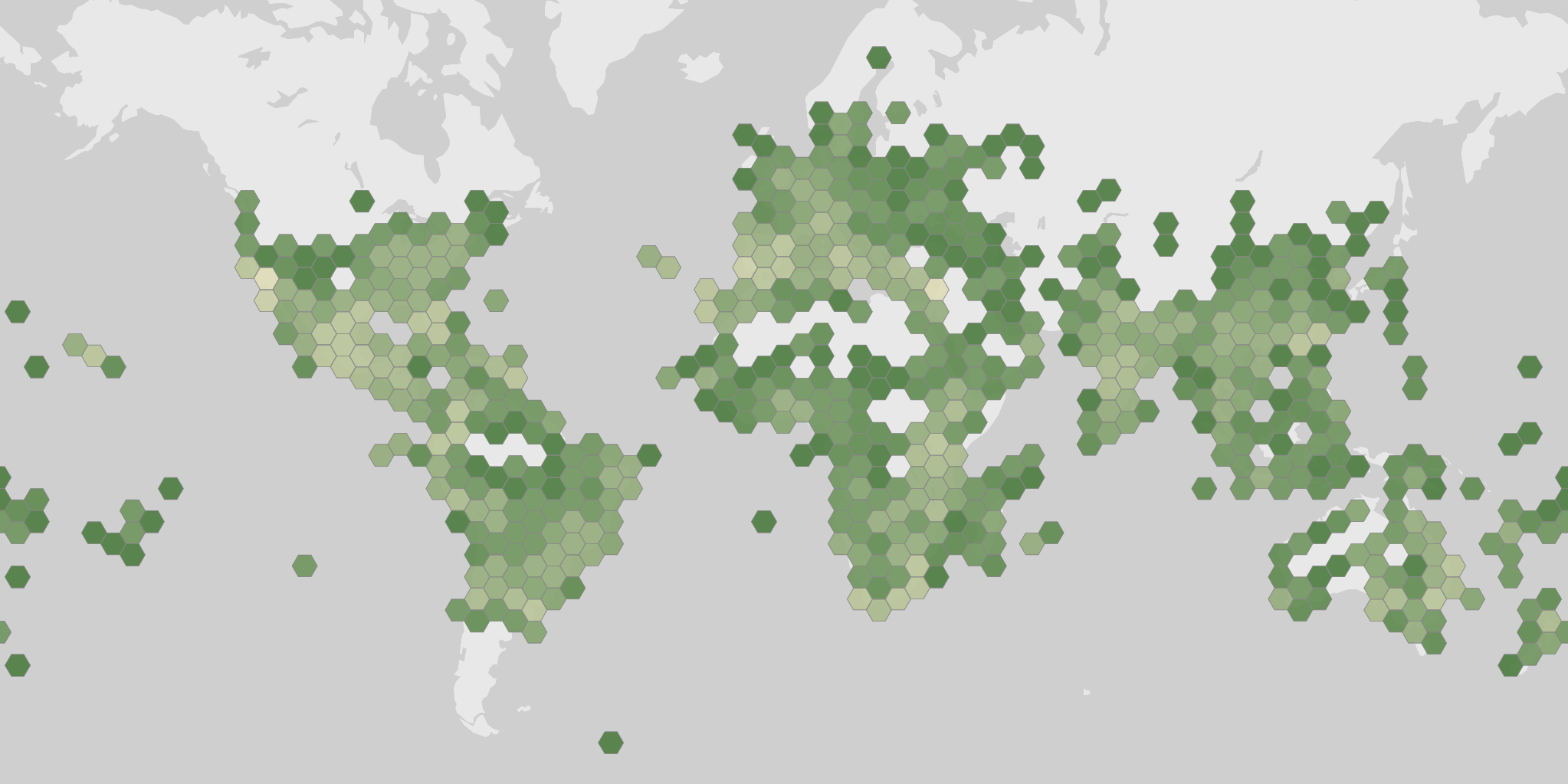
Castor bean is native to the southeastern Mediterranean Basin, Eastern Africa, and India, but it has since spread to become common throughout tropical regions worldwide. Where the climate suits it, the plant establishes easily and can turn invasive, often colonizing wasteland and disturbed ground far from where it was originally planted.
It grows as a cultivated plant, a ruderal weed along roadsides and waste areas, and occasionally as a naturalized species along riverbeds, generally at elevations below 100 to 500 meters, though it has been recorded as high as roughly 2,300 meters. This wide elevational tolerance helps explain its broad geographic footprint.
Monthly observation data show a clear peak in April, with counts nearly double the yearly low seen in December, suggesting stronger seasonal presence or detectability in spring in the regions covered by these records. These figures reflect where the plant has been observed, not its abundance or the full extent of its range, so they should be read as a rough seasonal signal rather than a population count.
Ecology and Relationships
Castor bean functions as a host plant for several moth and butterfly species, including the common castor butterfly (Ariadne merione), the eri silkmoth (Samia cynthia ricini), and the castor semi-looper moth (Achaea janata), whose larvae feed on its leaves. Other Lepidoptera larvae, such as those of Hypercompe hambletoni and the nutmeg moth (Discestra trifolii), also use it as a food source.
The plant has an unusual link to a jumping spider, Evarcha culicivora, which feeds on its nectar and preferentially uses castor bean as a site for courtship. This nectar relationship gives the plant a role in the spider's reproductive behavior that goes beyond simple food provision.
Seed dispersal depends heavily on ants. Each seed carries a fat-rich yellow nodule that ants find highly attractive; after hauling the seed back to their nest and stripping away this nutritious part, they discard the rest in their refuse pile, where the seed then germinates. This form of ant-mediated dispersal, known as myrmecochory, lets the plant colonize new ground without relying on wind or animals to carry the whole seed.
Uses and Human Relationships
People have grown castor bean both as a decorative garden plant and as a source of castor oil, and breeders have produced cultivars suited to each purpose. Ornamental varieties such as 'Carmencita', which has received the Royal Horticultural Society's Award of Garden Merit, along with 'Gibsonii', 'New Zealand Purple', 'Impala', 'Red Spire', and 'Zanzibarensis', have been selected for colorful foliage, stems, and seed pods, typically reaching 1.2 to 3 meters as annuals in gardens and parks. Separate cultivars bred for oil production, including 'Hale', 'Brigham', 'BRS Nordestina', 'BRS Energia', 'GCH5', 'GCH6', 'Abaro', and 'Hiruy', have been developed in places such as Texas, Brazil, India, and Ethiopia, with some, like 'Brigham', selected specifically to lower ricin content to about 10 percent of that found in 'Hale'.
Beyond ornamental and oil use, the plant carries a place in folklore and traditional medicine. Its leaves have historically been used as an insecticide, and the plant is associated in folk tradition with purification and protection against evil spirits. Castor bean has also featured in traditional medicine across Mediterranean and eastern cultures since ancient times and continues to appear in folk medicine practices worldwide.
Fun Facts
- The plant's association with folklore runs deep: its leaves have traditionally been used as an insecticide, and the species is linked in folk tradition to purification and protection against evil spirits.
- Castor bean has a long medicinal history, having been used in the pharmacopeia of Mediterranean and eastern cultures since antiquity and remaining part of folk medicine practices around the world today.
- The plant continues to attract modern scientific attention; a 2022 study published in connection with Archives of Toxicology examined its phytochemical, cytotoxic, and antimicrobial properties as part of an effort to test the scientific basis of its traditional folk uses.
Photos
Photographs from via iNaturalist, licensed under CC0 1.0., by Qadry Anthony via iNaturalist, licensed under CC BY 4.0., by Sofia Zvolanek via iNaturalist, licensed under CC BY 4.0., by Vasco Henrique Oliveira Fonseca via iNaturalist, licensed under CC BY 4.0., by 祐 via iNaturalist, licensed under CC BY 4.0., by Sarah Dillion via iNaturalist, licensed under CC BY 4.0., and by Nicole via iNaturalist, licensed under CC BY 4.0., credited on each photo.
Ecology and classification
Growth habit
- Shrub
Classification
- Phylum
- Tracheophyta
- Class
- Magnoliopsida
- Order
- Malpighiales
- Family
- Euphorbiaceae
- Genus
- Ricinus
- Species
- Ricinus communis
Sources
- GBIF Species names and classification
- iNaturalist Photos
- Wikidata Common names and conservation status
- Wikipedia Summary extract
- Encyclopedia of Life Habitat, diet and behavior traits