Aspergillus flavus is a fungus that can invade a crop in the field and then sit silently until the grain is bagged, shipped, or stored, only revealing itself as rot weeks or months later. It is both a saprotroph, living on decaying organic matter, and a plant pathogen with a cosmopolitan distribution, meaning it turns up on nearly every continent wherever suitable hosts and conditions exist.
The species is best known for colonizing cereal grains, legumes, and tree nuts, where it drives postharvest spoilage. Its name, flavus, is Latin for yellow, describing the color most often seen in its spore masses. Beyond its role in agriculture, the fungus has a long history of drawing attention wherever large stores of food are kept.
Fruiting Body and Identification
The most reliable field feature of Aspergillus flavus is its colony color: powdery masses of yellowish-green spores on the upper surface, with a reddish-gold tone on the underside. Growth is fast, and colonies quickly take on a dry, granular, powdery texture rather than a smooth or slimy one.
The fungus spreads through thread-like branching hyphae that form a mycelium. These hyphae are septate (divided into compartments) and hyaline (clear), and are rarely visible to the naked eye except where they mat together into dense mycelial felt bearing conidia. Once established, the mycelium releases enzymes that break down complex nutrients in the host tissue, which is what drives visible discoloration and dullness in infected grain or legumes.
Reproduction is mostly asexual, through conidiospores produced on rough, colorless conidiophores whose spore-bearing phialides can be arranged in a single row (uniseriate) or two rows (biseriate). A sexual stage, identified as Petromyces, has also been described: ascospores develop inside sclerotia when two compatible mating types are grown together, since the fungus is heterothallic and requires strains from different vegetative compatibility groups to reproduce sexually.
The species is further divided into two strain groups based on sclerotium size. Group I (L strains) produce sclerotia larger than 400 micrometers and are more aggressive as pathogens, though they generate less aflatoxin in culture. Group II (S strains) produce smaller sclerotia, are less aggressive, but produce more aflatoxin and are unique in also making aflatoxins G1 and G2 alongside the more common B1 and B2.
Distribution and Habitat
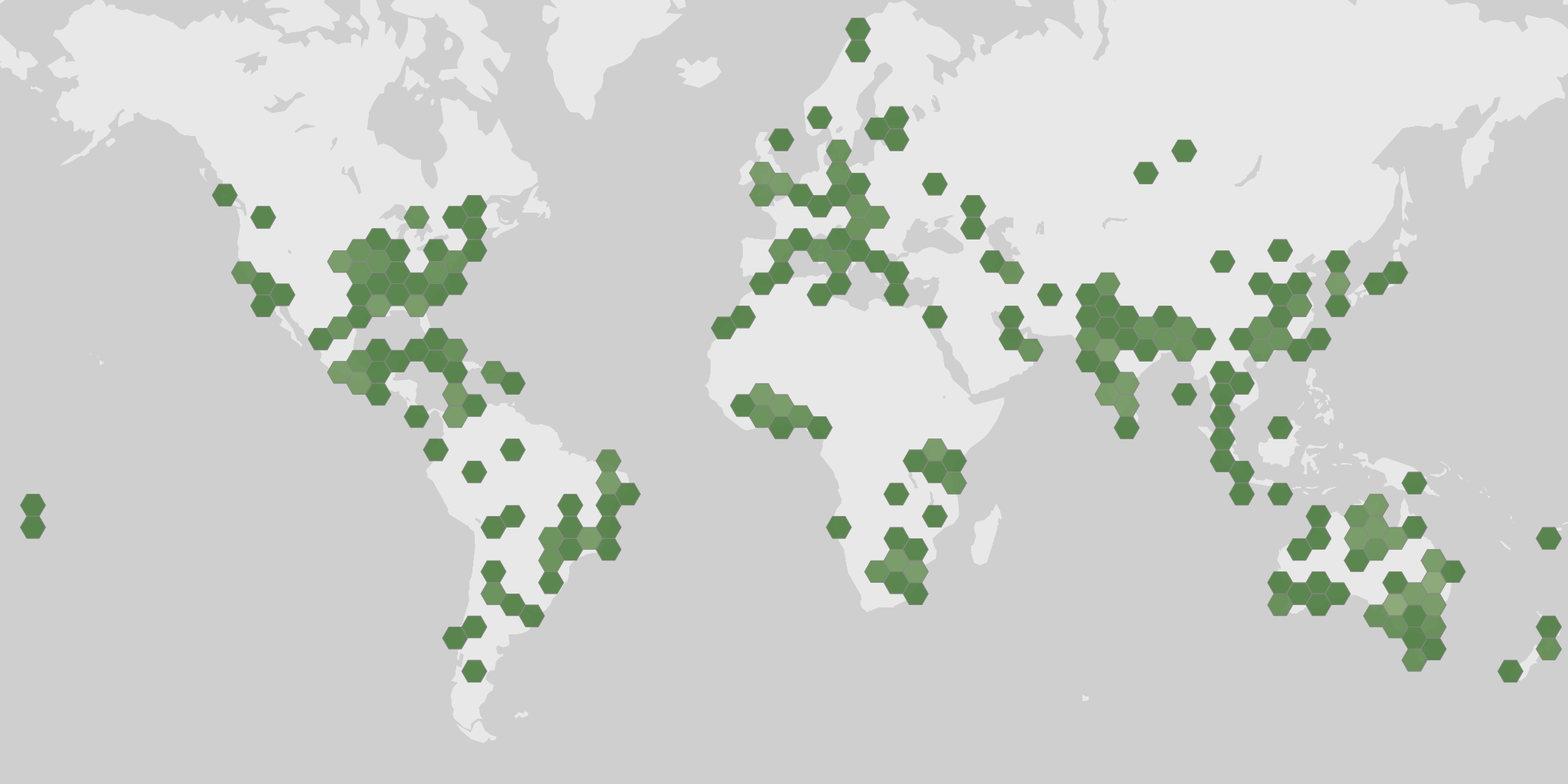
Observation data show Aspergillus flavus being recorded across every month of the year, consistent with its cosmopolitan distribution and its ability to persist wherever suitable hosts and storage conditions exist. Monthly counts are presence records only, not measures of abundance or population size, but the pattern still hints at seasonal shifts in detection.
Recorded observations rise sharply in March (668) and again in November (608) and October (478), with lower counts in February (217) and April (241). This suggests stronger detection during harvest-related periods in many regions, though the underlying data cannot confirm true seasonal abundance or define a complete range.
Because the fungus is tied to agricultural hosts such as cereal grains, legumes, and tree nuts, its recorded presence likely tracks cropping and storage cycles as much as it tracks the fungus's own biology.
Life Cycle
Aspergillus flavus is unusually thermotolerant, able to grow across a wide temperature range that excludes many competing fungi. Growth is possible from 12°C (54°F) up to 48°C (118°F), with an optimum around 37°C (99°F); growth is rapid between 30–55°C (86–131°F), slows markedly at 12–15°C (54–59°F), and nearly stops at 5–8°C (41–46°F).
Moisture availability is just as important as temperature. The fungus grows on starchy cereals at moisture levels of 13.0–13.2%, on soybeans at 11.5–11.8%, and on other crops around 14%. Its minimum required water activity is inversely tied to temperature, ranging from about 0.78 at 33°C (91°F) to 0.84 at 25°C (77°F), meaning warmer conditions allow the fungus to grow in drier material.
This flexible physiology explains why the species thrives especially in tropical countries, where heat and humidity combine to keep both temperature and moisture within its growing range for much of the year, supporting fruiting, sporulation, and spread through stored and field-grown crops alike.
Ecology and Relationships
Aspergillus flavus lives as a saprophyte in soils worldwide, overwintering there as mycelia or as hardened structures called sclerotia embedded in decaying plant matter. When conditions allow, sclerotia germinate to produce new hyphae and asexual conidia, which are then carried by wind and by insects such as stink bugs and Lygus bugs to new hosts.
As a pathogen, it causes ear rot in corn and yellow mold in peanuts, infecting hosts either before or after harvest. Infection risk rises sharply where insects have already damaged leaves or where crops are under stress from drought, stalk rot, or poor storage conditions; in corn, spores typically enter through the silks to reach the kernel. The fungus can invade seed embryos directly, cutting germination rates and sometimes killing seedlings outright, which lowers the grade and market value of affected grain.
Excess moisture and high storage temperatures push the fungus toward heavier aflatoxin production. Consumption of contaminated grain or feed by this route has been linked to liver cancer in both humans and other mammals, tying the fungus's ecological role as a decomposer and pathogen directly to its impact on food safety.
Fun Facts
- A sexual stage of Aspergillus flavus, named Petromyces, was identified relatively recently; it forms ascospores inside sclerotia only when two sexually compatible strains of opposite mating type are grown together.
- Spores of this fungus were found in tombs such as that of King Tutankhamun and were once feared for their potential to cause illness; the same species is now being studied for possible use in cancer treatment.
- Reproduction requires strains from different vegetative compatibility groups, meaning a single strain generally cannot complete the sexual cycle on its own.