No animal alive today, or known from the fossil record with confidence, matches the scale of Balaenoptera musculus. A blue whale can reach 29.9 to 30.5 meters in length and weigh up to 190–200 tonnes, making it the largest animal known to have ever existed.
The blue whale is a baleen whale in the rorqual family Balaenopteridae, order Cetacea, found in every ocean except the Arctic. Four subspecies are recognized, split across the North Atlantic and North Pacific, the Southern Ocean, the Indian and South Pacific Oceans, and the northern Indian Ocean, with a possible fifth population off Chile. Hunted to the edge of extinction in the 20th century, it is now classified as Endangered, and its slow recovery makes it one of the clearest test cases for what whale conservation can achieve.
Identification and Appearance
The single best field mark is the combination of immense size with a small, sickle-shaped dorsal fin set far back near the tail, a pairing no other whale shares at this scale. The body is long and slender rather than bulky, topped by a broad, flat, U-shaped head that makes up a large portion of the total length.
Skin coloration is a mottled grayish-blue that appears vividly blue when seen underwater, with mottling patterns near the dorsal fin unique to each individual, useful for photo-identification. The underside is paler and can look yellowish from diatoms that coat the skin, a pattern that once earned the species the nickname "sulphur bottom." Rare albino individuals are entirely white. The throat carries 60 to 88 grooves that let the skin expand enormously during feeding lunges, and the upper jaw holds 70 to 400 black baleen plates under a meter long.
Females are larger than males. In the Northern Hemisphere, sexually mature females average around 22 to 24 meters depending on population, while Antarctic females can reach 25.4 to 26.6 meters, the largest of all blue whales; pygmy blue whales in the Indian and South Pacific Oceans are smaller, with mature females around 21 meters. Two widely spaced blowholes can throw a spout nearly 9 to 12 meters into the air, useful for identifying the species at a distance before the animal itself is visible.
Distribution and Habitat
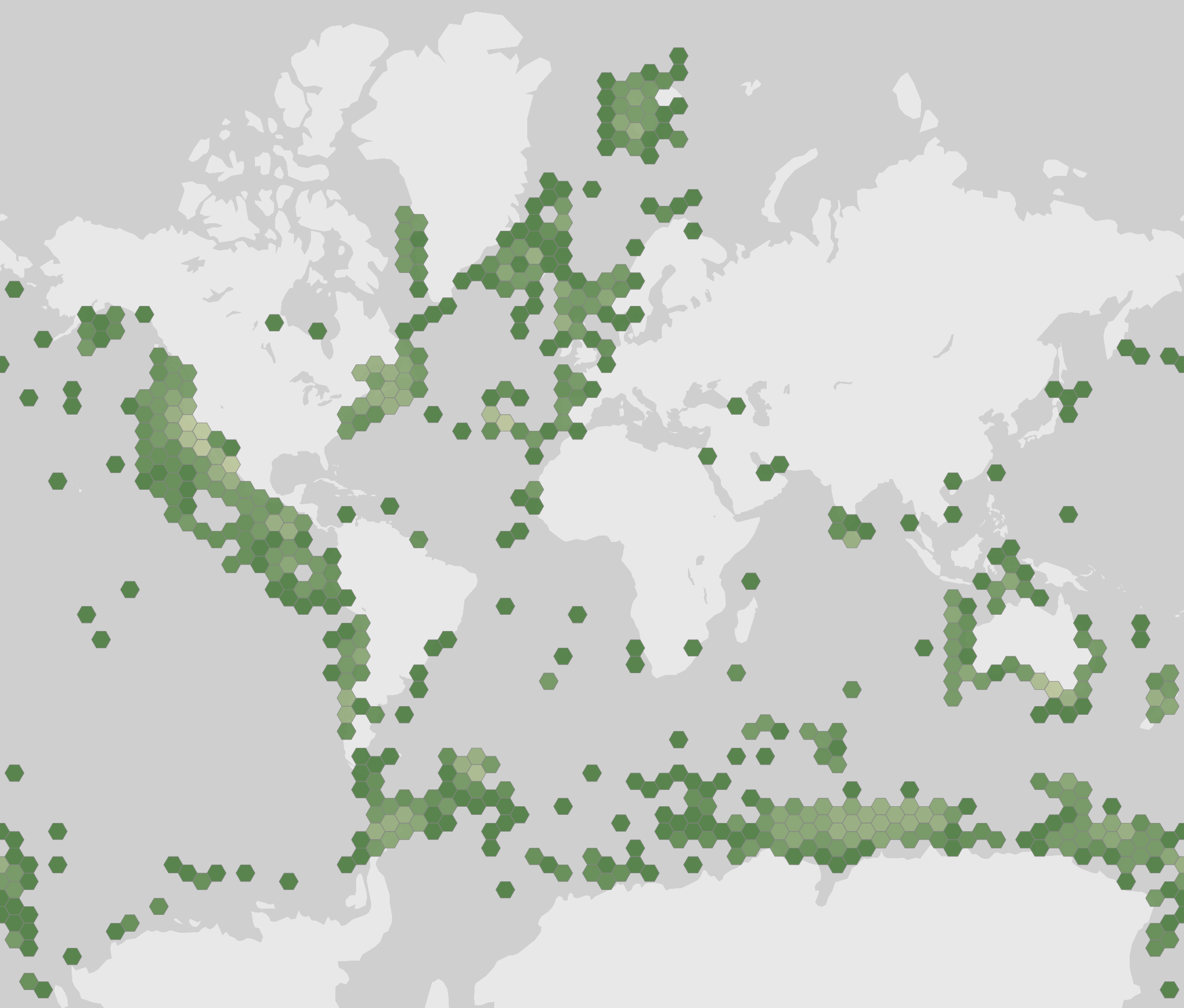
Blue whales range across the open ocean, a fully pelagic species found in temperate, tropical, and polar marine waters rather than tied to coastlines. Four recognized subspecies partition this range: B. m. musculus in the North Atlantic and North Pacific, B. m. intermedia in the Southern Ocean, B. m. brevicauda in the Indian Ocean and South Pacific, and B. m. indica in the northern Indian Ocean, with a distinct population off Chile that may represent a fifth group.
Monthly presence-observation counts show a clear peak in January, with a secondary rise from July through September, and lower counts in April, May, and November. Because these figures come from opportunistic sightings rather than systematic surveys, they should be read only as evidence of seasonal presence, not as a measure of population size or a complete map of the species' range.
Northern and southern hemisphere populations stay distinct from one another, migrating between low-latitude wintering waters and high-latitude summer feeding grounds on opposite schedules tied to their respective seasons.
Behavior and Lifestyle
Most blue whale populations are migratory, wintering in low-latitude waters before moving poleward each spring to feed through the summer in high-latitude waters, then returning toward the equator in fall; some individuals, however, remain resident year-round or migrate only partially, by age or sex. Whales appear to rely on memory to relocate productive feeding areas from year to year.
The species is typically solitary or found in pairs, though aggregations of more than 50 animals can form where food is abundant. Normal cruising speed is a modest 2 to 8 kilometers per hour, but a blue whale can accelerate to 32–48 kilometers per hour when startled by a vessel, a predator, or another whale, though sustaining top speed requires enormous energy given its size.
Feeding dives usually stay above 100 meters and last 10 to 20 minutes, separated by 8 to 15 surface breaths, but tagged whales have reached depths of 315 meters, with a pygmy blue whale recorded at 506 meters. During deep dives, heart rate can drop to as low as 2 beats per minute, then surge to around 37 beats per minute upon surfacing, a swing that reflects the extreme physiological demands of diving at this scale.
Communication
Blue whales produce some of the lowest-frequency, loudest sounds of any animal, with calls as low as 8 to 25 Hz reaching up to 188–200 decibels, loud enough to travel across ocean basins. In the Eastern North Pacific, researchers distinguish pulsed "A" calls, tonal "B" calls, upswept "C" tones, and downswept "D" calls; A and B calls are sung mainly by males in repeated sequences, suggesting a role in mate attraction, while D calls are produced by both sexes during feeding and by competing males.
Call structure varies by region: whales off Sri Lanka produce three-unit phrases spanning roughly 20 to 108 Hz, those off Madagascar use a shorter two-unit phrase, and Southern Ocean whales sing an 18-second call built from a long low tone followed by two downsweeps. Beyond song, low-frequency pulses may help whales build a sonic picture of distant seafloor and coastline features for navigation.
Song pitch has been dropping for decades: Eastern North Pacific calls fell 31% in tonal frequency from the early 1960s to the early 2000s, possibly linked to population recovery and shifting sexual selection, though a 2022 study argued the trend may simply be cultural. A 2025 study also found that whales off California vocalized less during a marine heatwave, likely because scarce prey left less energy to spare for singing.
Filter Feeding and Diet
Blue whales feed by lunging through dense patches of prey and straining the water through baleen, engulfing huge volumes of seawater and krill in a single mouthful before the throat grooves contract to expel the water and trap prey against the plates. This filter-feeding strategy lets an adult consume 3 to 4 tonnes of krill per day during peak feeding season.
The prey itself varies by ocean: in southern waters the whales target Antarctic krill (Euphausia superba), a small crustacean under 7 centimeters long but present in enormous swarms, while in northern waters they rely on Thysanoessa inermis and Meganyctiphanes norvegica, along with other planktonic crustaceans and occasional small fish.
Because krill swarms are patchy and seasonal, feeding is concentrated in high-latitude waters during summer months, when whales build the fat reserves that sustain them through migration and the winter breeding season, when little or no feeding occurs.
Reproduction and Raising Young
Mating in blue whales is poorly observed directly, but the species appears polygynous, with males trailing females and fighting off rivals during a fall-to-winter breeding season. Courtship and mating grounds remain largely undocumented despite decades of study.
Gestation lasts 10 to 12 months, unusually short for an animal of this size, and calves are born in warm, low-latitude waters during winter after their mothers return from high-latitude feeding grounds. Newborns measure roughly 6 to 8 meters and weigh 2 to 3 tonnes. Pregnant females feed heavily beforehand, eating around 4% of their body weight daily and building up fat reserves equal to 60% of their body weight over the summer to fuel gestation and nursing.
Calves gain about 90 kilograms per day on a diet of roughly 220 kilograms of milk daily, adding around 17,000 kilograms of weight before weaning at 6 to 8 months old and a length near 16 meters. After that, mother and calf separate, and the young whale becomes independent within 2 to 3 years. Males contribute no parental care; all provisioning and protection comes from the mother.
Females typically reach sexual maturity around 5 to 10 years of age at lengths of 21 to 24 meters depending on population, males slightly earlier at 20 to 22 meters, and thereafter give birth every 2 to 3 years, with twins occurring only rarely.
Population and Ecological Role
Global population estimates for 2015–2018 place the species at roughly 5,000 to 15,000 mature individuals and 10,000 to 25,000 total, a fraction of the at least 140,000 mature whales thought to have existed in 1926. Regional breakdowns suggest 1,000 to 3,000 whales in the North Atlantic, 3,000 to 5,000 in the North Pacific, 5,000 to 8,000 in the Antarctic, and 2,000 to 5,000 pygmy blue whales, with the global total likely rising over recent decades even though some populations, such as pygmy blue whales, lack reliable trend data.
As one of the ocean's largest consumers of krill, the blue whale plays an outsized role in shaping zooplankton populations wherever it feeds in numbers. Predation on blue whales is rare and effectively limited to orcas, which target vulnerable calves because killing an adult requires coordinated, sustained effort; rake-like scars from failed orca attacks appear on a notable share of photographed individuals, including 42.1% of pygmy blue whales studied off Western Australia, and the first direct observations of actual attacks were only recorded off southwestern Australia in 2019 and 2021.
Conservation and Threats
The blue whale is classified as Endangered on the IUCN Red List, listed under the U.S. Endangered Species Act, and placed on Appendix I of both CITES and the Convention on the Conservation of Migratory Species, reflecting a population still recovering from near-collapse. Commercial whaling, made possible by harpoon technology developed from the 1860s onward, killed an estimated 350,000 blue whales during the 20th century, with hunting peaking at 30,000 animals in the 1930–31 season alone; the Soviet Union continued illegal hunting into the 1970s even after the International Whaling Commission's 1966 worldwide ban.
Today the leading documented threat is ship strikes, which killed or likely killed 17 blue whales off the U.S. West Coast between 1998 and 2019, including five deaths in 2007 that were declared an unusual mortality event under the Marine Mammal Protection Act. Some populations, notably in the Antarctic, remain critically depleted, while data are too sparse to assess trends confidently in others, such as pygmy blue whales.
Protections have expanded gradually since the 1930s: the Southern Hemisphere gained protection in 1939, the North Atlantic in 1955, the Antarctic in 1965, and the North Pacific in 1966, though Iceland did not recognize North Atlantic protections until 1960. These measures, combined with the 1966 global whaling ban, appear to have allowed a slow population increase over recent decades.
Cultural Significance
For much of the industrial whaling era, the blue whale's sheer size made it commercially valuable second only to the sperm whale, with a single animal yielding 70 to 80 barrels of oil and baleen prized for its flexible, plastic-like properties used across a wide range of products. That extractive relationship has largely reversed in recent decades.
Today the species carries significant ecotourism value, drawing whale-watching interest specifically because of its status as the largest animal on Earth, a role that now provides economic incentive for its protection rather than its pursuit.
Fun Facts
- A blue whale's heart weighed 180 kilograms in one stranded North Atlantic specimen, the heaviest heart ever recorded in any animal, while its brain weighed only about 3.6 kilograms.
- Its blow can shoot 9 to 12 meters into the air through two blowholes, visible from long distances at sea.
- The most rigorously verified individual, examined via its vertebrae after capture in the Panama Canal, measured 29.9 meters from snout to tail.
- The species' pale, yellowish belly comes from diatoms coating the skin, which historically earned it the nickname "sulphur bottom."
- Rare albino blue whales exist, entirely white rather than the usual mottled blue-gray.
- Tagged individuals have dived to 315 meters, and a pygmy blue whale was recorded reaching 506 meters.
- Blue whale calves gain roughly 90 kilograms per day while nursing on milk their mothers produce at a rate of about 220 kilograms daily.
Ecology
Habitat
- Marine
Behavior
- Solitary
- Aquatic
- Migratory
Diet
- Filter Feeder
Photos
SourcesGBIFiNaturalistWikidataWikipediaAnimal Diversity WebAnAge